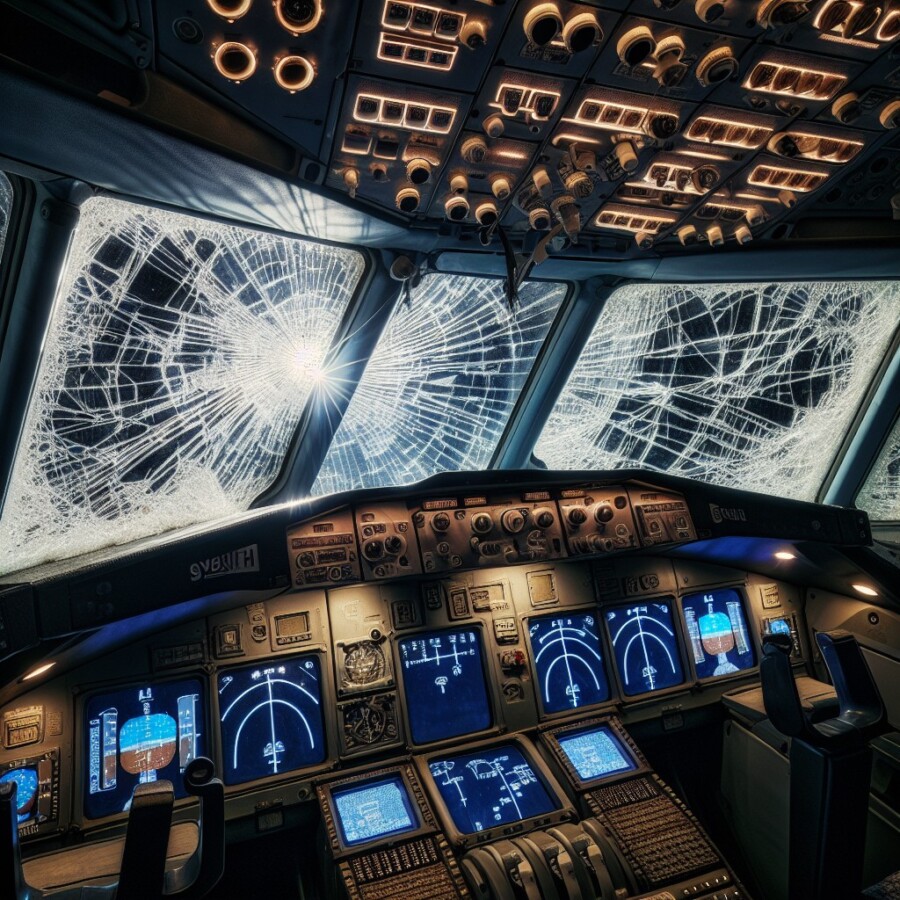
A domestic flight operated by All Nippon Airways (ANA) in Japan had to turn back to its departure airport due to a crack in the cockpit window. The crack was found in the outermost layer of the window and did not affect the flight's control or pressurization. The Boeing 737 aircraft was flying from Sapporo to Toyama when the crack was discovered. There were no injuries reported among the 59 passengers and six crew members on board. ANA, Japan's largest carrier, stated that the cause of the crack is still unknown.
Aviation expert John Strickland mentioned that incidents like this occasionally occur, possibly due to a bird strike or a hailstone hitting the window. Stress fractures from wear and tear are also rare but can happen. To ensure the safety of the aircraft, it is likely that the entire window will need to be replaced, not just the broken layer. ANA arranged alternative flights for the affected passengers.
It is important to note that this incident is unrelated to the recent grounding of Boeing 737 MAX 9 airplanes. The ANA flight involved an earlier version of the Boeing 737 and was not part of the MAX 9 fleet. The grounding of the MAX 9 planes was initiated by the US aviation regulator, the FAA, after an Alaska Airlines plane experienced a blowout, resulting in a cabin panel falling off mid-air. The FAA has extended the grounding indefinitely for further safety checks and will increase oversight of Boeing.
In conclusion, a crack in the cockpit window forced an ANA flight in Japan to return to its departure airport. The cause of the crack is still unknown, but it did not affect the flight's control or pressurization. ANA ensured the safety of the passengers by arranging alternative flights. This incident is separate from the grounding of Boeing 737 MAX 9 planes, which was prompted by a different safety issue.
Original news source: Cockpit window crack forces ANA Boeing flight in Japan to turn back (BBC)
🎧 Listen:
📖 Vocabulary:
Group or Classroom Activities
Warm-up Activities:
– News Summary
Instructions: Have students work in pairs or small groups. Ask them to read the article and then summarize the main points in their own words. They should focus on the key details and events mentioned in the article. After a designated time, have each group share their summaries with the class.
– Opinion Poll
Instructions: Divide the class into two groups: one group will argue that incidents like this are common and expected in the aviation industry, while the other group will argue that such incidents are rare and should not happen. Give each group time to discuss and gather evidence to support their arguments. Then, have a class debate where each group presents their opinions and supporting points. Encourage students to use persuasive language and counter-arguments.
– Sketch It
Instructions: Provide each student with a blank piece of paper and ask them to draw a sketch of the cracked cockpit window based on the description in the article. After a designated time, have students share their sketches with a partner and explain their drawing. Encourage students to use descriptive language to explain the details of their sketches.
– Vocabulary Pictionary
Instructions: Create a list of key vocabulary words from the article (e.g. domestic flight, cockpit window, pressurization, grounding). Divide the class into small groups. Give each group a vocabulary word and ask them to draw a picture that represents the word. The rest of the group should try to guess the word based on the drawing. Encourage students to discuss and explain their drawings to their group members.
– Future Predictions
Instructions: Have students work in pairs or small groups. Ask them to discuss and make predictions about the future of aviation safety measures based on the incidents mentioned in the article. They should consider how these incidents might impact the industry and what changes or improvements could be made to prevent similar incidents in the future. After a designated time, have each group share their predictions with the class. Encourage students to support their predictions with logical reasoning.
🤔 Comprehension Questions:
🎧✍️ Listen and Fill in the Gaps:
A domestic flight operated by All Airways (ANA) in Japan had to turn back to its departure due to a crack in the cockpit window. The crack was found in the outermost layer of the window and did not affect the flight's control or pressurization. The Boeing 737 aircraft was flying from Sapporo to Toyama when the crack was . There were no injuries among the 59 passengers and six crew members on board. ANA, Japan's largest carrier, stated that the cause of the crack is still unknown. Aviation expert John Strickland mentioned that incidents like this occasionally , possibly due to a bird strike or a hailstone hitting the . Stress fractures from wear and tear are also rare but can . To ensure the safety of the aircraft, it is likely that the entire window will need to be replaced, not just the broken layer. ANA arranged alternative for the affected passengers. It is important to note that this incident is unrelated to the recent grounding of Boeing 737 MAX 9 airs. The ANA flight involved an earlier version of the Boeing 737 and was not part of the MAX 9 fleet. The grounding of the MAX 9 planes was initiated by the US aviation regulator, the FAA, after an Airlines plane experienced a blowout, resulting in a panel falling off mid-air. The FAA has extended the grounding indefinitely for checks and will increase oversight of Boeing. In conclusion, a crack in the cockpit window forced an ANA flight in Japan to to its departure airport. The cause of the crack is still unknown, but it did not affect the flight's control or pressurization. ANA ensured the safety of the passengers by arranging alternative flights. This incident is from the grounding of Boeing 737 MAX 9 planes, which was prompted by a safety issue.
💬 Discussion Questions:
1. What is your opinion on the safety measures taken by ANA to ensure the passengers' safety?
2. Have you ever experienced a flight delay or cancellation due to a technical issue? How did it make you feel?
3. How do you think incidents like a crack in the cockpit window affect passengers' confidence in the airline?
4. Do you think the cause of the crack should be identified and addressed before the aircraft is allowed to fly again? Why or why not?
5. How would you feel if you were on a flight and discovered a crack in the cockpit window?
6. Have you ever been on a flight where the aircraft had to turn back due to a technical issue? If so, what was your experience like?
7. What safety precautions do you think should be taken to prevent incidents like a crack in the cockpit window?
8. Do you think incidents like this affect the reputation of the airline? Why or why not?
9. How would you feel if you were a pilot and discovered a crack in the cockpit window during a flight?
10. Have you ever had a fear of flying or experienced anxiety while on an airplane? How do incidents like this contribute to those fears or anxieties?
11. What do you think are the biggest challenges for airlines in maintaining the safety and reliability of their aircraft?
12. Do you think incidents like a crack in the cockpit window are preventable? Why or why not?
13. How do you think incidents like this affect the overall perception of air travel safety?
14. What measures do you think should be taken to ensure the safety of passengers in situations like a crack in the cockpit window?
15. Have you ever been on a flight where the aircraft had to make an emergency landing? If so, what was your experience like?
Individual Activities
📖💭 Vocabulary Meanings:
Click a dot next to a word, then click the dot next to its meaning to draw a line connecting them.
Words
Meanings
🔡 Multiple Choice Questions:
🕵️ True or False Questions:
📝 Write a Summary:
Write a summary of this news article in two sentences.
Check your writing now with the best free AI for English writing!