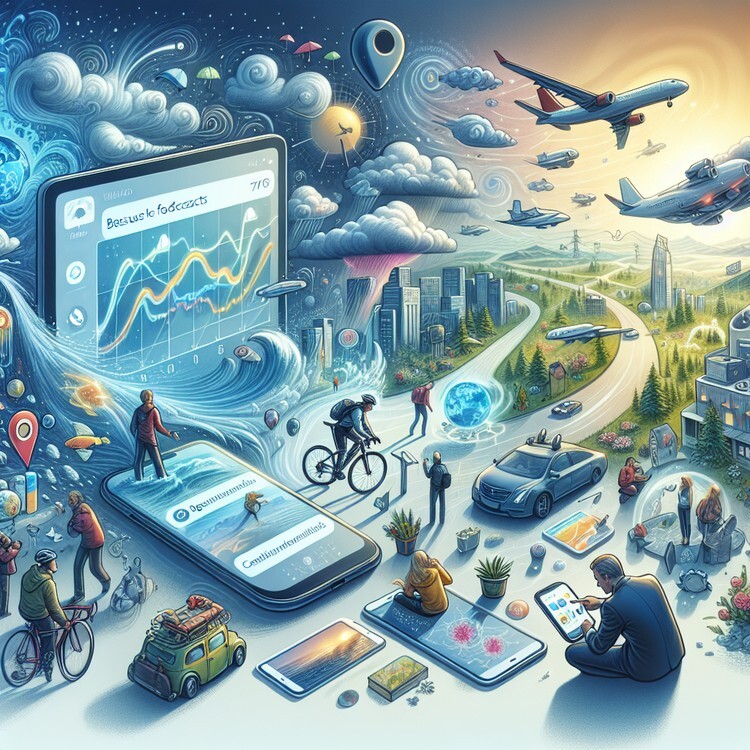
Weather apps are constantly evolving to provide more accurate and personalized forecasts. With advancements in technology and artificial intelligence, these apps are able to offer real-time updates and tailored recommendations. For example, the app Windy helps cyclists like Zoe Ashbridge track the direction of the wind, allowing them to plan their routes more efficiently and save time and energy. Weather forecasting models have become more accurate due to technological advancements, with the ultimate goal of helping to save lives and protect property.
The UK's Met Office has made significant improvements to its digital weather maps and data, allowing users to see real-time movement of weather patterns and forecast up to five days in advance. To cater to specific needs, the Met Office has introduced dedicated beach and mountain forecasts, providing information on wind conditions, wave heights, and weather at different altitudes. The Met Office has also partnered with airlines to gather data from sensors on aircraft, enhancing forecast accuracy and enabling the prediction of extreme weather events and localized thunderstorms.
Weather forecasters are increasingly focused on communicating forecasts quickly and accurately, especially in the face of climate change and more unpredictable weather patterns. However, the lack of financial backing for weather app start-ups is a challenge, as investors in Silicon Valley, where many tech investors are based, do not typically experience extreme weather conditions. Nevertheless, weather app providers like Accuweather are investing in artificial intelligence to improve language translation and generate detailed phrases related to weather conditions. They are also prioritizing health and safety by providing information on air quality, wildfire predictions, and enhancing warnings and visualizations.
In conclusion, weather apps are leveraging technology and artificial intelligence to provide more accurate and personalized forecasts. These advancements allow users to plan their activities more efficiently, save time and energy, and make informed decisions based on real-time weather updates. The ultimate goal is to enhance safety and protect lives and property. However, the lack of financial support for weather app start-ups remains a challenge, as investors in regions unaffected by extreme weather conditions may not prioritize investments in this area.
Original news source: How weather apps are trying to be more accurate (BBC)
🎧 Listen:
📖 Vocabulary:
Group or Classroom Activities
Warm-up Activities:
– News Summary
Instructions: Have the students read the article individually or in pairs. Then, ask them to write a summary of the article in their own words, focusing on the main points and key details. After they have finished writing, have them share their summaries with a partner or in small groups and compare their responses.
– Opinion Poll
Instructions: Divide the class into small groups and assign each group a discussion question related to the article. For example, "Do you think weather apps are becoming more accurate? Why or why not?" Give the groups a few minutes to discuss their opinions and come up with reasons to support their answers. Then, have each group present their opinions to the class and facilitate a class discussion based on their responses.
– Vocabulary Pictionary
Instructions: Choose 10-15 vocabulary words from the article and write them on the board. Divide the class into teams and have them take turns sending one member to the front of the class. Give each student a vocabulary word and ask them to draw a picture that represents the word without using any letters or numbers. The student's team must try to guess the word based on the drawing within a time limit. If the team guesses correctly, they earn a point. The team with the most points at the end of the game wins.
– Pros and Cons
Instructions: Divide the class into two groups: one group representing the pros of weather apps and the other group representing the cons. Give each group a few minutes to brainstorm reasons to support their assigned position. Then, have the groups take turns presenting their arguments to the class. After each presentation, facilitate a class discussion to compare and contrast the different perspectives.
– Future Predictions
Instructions: Ask the students to imagine what weather apps could look like in the future. Have them brainstorm and write down their ideas individually. Then, divide the class into pairs or small groups and ask them to discuss their ideas and come up with a list of future predictions for weather apps. After they have finished discussing, have each group share their predictions with the class and facilitate a class discussion based on their ideas.
🤔 Comprehension Questions:
🎧✍️ Listen and Fill in the Gaps:
Weather apps are constantly evolving to provide more accurate and personalized forecasts. With in technology and artificial intelligence, these apps are able to offer real-time updates and tailored recommendations. For example, the app Windy helps like Zoe Ashbridge track the direction of the wind, allowing them to plan their routes more efficiently and save time and energy. Weather models have become more accurate due to technological advancements, with the ultimate goal of helping to save lives and protect property. The UK's Met Office has made improvements to its digital maps and data, allowing users to see real-time of weather patterns and forecast up to five days in advance. To cater to specific needs, the Met Office has introduced beach and mountain forecasts, information on wind conditions, wave heights, and weather at different altitudes. The Met Office has also partnered with airlines to gather data from sensors on aircraft, enhancing forecast accuracy and enabling the prediction of extreme weather events and localized thunderstorms. Weather forecasters are increasingly focused on communicating forecasts quickly and accurately, especially in the face of climate change and more unpredictable weather patterns. However, the lack of financial backing for weather app start-ups is a challenge, as investors in Valley, where many tech investors are based, do not typically experience extreme weather . Nevertheless, weather app providers like are investing in artificial intelligence to improve language translation and generate phrases related to weather conditions. They are also prioritizing health and safety by providing information on air quality, wildfire predictions, and enhancing warnings and visualizations. In conclusion, weather apps are leveraging technology and artificial to more accurate and personalized forecasts. These advancements allow users to plan their more efficiently, save time and energy, and make informed decisions based on real-time weather updates. The ultimate goal is to enhance safety and protect and property. However, the lack of financial support for weather app start-ups remains a challenge, as investors in regions unaffected by extreme weather conditions may not prioritize investments in this area.
💬 Discussion Questions:
1. How often do you check the weather forecast? Why or why not?
2. What is the importance of accurate weather forecasting in your daily life?
3. How would you feel if you were caught in a severe weather event without any warning? Why?
4. Do you think weather apps are reliable sources of information? Why or why not?
5. Have you ever used a weather app to plan your activities? How did it help you?
6. What is a weather app feature that you find particularly useful? Why?
7. How do you think weather apps can further improve their accuracy and personalized forecasts?
8. Do you like the idea of weather apps using artificial intelligence to generate detailed phrases related to weather conditions? Why or why not?
9. How would you feel if weather apps started providing information on air quality and wildfire predictions in your area? Why?
10. Do you think weather app start-ups deserve more financial support? Why or why not?
11. Have you ever experienced extreme weather conditions? How did it impact your life?
12. How do you think climate change affects the accuracy of weather forecasts? Why?
13. What other features or information would you like to see in weather apps? Why?
14. How do you think weather apps can help in protecting lives and property during extreme weather events?
15. Do you think weather apps will eventually replace traditional weather forecasting methods? Why or why not?
Individual Activities
📖💭 Vocabulary Meanings:
Click a dot next to a word, then click the dot next to its meaning to draw a line connecting them.
Words
Meanings
🔡 Multiple Choice Questions:
🕵️ True or False Questions:
📝 Write a Summary:
Write a summary of this news article in two sentences.
Check your writing now with the best free AI for English writing!