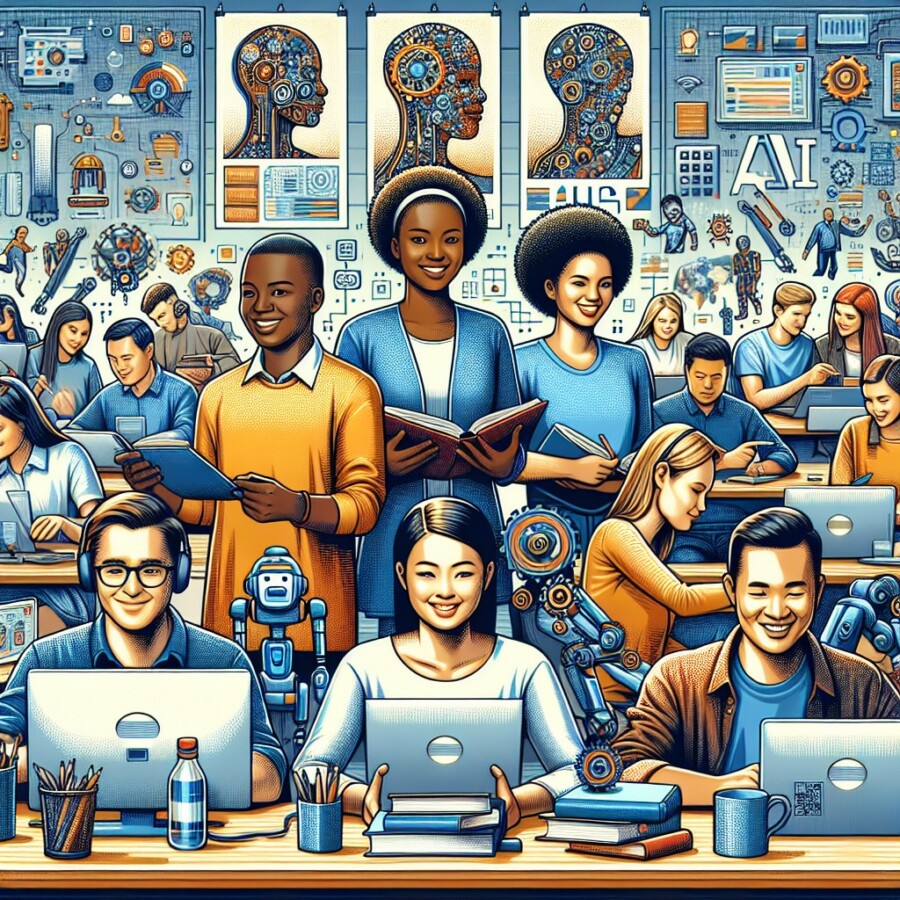
According to a recent analysis by the International Monetary Fund (IMF), artificial intelligence (AI) is projected to impact almost 40% of all jobs. The managing director of the IMF, Kristalina Georgieva, stated that in most scenarios, AI is likely to worsen overall inequality. She emphasized the need for policymakers to address this concerning trend and prevent the technology from further exacerbating social tensions. The IMF report suggests that AI will have a greater impact on jobs in advanced economies, with around 60% of jobs being affected. While some workers may benefit from the integration of AI and experience increased productivity, others may face job losses and wage reductions. In low-income countries, the IMF predicts that AI will impact only 26% of jobs. However, the lack of infrastructure and skilled workforce in these countries could lead to increased inequality among nations.
The IMF analysis also highlights the potential disproportionate impact of AI on different groups of workers. Higher-income and younger workers may see a significant increase in their wages after adopting AI, while lower-income and older workers could fall behind. To address this issue, the IMF suggests that countries should establish comprehensive social safety nets and offer retraining programs for vulnerable workers. By doing so, the transition to AI can be made more inclusive, protecting livelihoods and curbing inequality.
The discussion around AI has gained momentum, with global business and political leaders gathering at the World Economic Forum in Davos, Switzerland. The regulation of AI is also becoming a priority in many countries. The European Union recently reached a provisional deal on comprehensive laws to regulate the use of AI, while China has already introduced national regulations on AI development and deployment. In the United States, President Biden signed an executive order requiring developers to share safety results related to AI with the government. These efforts aim to ensure the safe and responsible development of AI technology.
In conclusion, the IMF's analysis highlights the significant impact that AI is expected to have on jobs, with potential consequences for inequality. Policymakers are urged to address this trend and implement measures to protect vulnerable workers and promote inclusivity. The regulation of AI is also gaining traction globally, with countries taking steps to ensure the responsible use of this technology.
Original news source: AI to hit 40% of jobs and worsen inequality, IMF says (BBC)
🎧 Listen:
📖 Vocabulary:
Group or Classroom Activities
Warm-up Activities:
– News Summary
Instructions: Ask students to read the article and write a summary of the main points. They should aim to condense the information into a few sentences, highlighting the key ideas and arguments presented in the article. Afterward, have students share their summaries with a partner or in small groups and discuss any similarities or differences in their summaries.
– Opinion Poll
Instructions: Divide the class into groups and assign each group a specific question related to the article. For example, "Do you agree with the IMF's suggestion of establishing social safety nets and retraining programs for vulnerable workers?" Have each group conduct a mini opinion poll within the class, asking their assigned question to different students. After gathering responses, each group should present their findings to the class and engage in a discussion about the various opinions expressed.
– Headline Creation
Instructions: Ask students to create attention-grabbing headlines for the article. They should aim to capture the main idea or key takeaway in a concise and engaging manner. Afterward, have students share their headlines with the class and discuss the different approaches taken. This activity encourages students to think critically about the content and practice summarizing complex information in a succinct way.
– Vocabulary Pictionary
Instructions: Select 10-15 vocabulary words from the article and write them on separate slips of paper. Divide the class into pairs or small groups and distribute the vocabulary words equally among them. Each group should take turns selecting a word and drawing a quick sketch to represent it without using any letters or numbers. The other group members must guess the word based on the drawing alone. This activity helps reinforce vocabulary retention and encourages creative thinking.
– Pros and Cons
Instructions: Divide the class into two groups, assigning one group to discuss the pros of AI's impact on jobs and the other group to discuss the cons. Give students time to prepare their arguments, considering the points raised in the article as well as their own opinions and experiences. Then, have each group present their arguments to the class and engage in a respectful debate, exploring the different perspectives and potential implications of AI on jobs and inequality.
🤔 Comprehension Questions:
🎧✍️ Listen and Fill in the Gaps:
According to a recent analysis by the International Fund (IMF), artificial intelligence (AI) is projected to impact almost 40% of all jobs. The managing director of the IMF, Kristalina Georgieva, stated that in most scenarios, AI is likely to worsen overall inequality. She emphasized the need for policymakers to address this concerning and the technology from further exacerbating social tensions. The IMF report suggests that AI will have a greater impact on jobs in advanced economies, with around 60% of jobs being affected. While some workers may benefit from the of AI and experience increased productivity, others may face job losses and wage reductions. In low-income countries, the IMF predicts that AI will impact only 26% of jobs. However, the lack of infrastructure and skilled workforce in these countries could lead to increased inequality among . The IMF analysis also highlights the potential disproportionate impact of AI on different groups of workers. Higher-income and younger workers may see a significant increase in their wages after adopting AI, while lower-income and older workers could fall behind. To this , the IMF suggests that countries should social safety nets and offer programs for vulnerable workers. By doing so, the transition to AI can be made more inclusive, protecting livelihoods and curbing inequality. The discussion around AI has gained momentum, with global business and political leaders gathering at the Economic Forum in Davos, Switzerland. The regulation of AI is also becoming a priority in many countries. The European Union recently reached a provisional deal on comprehensive laws to regulate the use of AI, while China has already introduced regulations on AI development and deployment. In the United States, President Biden signed an executive order requiring developers to share safety results related to AI with the government. These efforts aim to ensure the safe and responsible development of AI . In conclusion, the IMF's analysis highlights the significant impact that AI is expected to have on jobs, with potential consequences for inequality. Policymakers are urged to address this trend and implement to protect vulnerable workers and inclusivity. The regulation of AI is also gaining globally, with countries taking steps to ensure the responsible use of this technology.
💬 Discussion Questions:
1. What is your opinion on the impact of artificial intelligence on jobs?
2. How would you feel if your job was replaced by AI technology?
3. Do you think AI will worsen overall inequality? Why or why not?
4. What measures do you think policymakers should take to address the potential consequences of AI on jobs?
5. How do you think the integration of AI will affect productivity in the workplace?
6. Do you believe that AI will have a greater impact on jobs in advanced economies compared to low-income countries? Why or why not?
7. What do you think are the challenges that low-income countries face in dealing with the impact of AI on jobs?
8. How do you think AI will affect different groups of workers, such as higher-income and lower-income workers?
9. What are your thoughts on the suggestion of establishing comprehensive social safety nets and retraining programs for vulnerable workers?
10. Do you think the regulation of AI is necessary? Why or why not?
11. What are some potential benefits and drawbacks of regulating the use of AI?
12. How do you think the responsible development of AI technology can be ensured?
13. What role do you think international cooperation should play in addressing the impact of AI on jobs and inequality?
14. How do you think the global business and political leaders gathering at the World Economic Forum can contribute to addressing the challenges of AI?
15. What are your predictions for the future of AI and its impact on society?
Individual Activities
📖💭 Vocabulary Meanings:
Click a dot next to a word, then click the dot next to its meaning to draw a line connecting them.
Words
Meanings
🔡 Multiple Choice Questions:
🕵️ True or False Questions:
📝 Write a Summary:
Write a summary of this news article in two sentences.
Check your writing now with the best free AI for English writing!