
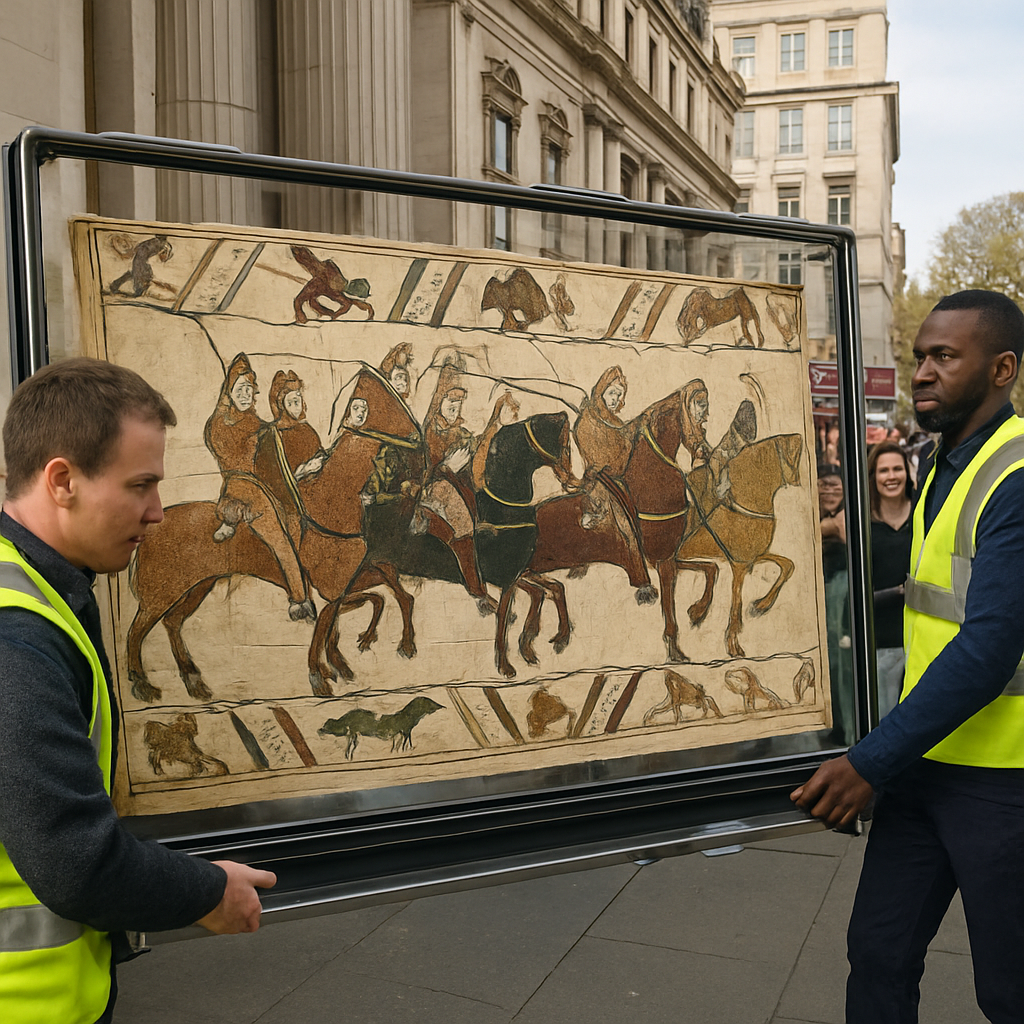
The Bayeux Tapestry, an emblematic artifact of early medieval Europe, has recently been relocated to the British Museum in London. Described by the French culture minister as being in a "wonderful state", this masterpiece vividly narrates the tale of the 1066 Norman Conquest through its intricate embroidery. The tapestry's relocation had initially provoked concern over the susceptibility to harm during transit from Bayeux, France, its long-time residence. Nevertheless, a meticulous collaboration between French and British conservators has guaranteed its safe arrival with no damage incurred. This event also signifies the tapestry's first presence in the United Kingdom in a millennium, highlighting the enduring cooperation between the nations.
The tapestry will be exhibited with utmost caution, displayed flat to avert gravitational strain on its fragile fabric. In a space meticulously designed to minimize environmental impacts on the artifact, visitors will marvel at the 70-meter-long chronicle as it unravels before them. The British Museum has meticulously prepared for this exhibition, slated to commence in September, with immense anticipation for attendance numbers reminiscent of previous significant exhibitions.
Parallel to this exchange, the British Museum is engaging in a reciprocal cultural exchange by dispatching invaluable artifacts to France, thereby ascribing another layer to the already robust cultural liaison between the two countries. This gesture is a reaffirmation of the ties that continue to bind these historical bedfellows, reminding us of the diplomatic potency of cultural diplomacy.
The Bayeux Tapestry's journey to the UK is not merely an event of aesthetic appreciation but also a reinforcement of historical bonds that challenge temporal restraints. Its arrival has been much anticipated, drawing attention and enthusiasm from both scholars and the public. This exhibition promises not only to attract art aficionados but to educate those interested in the rich tableau of European history.
As the anticipation for viewing this renowned relic heightens, it exemplifies the symbiotic relationships fostered through cultural exchanges and the preservation of historical artifacts. It stands as a testament to preservation efforts that allow this ancient narrative to resonate with contemporary audiences, embodying an intertwined history that transcends present borders.
Original news source: Bayeux Tapestry in 'wonderful state' after journey to London, French minister says – BBC News (BBC)
🎧 Listen:
📖 Vocabulary:
Group or Classroom Activities
Warm-up Activities:
1. Discuss with a partner what you know about the Norman Conquest of 1066.
2. Share a cultural artifact from your country and explain its significance.
3. Have you ever visited a museum outside of your home country? Share your experience.
4. What are some challenges in transporting valuable cultural artifacts?
5. Talk about how cultural exchanges can benefit international relationships.
🤔 Comprehension Questions:
The Bayeux Tapestry is an emblematic artifact of early medieval Europe that narrates the 1066 Norman Conquest.
The tapestry has been relocated to the British Museum in London.
There were initial concerns about the susceptibility to harm during its transportation from Bayeux, France.
French and British conservators collaborated to ensure its safe arrival without damage.
The tapestry will be shown flat to prevent gravitational strain on its delicate fabric.
The cultural exchange involving both countries sending artifacts to one another is strengthening the bond.
The journey of the tapestry symbolizes the reinforcement of historical bonds that defy temporal constraints.
🎧✍️ Listen and Fill in the Gaps:
The Bayeux Tapestry, an emblematic artifact of early medieval Europe, has recently been relocated to the British in London. Described by the French culture as being in a "wonderful state", this masterpiece vividly narrates the tale of the 1066 Norman Conquest through its intricate embroidery. The tapestry's had initially provoked concern over the susceptibility to harm during transit from Bayeux, France, its long-time . Nevertheless, a meticulous collaboration between French and British conservators has guaranteed its safe arrival with no damage incurred. This event also signifies the tapestry's first presence in the Kingdom in a , highlighting the enduring cooperation between the nations. The tapestry will be exhibited with utmost caution, displayed flat to avert gravitational strain on its fragile fabric. In a space meticulously designed to minimize environmental impacts on the artifact, will marvel at the 70-meter-long chronicle as it unravels before them. The British Museum has meticulously prepared for this exhibition, slated to commence in September, with immense for attendance numbers reminiscent of previous significant exhibitions. to this , the British Museum is engaging in a reciprocal cultural exchange by dispatching invaluable artifacts to France, thereby ascribing another layer to the already robust cultural liaison the two countries. This gesture is a reaffirmation of the ties that continue to bind these historical bedfellows, reminding us of the diplomatic potency of cultural diplomacy. The Bayeux Tapestry's journey to the UK is not merely an event of aesthetic appreciation but also a of historical bonds that challenge temporal restraints. Its has been much anticipated, drawing attention and enthusiasm from both scholars and the public. This exhibition promises not only to attract art aficionados but to educate those interested in the rich tableau of European . As the anticipation for viewing this renowned relic heightens, it exemplifies the symbiotic relationships fostered through cultural exchanges and the preservation of historical . It stands as a testament to preservation efforts that allow this ancient narrative to resonate with audiences, embodying an intertwined history that transcends present borders.
💬 Discussion Questions:
1. What do you think makes the Bayeux Tapestry an important historical artifact?
2. Do you believe cultural artifacts should be returned to their country of origin? Why or why not?
3. How can modern technology aid in the preservation of historic items?
4. What role do museums play in cultural education?
5. How important is it to study historical events through artifacts?
6. How do you think the tapestry's presence in the UK will influence British-French relations?
7. In your opinion, what are the responsibilities of a country when hosting international artifacts?
8. Discuss a cultural exchange you've participated in or would like to participate in.
9. How effective do you think cultural diplomacy is in solving international conflicts?
10. In what ways could art play a role in shaping political relationships?
11. How important is it to have cultural representation in global exhibits?
12. What challenges do you foresee in organizing international exhibitions?
Individual Activities
📖💭 Vocabulary Meanings:
Click a dot next to a word, then click the dot next to its meaning to draw a line connecting them.