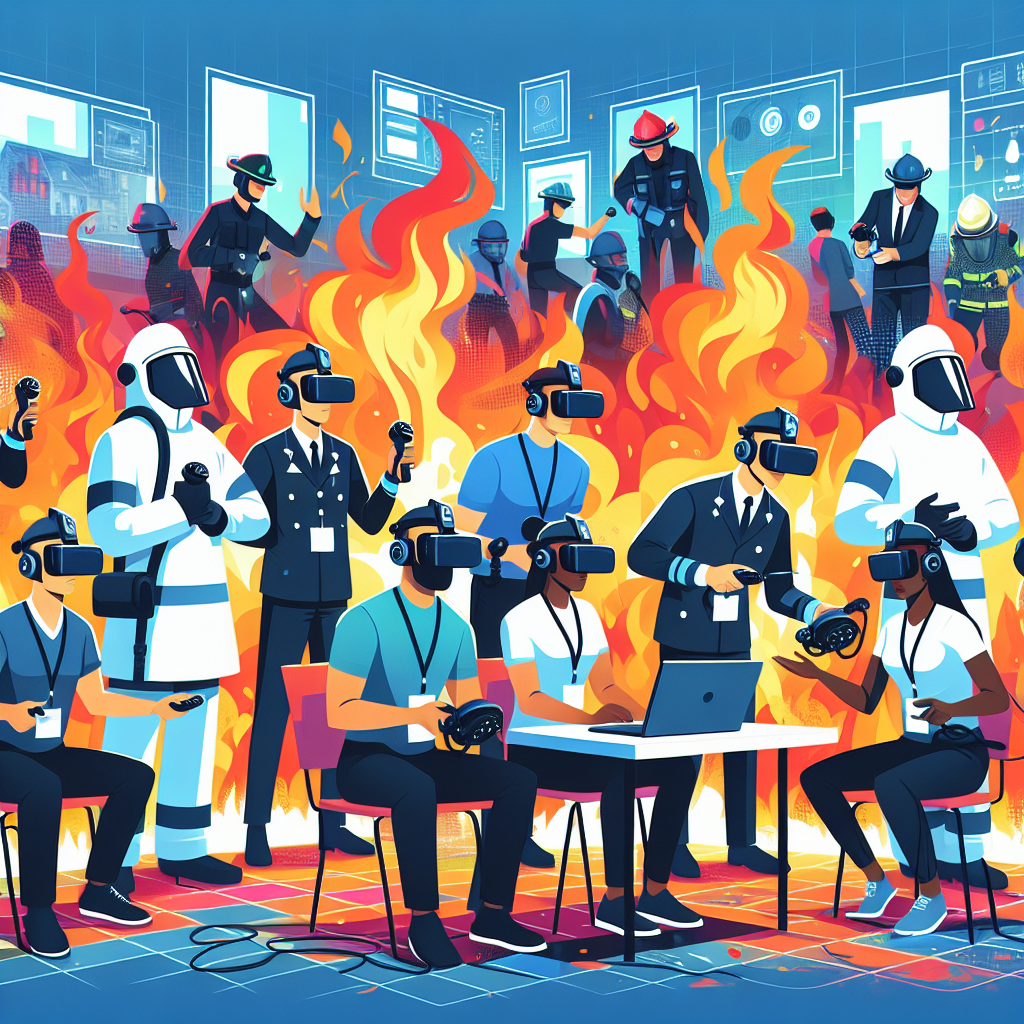
Virtual reality (VR) is a new tool to help people learn how to find out why fires happen. Scientists and firefighters work together to make pretend fire scenes. They study how the fire moves and burns things. Then, they use computers to make a virtual world of the fire. This helps people learn about fires in a safe way.
Using VR helps fire investigators learn better. It helps them find out how fires start and grow. This new way of learning can be shared with other fire experts. The goal is to make VR a regular part of learning about fires. This will help make fire investigations better and safer.
Original news source: Investigating crime scenes in virtual reality (BBC)
🎧 Listen:
📖 Vocabulary:
Group or Classroom Activities
Warm-up Activities:
– CHARADES
Instructions: Divide the class into two teams. Each team takes turns sending one member to act out a word or phrase related to virtual reality or fire safety (e.g., "firefighter," "VR headset," "fire investigation"). The team must guess the word within a time limit.
– VOCABULARY PICTIONARY
Instructions: Write vocabulary words from the article on slips of paper. Students take turns drawing a slip and then must draw the word on the board while their classmates guess what it is. Words could include "fire," "investigator," "virtual," and "learning."
– MIND MAP
Instructions: On a large sheet of paper or a whiteboard, write "Virtual Reality and Fire Safety" in the center. Ask students to contribute words or ideas they associate with the topic, creating branches for each idea (e.g., "learning," "safety," "firefighters"). This helps visualize connections between concepts.
– OPINION POLL
Instructions: Pose the question, "Do you think virtual reality is a good way to learn about fires?" Have students walk around the classroom to express their opinions by either standing in one area for "yes," another for "no," or a middle ground for "maybe." Afterwards, discuss their choices as a class.
– TWO TRUTHS AND A LIE
Instructions: Have each student think of three statements related to virtual reality and fire safety—two true statements and one false statement. They take turns sharing their statements while the rest of the class tries to guess which one is the lie. This encourages speaking and critical thinking.
🤔 Comprehension Questions:
VR is used to help people learn about fires and why they happen.
Scientists and firefighters work together.
They study how the fire moves and burns things.
VR helps people learn in a safe way by showing pretend fires.
They learn how fires start and grow.
They want to use VR all the time to make learning better and safer.
Using VR makes fire investigations better by helping people learn more.
🎧✍️ Listen and Fill in the Gaps:
Virtual reality (VR) is a new to help people learn how to find out why fires happen. Scientists and firefighters work together to make fire scenes. They study how the fire moves and burns things. Then, they use computers to a world of the fire. This helps people learn about fires in a safe way. Using VR helps fire investigators learn better. It helps them out how fires and grow. This new way of learning can be shared with other fire experts. The goal is to make VR a regular part of about fires. This will help make fire investigations better and .
💬 Discussion Questions:
1. What is virtual reality (VR) to you?
2. Do you like to play games in virtual reality? Why or why not?
3. How would you feel if you could visit a virtual world?
4. What is your favorite way to learn new things?
5. Do you think it is fun to learn about fires? Why or why not?
6. Have you ever seen a fire? How did it make you feel?
7. What do you think is the most important thing to know about fire?
8. How would you feel if you could be a firefighter for a day?
9. Do you think using computers is a good way to learn? Why?
10. What is a safe way to learn about something dangerous?
11. How would you feel if you could help people learn about fire safety?
12. Do you think learning with virtual reality is better than learning in a classroom? Why or why not?
Individual Activities
📖💭 Vocabulary Meanings:
Click a dot next to a word, then click the dot next to its meaning to draw a line connecting them.
Words
Meanings
🔡 Multiple Choice Questions:
🕵️ True or False Questions:
📝 Write a Summary:
Write a summary of this news article in two sentences.
Check your writing now with the best free AI for English writing!