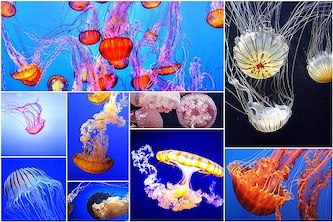
People think there are more jellyfish because it was very hot in June. The world is getting warmer, and that changes the sea. The people who study the sea say we need to learn more about how the warm weather changes things for animals in the sea. They also saw more big sea turtles this year. There were 12 turtles seen, and four were the biggest kind.
Original news source: Boom in unusual jellyfish spotted in UK waters (BBC)
📖 Vocabulary:
Group or Classroom Activities
Warm-up Activities:
– News Reporter Role-play
Instructions: Students pair up and take turns being a news reporter and an eyewitness. The reporter asks the eyewitness about their experience with the jellyfish sighting. The eyewitness uses phrases from the article to describe what they saw. Encourage beginners to use simple present tense and past tense verbs, such as "see," "is," "like," and "come."
– Opinion Poll
Instructions: Write a series of statements about the article on the board (e.g., "The sea is getting warmer," "There are more jellyfish," "We need to learn more about sea animals"). Students walk around the room and ask their classmates if they agree or disagree with each statement, practicing simple phrases such as "Do you think…?" and recording the number of agreements and disagreements.
– Vocabulary Pictionary
Instructions: Write down key vocabulary words from the article on slips of paper (e.g., "jellyfish," "beaches," "computer," "turtles"). Divide the class into two teams. Players take turns drawing the words for their team to guess, without speaking or writing letters or numbers. Set a time limit for each turn. This helps students associate the words with images and reinforces their meaning.
– Sketch It
Instructions: Give students a copy of the article and ask them to draw scenes based on the text. For example, they might draw jellyfish in the sea, people using computers and phones, or the west side of the UK. After drawing, have them label each part of their sketch with vocabulary words from the article, which helps with word recognition and spelling.
– Future Predictions
Instructions: Have students write down predictions about what they think will happen with the jellyfish and the sea in the future, based on the article. For example, "There will be more jellyfish next year," or "The sea will get even warmer." Students can then share their predictions with the class, and the teacher can correct language errors and introduce future tense structures.
🤔 Comprehension Questions:
There are more jellyfish in the sea and on beaches.
The sea is getting warmer and jellyfish like warm water.
People saw a lot of big jellyfish and some special clear ones.
People used a computer or a phone to tell others when they saw jellyfish.
People saw a lot of jellyfish near the west side of the UK.
People think there are more jellyfish because it was very hot in June.
People saw more big sea turtles this year.
🎧✍️ Listen and Fill in the Gaps:
There are more in the sea and on the beaches in the UK than before. The sea is warmer because of the weather changing, and jellyfish like it. People saw a lot of big jellyfish and some special clear ones too. This might mean the sea is starting to feel like a warm place where these jellyfish come from. People used a or a phone to when they saw jellyfish, and they saw a lot near the side of the UK. People think there are more jellyfish because it was very hot in June. The world is getting , and that changes the sea. The people who study the sea say we need to learn more about how the warm changes things for animals in the sea. They also saw more big sea turtles this year. There were 12 turtles , and four were the biggest kind.
💬 Discussion Questions:
1. What is a jellyfish?
2. Do you like jellyfish? Why or why not?
3. How would you feel if you saw a jellyfish on the beach?
4. What is the sea?
5. Do you think it's good when the sea gets warmer? Why or why not?
6. Have you ever seen a jellyfish? Where?
7. What is a computer? Do you use one?
8. What is a phone? Do you have one?
9. Do you like hot weather? Why or why not?
10. What is a turtle? Do you think turtles are cute?
11. Have you ever seen a big animal? What was it?
12. Do you think we should learn about sea animals? Why or why not?
Individual Activities
📖💭 Vocabulary Meanings:
Click a dot next to a word, then click the dot next to its meaning to draw a line connecting them.
Words
Meanings
🔡 Multiple Choice Questions:
🕵️ True or False Questions:
📝 Write a Summary:
Write a summary of this news article in two sentences.
Check your writing now with the best free AI for English writing!