

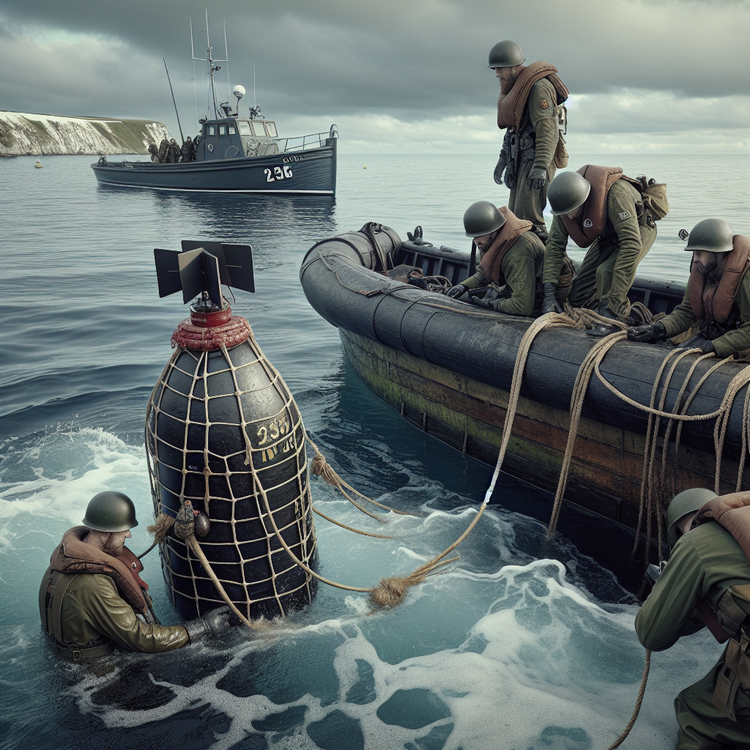
A fisherman found a very old bomb in his net near an island called Langeland in Denmark. People who are good at handling bombs came and took the bomb into the water. They put a small bomb on the big bomb to make it safe. Then they made the bomb go "boom" under the water. It was a big splash 15 meters deep.
The bomb was from a time when many countries were fighting, called World War Two. The fisherman told the people who could help, and they knew what to do. They made sure no one would get hurt by the bomb. They did their job very well and made the bomb go "boom" in the water. People who know about bombs are still looking for more in the water to keep everyone safe.
Original news source: World War Two bomb detonated off coast of Denmark (BBC)
🎧 Listen:
📖 Vocabulary:
Group or Classroom Activities
Warm-up Activities:
– Charades
Instructions: Divide the class into small groups. Give each group a word or phrase related to the article (e.g. fisherman, bomb, World War Two). One student from each group acts out the word or phrase without speaking, while the other group members try to guess what it is.
– Word Association
Instructions: Write the word "bomb" on the board. Ask the students to quickly brainstorm as many words as they can that are related to the word "bomb" (e.g. explosion, danger, war). Encourage them to share their answers and discuss the connections between the words.
– Sketch It
Instructions: Give each student a piece of paper and ask them to draw a picture related to the article (e.g. a fisherman, a bomb, an explosion). After a few minutes, have the students share their drawings with the class and explain what they have drawn.
– Vocabulary Pictionary
Instructions: Write a selection of vocabulary words from the article (e.g. fisherman, bomb, net) on separate pieces of paper. Divide the class into small groups and give each group a set of vocabulary words. One student from each group picks a word and draws it on the board, while the other group members try to guess what it is.
– Speed Summarizing
Instructions: Divide the class into pairs. Give each pair a copy of the article. Set a timer for two minutes and ask the students to read the article quickly. After the two minutes, one student from each pair has to summarize the article to their partner in one minute or less. Then, the roles switch and the other student summarizes the article. Finally, ask a few pairs to share their summaries with the class.
🤔 Comprehension Questions:
The fisherman found a bomb in his net.
The bomb was found near an island called Langeland in Denmark.
The people put a small bomb on the big bomb to make it safe.
They made the bomb go "boom" under the water, 15 meters deep.
The bomb was from World War Two, a time when many countries were fighting.
The fisherman told the people who could help about the bomb.
People are still looking for more bombs in the water to keep everyone safe.
🎧✍️ Listen and Fill in the Gaps:
A fisherman a very old bomb in his net near an island called Langeland in Denmark. People who are good at bombs came and took the bomb into the water. They put a small bomb on the big bomb to make it safe. Then they made the bomb go "boom" under the water. It was a big splash 15 meters . The bomb was from a when many countries were fighting, called World War Two. The fisherman told the people who could help, and they what to do. They made sure no one would get by the bomb. They did their job very well and made the bomb go "boom" in the water. who know about are still looking for more in the water to keep everyone safe.
💬 Discussion Questions:
1. What did the fisherman find in his net?
2. How do you think the fisherman felt when he found the bomb?
3. What do you think the bomb looked like?
4. Have you ever seen a bomb before? Why or why not?
5. How do you think the people felt when they saw the bomb?
6. Do you think it was dangerous to have the bomb in the net? Why or why not?
7. How did the people make sure no one would get hurt by the bomb?
8. How do you think the bomb sounded when it went "boom"?
9. Would you like to see the bomb go "boom" in the water? Why or why not?
10. Do you think it's important for people to look for more bombs in the water? Why or why not?
11. What do you think the people who handle bombs do to stay safe?
12. How would you feel if you found a bomb in your net? Why?
Individual Activities
📖💭 Vocabulary Meanings:
Click a dot next to a word, then click the dot next to its meaning to draw a line connecting them.
Words
Meanings
🔡 Multiple Choice Questions:
🕵️ True or False Questions:
📝 Write a Summary:
Write a summary of this news article in two sentences.
Check your writing now with the best free AI for English writing!