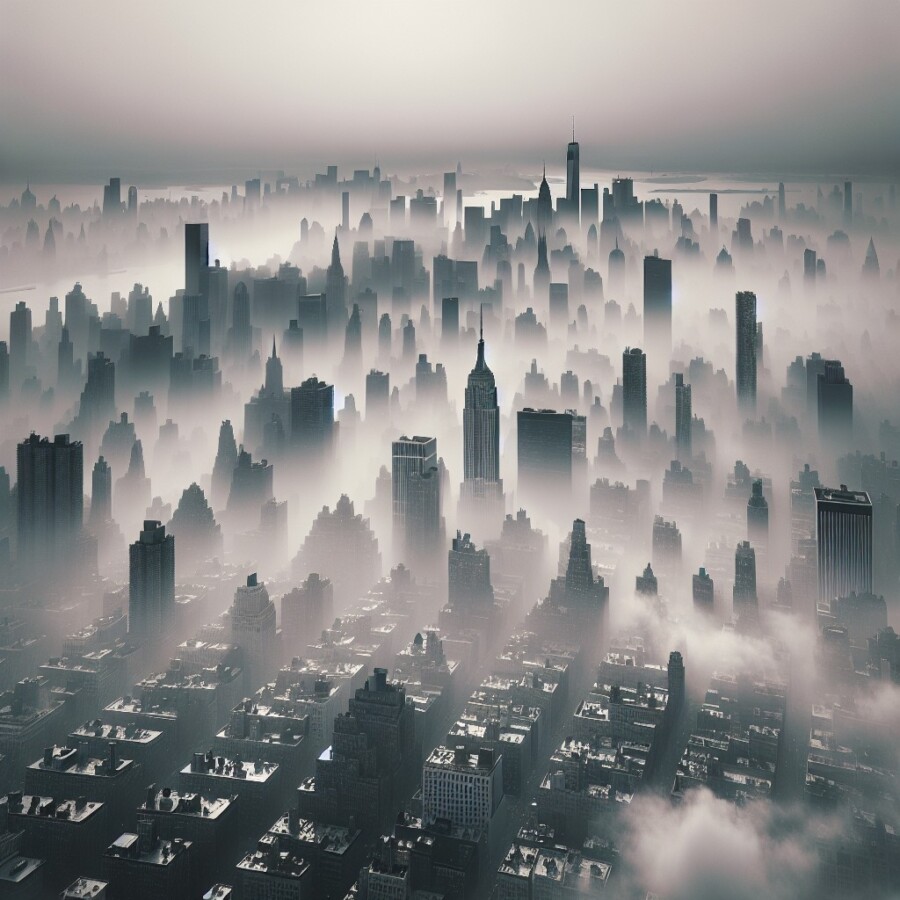
On Tuesday morning, New York City was covered in a very thick fog. This made the city look like it was floating in the clouds. The fog came because the wind blew over cold water and then moved over the city. This kind of fog is called "advection fog." It happened because the wind was blowing a certain way and the water was cold.
The fog made it hard to see the big buildings in the city. It was like a dream. Because of the fog, people driving cars had to be very careful. But, some people thought the fog made the city look special and pretty. This kind of fog happens a lot near the ocean, especially when the weather starts to get warm but the water is still cold. It can make things look beautiful but also make it hard to go places or do things outside.
Original news source: Dense fog transforms New York into a city on clouds (BBC)
🎧 Listen:
📖 Vocabulary:
Group or Classroom Activities
Warm-up Activities:
– Charades
Instructions: Divide the class into small groups. Give each group a set of vocabulary words related to the article (e.g. fog, city, wind, water, buildings). One student from each group will act out the word without speaking, while the rest of the group tries to guess what the word is.
– News Summary
Instructions: Read the article aloud to the class. Then, in pairs, have the students take turns summarizing the main points of the article to each other. Encourage them to use their own words and keep their summaries brief.
– Vocabulary Pictionary
Instructions: Write a list of vocabulary words from the article on the board (e.g. fog, advection, ocean, special, pretty). Divide the class into small groups. One student from each group will choose a word and draw a picture representing it, while the rest of the group tries to guess what word it is.
– Keyword Hangman
Instructions: Choose several key words from the article and write dashes on the board to represent each letter of the word. Students take turns guessing letters to try and complete the word. If a correct letter is guessed, it is filled in on the appropriate dash. If a wrong letter is guessed, a body part of a stick figure is drawn. The students have to guess the word before the stick figure is completed.
– Think-Pair-Share
Instructions: Ask the students to think about their own experiences with fog. Then, in pairs, have them share their experiences with each other. Afterward, ask a few pairs to share their stories with the whole class. Encourage the use of English vocabulary and expressions to describe their experiences.
🤔 Comprehension Questions:
New York City was covered in thick fog on Tuesday morning.
The city looked like it was floating in the clouds because of the thick fog.
It is called "advection fog" when the wind blows over cold water and then moves over the city.
The fog made it hard to see the big buildings because it was very thick and blocked the view.
The fog made people driving cars feel cautious and they had to be very careful.
This kind of fog happens a lot near the ocean.
The fog can make it difficult to go places or do things outside.
🎧✍️ Listen and Fill in the Gaps:
On Tuesday morning, New York City was covered in a very thick fog. This made the look like it was floating in the clouds. The fog came because the wind blew over water and then moved over the city. This kind of fog is "advection fog." It happened because the wind was blowing a way and the water was cold. The fog made it hard to see the big buildings in the city. It was like a dream. Because of the fog, people driving cars had to be very careful. But, some people the fog made the city special and pretty. This kind of fog happens a lot near the ocean, especially when the weather to get warm but the water is still cold. It can make things look beautiful but also make it hard to go or do things outside.
💬 Discussion Questions:
1. What is fog?
2. Have you ever seen fog before? Where?
3. How would you feel if you were driving in a car and there was a lot of fog?
4. Do you think the fog made the city look special? Why or why not?
5. What do you think the fog made it hard to do outside?
6. Do you like the way fog looks? Why or why not?
7. Have you ever been near the ocean? What was it like?
8. Do you think fog is beautiful? Why or why not?
9. How do you think the fog made people feel who were walking outside?
10. What do you think the fog looked like in the city?
11. What is advection fog?
12. Do you think it's fun to play in the fog? Why or why not?
Individual Activities
📖💭 Vocabulary Meanings:
Click a dot next to a word, then click the dot next to its meaning to draw a line connecting them.
Words
Meanings
🔡 Multiple Choice Questions:
🕵️ True or False Questions:
📝 Write a Summary:
Write a summary of this news article in two sentences.
Check your writing now with the best free AI for English writing!