

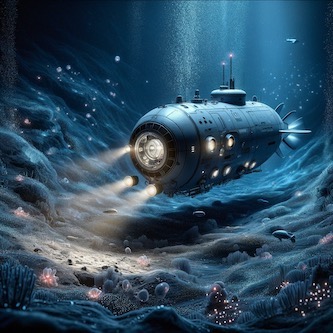
After his trip, Don Walsh kept working to help the ocean. He taught people about the ocean and helped them stay safe when they went to explore it. He warned about a dangerous event with another underwater boat and was happy when others made similar trips. He was even proud when his own son went to the Mariana Trench.
Don Walsh's trip to the bottom of the ocean was very special. It helped people know more about the deep sea. Now, with better tools, we can learn even more about the ocean and how it helps our planet. Don Walsh will be remembered for helping us understand the deep, dark parts of the sea.
Original news source: Don Walsh: The man who made the deepest ever dive (BBC)
📖 Vocabulary:
Group or Classroom Activities
Warm-up Activities:
– News Reporter Role-play
Instructions: Students pair up. One student takes on the role of a news reporter, and the other is Don Walsh. The reporter asks questions about Walsh's experience in the Mariana Trench, and Walsh (the student) answers using information from the article. They should cover topics such as the journey, the Trieste, and the significance of the expedition.
– Vocabulary Pictionary
Instructions: Write down key vocabulary from the article on slips of paper (e.g., adventure, underwater, ocean, Mariana Trench, Trieste, explore). Students take turns drawing the words for their team to guess without speaking or writing any part of the word.
– Sketch It
Instructions: Have students draw a scene from the article, such as Don Walsh in the Trieste descending into the Mariana Trench. After they finish, they should show their partner and explain what is happening in the drawing, using vocabulary from the article.
– Think-Pair-Share
Instructions: Pose a question related to the article, such as "Why do you think exploring the ocean is important?" Students first think about their answer individually, then pair up to discuss their thoughts, and finally, share their ideas with the class.
– Future Predictions
Instructions: Ask students to imagine what underwater exploration might look like in the future based on what they learned from the article about Don Walsh and the Trieste. They can write down their predictions and then share with a partner or the class, using phrases like "I think that…", "It's possible that…", or "In the future, we might…".
🤔 Comprehension Questions:
Don Walsh was the first person to go to the very bottom of the ocean.
The special underwater boat Don Walsh used is called the Trieste.
It took Don Walsh five hours to reach the bottom of the ocean.
After his big underwater adventure, Don Walsh taught people about the ocean and helped them to be safe when exploring it.
Don Walsh taught people about the ocean.
Don Walsh's trip to the bottom of the ocean was important because it helped people learn more about the deep sea.
With better tools, we can now learn even more about the ocean and how it helps our planet.
🎧✍️ Listen and Fill in the Gaps:
A long time ago, a man named Don Walsh went on a big adventure. He was the first person to go to the very bottom of the , in a place called the Mariana Trench. He used a special underwater boat called the to go down really deep. It took him five hours to get there, and it was a very important trip that helped people more about the ocean. After his trip, Don kept to help the ocean. He taught people about the ocean and helped them stay safe when they to explore it. He warned about a dangerous event with another underwater and was happy when others made similar . He was even proud when his own son went to the Mariana Trench. Don Walsh's trip to the bottom of the ocean was very special. It people know more about the sea. Now, with better tools, we can learn even more about the ocean and how it helps our planet. Don Walsh will be remembered for helping us understand the deep, parts of the sea.
💬 Discussion Questions:
1. What is an adventure you have been on?
2. How would you feel if you went to the bottom of the ocean?
3. Do you like to swim in the ocean? Why or why not?
4. What do you think you would see at the bottom of the sea?
5. Have you ever been on a boat? What was it like?
6. Why do you think it is important to learn about the ocean?
7. What is a special trip you would like to go on?
8. Would you like to explore deep places like Don Walsh? Why or why not?
9. How do you think Don Walsh felt when his son went to the Mariana Trench?
10. What is something new you would like to learn about our planet?
11. Do you think underwater boats are scary? Why or why not?
12. If you could help the ocean, what would you do?
Individual Activities
📖💭 Vocabulary Meanings:
Click a dot next to a word, then click the dot next to its meaning to draw a line connecting them.
Words
Meanings
🔡 Multiple Choice Questions:
🕵️ True or False Questions:
📝 Write a Summary:
Write a summary of this news article in two sentences.
Check your writing now with the best free AI for English writing!