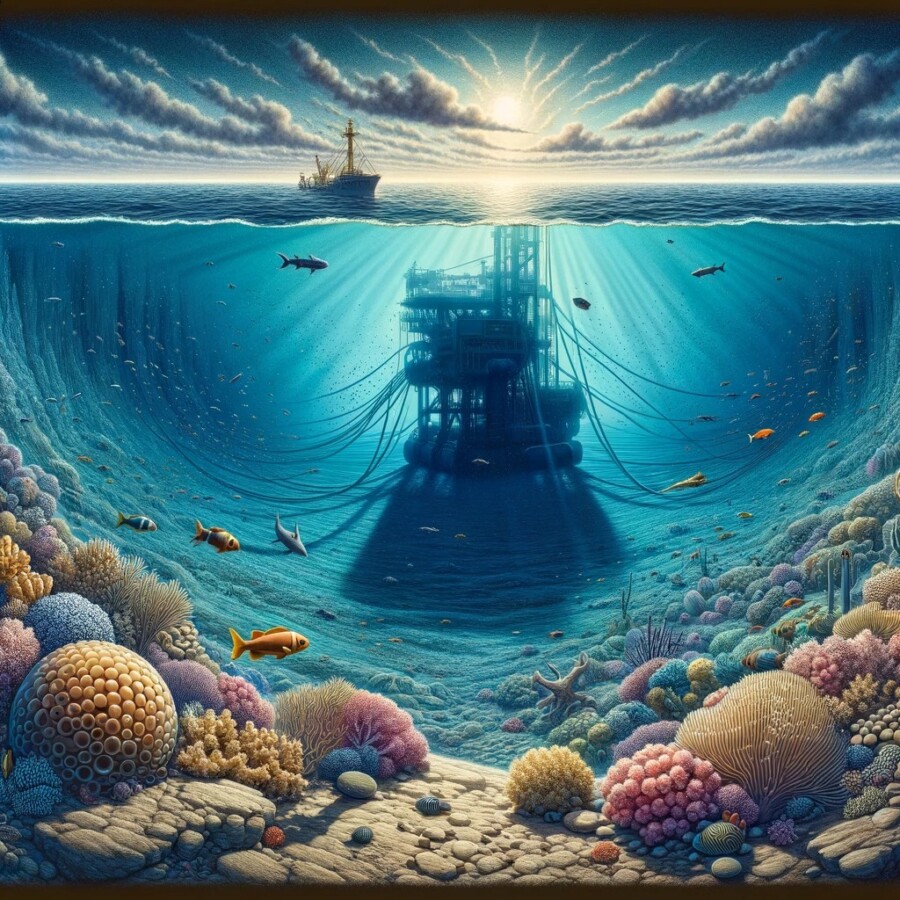
Some people think digging for minerals under the sea is a good idea because we need them for things like batteries. A company called The Metals Company says they can get these rocks from the sea without hurting the ocean too much. They use special machines that are controlled from far away to pick up the rocks. But some countries, like the UK, Brazil, and Germany, don't want this to happen because they are worried it could hurt the water and everything living in it.
Groups that care about nature, like the WWF and EASAC, say that digging in the sea is bad for fish and plants there. They are scared that it could ruin the homes of sea creatures and even wipe out some kinds of animals. The EASAC also thinks we don't really need to dig in the sea because we already have enough minerals. They say we should focus on recycling and finding new ways to do things instead of looking for more minerals under the sea.
A man named Gerard Barron, who works for the mining company, thinks that mining deep in the sea is not as bad as mining on land. He says there are not many living things deep in the sea, but there are lots of plants and animals where they dig for minerals on land, like in rainforests. Still, people who don't like sea mining say we should try to use less minerals and recycle more. Right now, a big group called the ISA is trying to decide if they will let companies dig in the sea, and no one knows what they will decide.
Original news source: Is seabed mining an economic necessity or a hazard? (BBC)
🎧 Listen:
📖 Vocabulary:
Group or Classroom Activities
Warm-up Activities:
– Charades
Instructions: Divide the class into two teams. Write the vocabulary words from the article on small pieces of paper and put them in a hat. Each team takes turns sending one person to pick a word from the hat and act it out without speaking. The team members must guess the word within a certain time limit (e.g., 1 minute). The team that guesses the most words correctly wins.
– News Summary
Instructions: In pairs, students take turns summarizing the main points of the article to their partner. Each student has 1 minute to give a brief summary, using their own words. After both students have had a turn, they can discuss any differences in their summaries and clarify any points they may have missed.
– Vocabulary Pictionary
Instructions: Write the vocabulary words from the article on the board. Divide the class into small groups. Each group takes turns sending one person to choose a word and draw it on the board without speaking. The rest of the group must guess the word within a certain time limit (e.g., 1 minute). The group that guesses the most words correctly wins.
– Pros and Cons
Instructions: Divide the class into two groups. One group will discuss the pros of digging for minerals under the sea, while the other group will discuss the cons. Give the groups some time to brainstorm and write down their ideas. Then, have a class discussion where each group shares their points and tries to convince the other group of their position. Encourage students to use the vocabulary and arguments from the article in their discussion.
– Opinion Spectrum
Instructions: Create a line on the board with "Strongly Agree" on one end and "Strongly Disagree" on the other end. Read a statement related to the article, such as "Digging for minerals under the sea is necessary for our future needs." Ask students to stand along the line based on their opinion, with "Strongly Agree" on one side and "Strongly Disagree" on the other side. Students can then take turns explaining their position and discussing with others who have different opinions. Encourage them to use the vocabulary and arguments from the article in their discussion.
🤔 Comprehension Questions:
Some people think it's a good idea because we need the minerals for things like batteries.
They use special machines that are controlled from far away to pick up the rocks.
They are worried it could hurt the water and everything living in it.
They are scared that it could ruin the homes of sea creatures and even wipe out some kinds of animals.
They suggest we should focus on recycling and finding new ways to do things instead of looking for more minerals under the sea.
He says there are not many living things deep in the sea, but there are lots of plants and animals where they dig for minerals on land, like in rainforests.
The big group is called the ISA.
🎧✍️ Listen and Fill in the Gaps:
Some people digging for minerals under the sea is a good idea because we need them for things like batteries. A company called The Metals Company says they can get these rocks from the sea without hurting the too much. They use special machines that are controlled from far away to pick up the rocks. But some , like the UK, Brazil, and Germany, don't this to happen because they are worried it could the water and everything living in it. Groups that care about nature, like the WWF and EASAC, say that digging in the sea is bad for fish and plants there. They are scared that it could ruin the homes of sea creatures and even out some kinds of animals. The EASAC also thinks we don't really need to dig in the sea because we already have enough minerals. They say we should focus on recycling and finding new ways to do things instead of looking for more minerals under the sea. A man named Barron, who works for the mining company, that mining deep in the sea is not as bad as mining on . He says there are not many living things deep in the sea, but there are lots of and animals where they dig for minerals on land, like in rainforests. Still, people who don't like sea mining say we should try to use less minerals and recycle more. Right now, a big group called the ISA is to decide if they will let companies dig in the sea, and no one what they will decide.
💬 Discussion Questions:
1. What are some things that we need minerals for?
2. How do you think the special machines pick up rocks from the sea?
3. How do you think digging in the sea could hurt the water and everything living in it?
4. Why do you think groups like WWF and EASAC think digging in the sea is bad for fish and plants?
5. What are some ways that digging in the sea could ruin the homes of sea creatures?
6. Why do you think the EASAC believes we don't need to dig in the sea?
7. Why does Gerard Barron think mining deep in the sea is not as bad as mining on land?
8. Why do people who don't like sea mining think we should use less minerals and recycle more?
9. How do you think we can use less minerals in our daily lives?
10. Do you think the ISA should allow companies to dig in the sea? Why or why not?
11. How would you feel if you lived near an area where they were digging for minerals in the sea?
12. Do you think it's more important to find new ways to do things or to keep digging for minerals? Why?
Individual Activities
📖💭 Vocabulary Meanings:
Click a dot next to a word, then click the dot next to its meaning to draw a line connecting them.
Words
Meanings
🔡 Multiple Choice Questions:
🕵️ True or False Questions:
📝 Write a Summary:
Write a summary of this news article in two sentences.
Check your writing now with the best free AI for English writing!