
Free Materials For ESL Teachers and Learners

English Newsroom

Learn English through news articles - complete lesson plans, including articles, listening, classroom activities, quiz questions and more!

Bison Incident in Yellowstone Park

A bison attack in Yellowstone National Park injured a 65-year-old man.
Try this article at a different level?

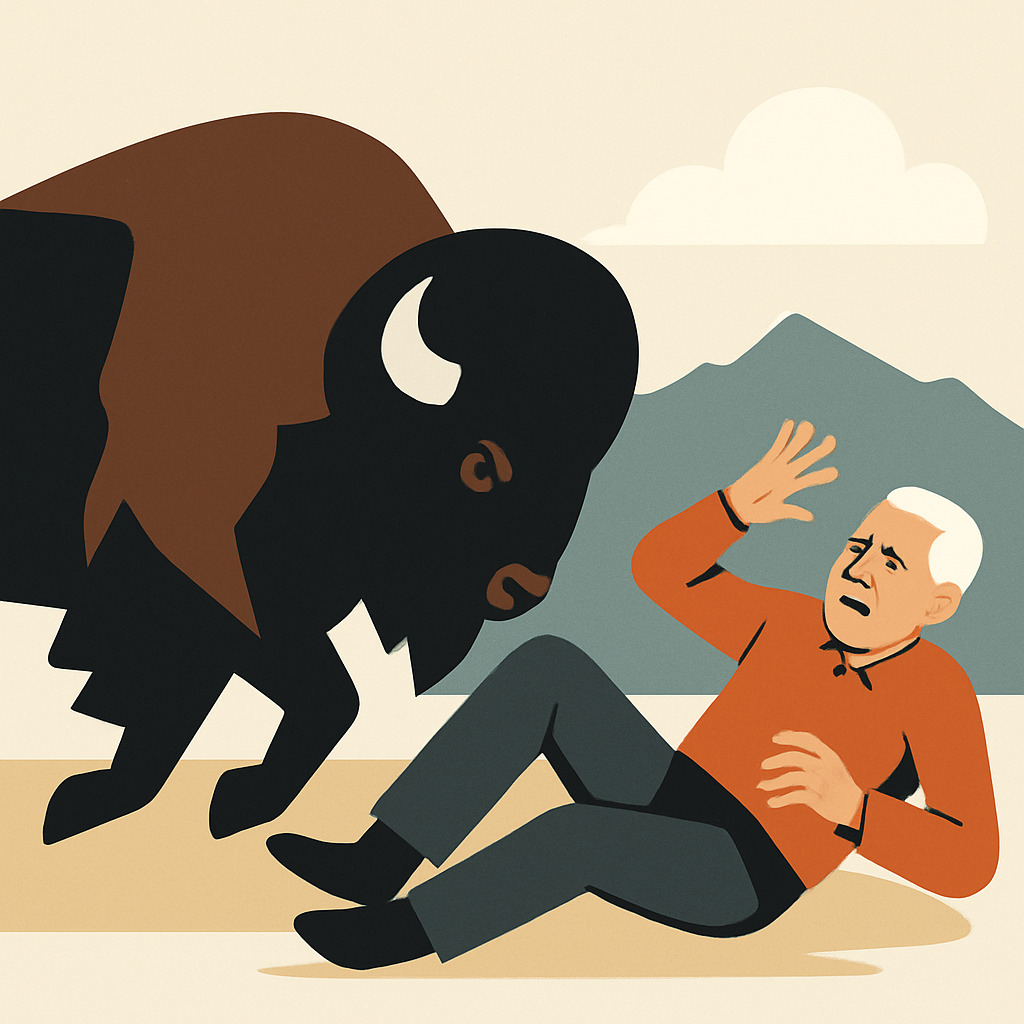
An elderly man named Carl was at Yellowstone National Park with his grandson. They stopped to take a picture of a bison. Suddenly, the bison ran at Carl and hit him. He flew into the air and needed to go to the hospital afterward.

Bison seem calm but can be very dangerous. They can run much faster than humans. The National Park Service says people should stay at least 25 yards away from bison. Unfortunately, some people still get too close to them and can get hurt.

Carl was near a campground when the bison attacked. It was almost sunset, and he and his grandson started running to some trees. Despite their efforts, the bison reached Carl. It used its horn to throw him in the air, and he landed on his side.

Original news source: Bison rams elderly man in Yellowstone, flinging him into the sky (BBC)

🎧 Listen:

πŸ“– Vocabulary:

1. charged
2. suddenly
3. peaceful
4. visitors
5. unfortunately
6. incident
7. escape
8. caught
9. threw
10. horn
11. landed
12. startled

Group or Classroom Activities

Warm-up Activities:

1. Have you ever been to a national park? Share your experience.
2. What animals can be dangerous in the wild?
3. What are some precautions to take when visiting a place with wild animals?
4. Can you name other animals that have horns like a bison?
5. Why is it important to follow safety guidelines in nature parks?

πŸ€” Comprehension Questions:

1. Who was with Carl during the incident?

2. What caused the bison to run at Carl?

3. How fast can bison run compared to humans?

4. What distance should people keep from bison?

5. Where did the incident take place?

6. What did Carl attempt to do to escape the bison?

7. What was Carl's condition after the bison attack?

🎧✍️ Listen and Fill in the Gaps:

An elderly man named Carl was at National with his grandson. They stopped to a picture of a bison. Suddenly, the bison ran at Carl and hit him. He flew into the air and needed to go to the afterward. Bison seem but can be very dangerous. They can run much faster than humans. The National Park says people should stay at 25 yards away from bison. Unfortunately, some people still get too to them and can get . Carl was near a campground when the bison attacked. It was almost sunset, and he and his grandson started running to some trees. their , the bison reached Carl. It used its horn to him in the air, and he landed on his side.

πŸ’¬ Discussion Questions:

1. How do you feel about visiting places with wild animals?
2. Why do you think people get too close to wild animals?
3. What is the most exciting wildlife encounter you've heard of?
4. How should people react if they encounter a dangerous animal?
5. What habitats do bison usually live in?
6. What are the challenges of protecting wildlife in national parks?
7. Do you think national parks should have more safety warnings?
8. How can visitors learn more about the animals in a park?
9. What should park rangers do to prevent such incidents?
10. What other national parks are popular for visitors?
11. How do you think Carl and his grandson felt after the incident?
12. Should people have certain qualifications before visiting parks with dangerous animals?

Individual Activities

πŸ“–πŸ’­ Vocabulary Meanings:

Click a dot next to a word, then click the dot next to its meaning to draw a line connecting them.


Words

1. charged
2. suddenly
3. peaceful
4. visitors
5. unfortunately
6. incident
7. escape
8. caught
9. threw
10. horn
11. landed
12. startled

Meanings

(A) moved quickly
(B) sadly
(C) captured
(D) pointy body part on an animal
(E) event
(F) get away
(G) calm
(H) without warning
(I) guests
(J) surprised
(K) tossed
(L) hit the ground

πŸ”‘ Multiple Choice Questions:

1. What did the bison do to Carl?
(a) Barked at him
(b) Gave him food
(c) Flew over him
(d) Charged at him
2. How does the article describe bison?
(a) Slow and harmless
(b) Calm but dangerous
(c) Small and gentle
(d) Quiet and friendly
3. How far should people stay from bison according to the National Park Service?
(a) Just 5 yards
(b) 50 yards or more
(c) At least 25 yards
(d) As close as possible
4. What time of the day did the incident occur?
(a) Near sunset
(b) Noon
(c) Early morning
(d) Midnight
5. Why did Carl stop in the park?
(a) To take a photo
(b) To feed the bison
(c) To sleep
(d) To make a fire
6. Who was with Carl during the incident?
(a) A park ranger
(b) His grandson
(c) A group of tourists
(d) His pet dog
7. What happened to Carl after the bison hit him?
(a) He laughed
(b) He went swimming
(c) He drove home
(d) He needed to go to the hospital
8. Where did Carl and his grandson try to escape?
(a) Into a car
(b) Behind a boulder
(c) To some trees
(d) Under a bridge

πŸ•΅οΈ True or False Questions:

1. The bison ran at Carl suddenly.
2. Carl was without his grandson at Yellowstone National Park.
3. Carl needed to go to the hospital after the incident.
4. The incident happened near sunset at Bridge Bay Campground.
5. Visitors should stay at least 50 yards away from bison.
6. The bison used its tail to launch Carl in the air.
7. Carl and his grandson tried to escape by running to trees.
8. Bison are much slower than humans.

Writing Questions:

1. What safety tips would you give someone visiting a national park?
2. Describe a time when you saw an animal up close.
3. How should people prepare for a trip to a wildlife area?
4. What would you do if you saw a wild animal too close?
5. What is the importance of preserving natural habitats like Yellowstone?

How about these other Level 2 articles?

Online
Class
Writing
Coach
β˜• 컀피 3μž” &
무료 ν”Όλ“œλ°±! πŸŽ“
β˜• 컀피 3μž” & 무료 ν”Όλ“œλ°±! πŸŽ“

X

[100% 온라인] λž­μ»€μŠ€ν„° λŒ€ν•™κ΅ μ˜μ–΄ 연ꡬ μ°Έμ—¬μž λͺ¨μ§‘
λ³„λ„μ˜ μ°Έκ°€λΉ„ 없이 영ꡭ λŒ€ν•™ 연ꡬ에 도움도 μ£Όμ‹œκ³ , 무료 μ˜μ–΄ μ‹€μ „ μ—°μŠ΅κ³Ό ν”Όλ“œλ°±λ„ λ°›μ•„λ³΄μ„Έμš”!

영ꡭ λž­μ»€μŠ€ν„° λŒ€ν•™κ΅(Lancaster University)μ—μ„œ ν•œκ΅­μΈ μ˜μ–΄ ν•™μŠ΅μžλΆ„λ“€μ„ λŒ€μƒμœΌλ‘œ μƒˆλ‘œμš΄ 연ꡬ ν”„λ‘œμ νŠΈλ₯Ό μ§„ν–‰ν•©λ‹ˆλ‹€. μ „ κ³Όμ • 온라인으둜 μ§„ν–‰λ˜μ–΄ μ–΄λ””μ„œλ“  νŽΈν•˜κ²Œ μ°Έμ—¬ν•˜μ‹€ 수 μžˆμŠ΅λ‹ˆλ‹€. μ—¬λŸ¬λΆ„μ˜ μ†Œμ€‘ν•œ μ°Έμ—¬λ‘œ ν•œκ΅­μΈμ˜ μ˜μ–΄ μ‚¬μš© 방식을 μ•Œμ•„λ³΄λŠ” ν₯미둜운 연ꡬ가 μ™„μ„±λ©λ‹ˆλ‹€.

🎁 μ°Έμ—¬ ν˜œνƒ:
– 원어민 μ—°κ΅¬μ›κ³Όμ˜ 1:1 νšŒν™” μ—°μŠ΅
– μ‹€μ „ μ˜μž‘ μ—°μŠ΅ & λ§žμΆ€ν˜• μ˜μ–΄ ν”Όλ“œλ°± 리포트
– 컀피 κΈ°ν”„ν‹°μ½˜ 총 3μž” μ„ λ¬Ό! (첫 μ„Έμ…˜ ν›„ 1μž”, λ§ˆμ§€λ§‰ μ„Έμ…˜ μ™„λ£Œ ν›„ 2μž” 더 λ“œλ €μš”! β˜•β˜•)

πŸ“… μ°Έμ—¬ 방식: 총 2회의 온라인 μ„Έμ…˜ (Zoom 등을 이용, 각 μ„Έμ…˜λ‹Ή μ•½ 60~80λΆ„ μ†Œμš”) λ§ν•˜κΈ°μ™€ μ“°κΈ° ν™œλ™μ΄ μ„žμ—¬ μžˆμ–΄ λΆ€λ‹΄ 없이 즐겁게 μ°Έμ—¬ν•˜μ‹€ 수 μžˆμŠ΅λ‹ˆλ‹€.

βœ… λŒ€μƒ: μ˜μ–΄ μ‹€λ ₯에 상관없이 μ°Έμ—¬λ₯Ό ν¬λ§ν•˜λŠ” 18μ„Έ 이상 ν•œκ΅­μΈ λˆ„κ΅¬λ‚˜

Feedback