


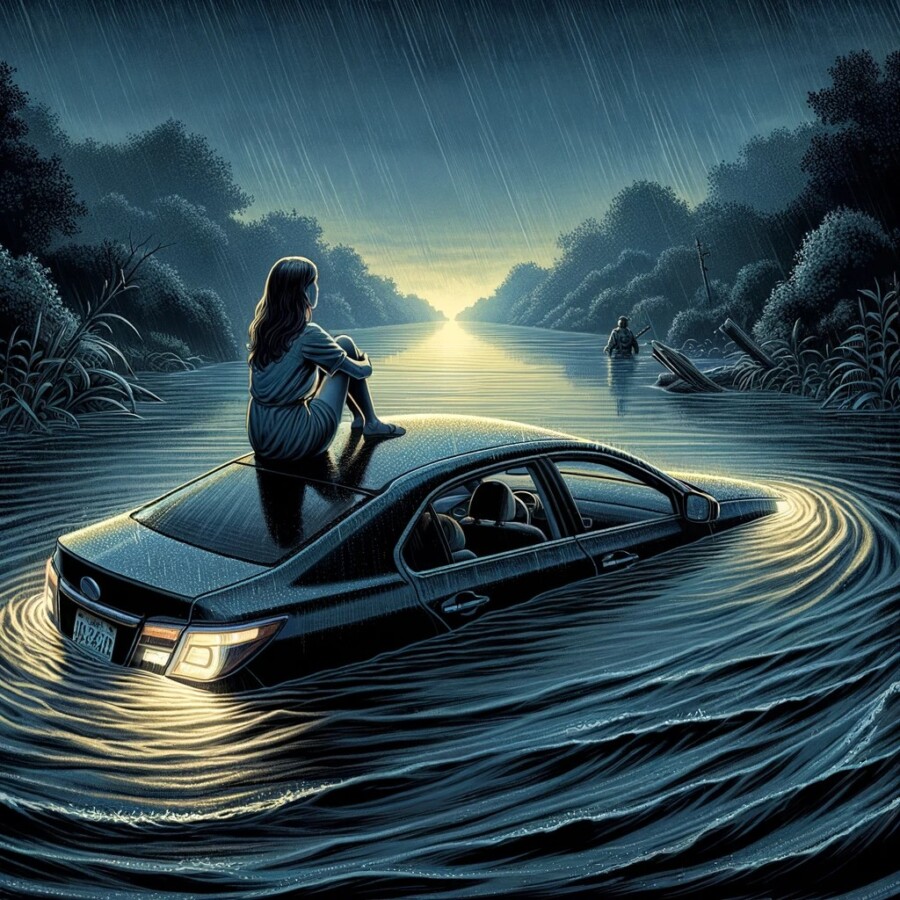
A woman was in her car when it went into a big creek and turned upside down. She climbed on top of her car and stayed there for a long time, waiting for someone to find her. A person camping saw her the next day and called for help. People came in a helicopter and took her to the hospital, but she was not very hurt.
This story shows that it can be very dangerous to drive when the weather is bad. It also shows that people can be brave and smart when they are in trouble. The woman stayed calm and waited on her car, which helped her stay safe until she was rescued.
The people who help keep us safe say that we should be careful when we drive, especially when there is a lot of water on the roads. They say we should know what the weather will be like and if any roads are closed. It's also good to have a plan for what to do if something goes wrong while we are driving.
Original news source: Woman rescued after 14 hours atop submerged car (BBC)
🎧 Listen:
📖 Vocabulary:
Group or Classroom Activities
Warm-up Activities:
– News Summary
Instructions:
1. Divide the class into pairs or small groups.
2. Give each group a copy of the article.
3. Ask the groups to read the article and summarize the main points in just a few sentences.
4. After a few minutes, ask each group to share their summary with the class.
– Opinion Poll
Instructions:
1. Write the following question on the board: "Do you think it is dangerous to drive in bad weather?"
2. Divide the class into pairs or small groups.
3. Give each group a few minutes to discuss their opinions and reasons for their answer.
4. After the discussion, ask each group to share their opinions with the class and explain their reasoning.
– Vocabulary Pictionary
Instructions:
1. Write a list of key vocabulary words from the article on the board (e.g. creek, helicopter, rescued).
2. Divide the class into teams.
3. Choose one person from each team to come to the board.
4. Give each person a vocabulary word and ask them to draw a picture representing that word.
5. The rest of the team must guess the word based on the drawing.
6. The team that guesses correctly gets a point.
7. Repeat with different team members and vocabulary words.
– Sketch It
Instructions:
1. Divide the class into pairs.
2. Give each pair a blank piece of paper and a pen or pencil.
3. One person in each pair will describe a scene from the article while the other person tries to sketch it based on the description.
4. After a few minutes, switch roles and repeat the activity.
5. After both rounds, ask the pairs to share their sketches and describe the scenes they were trying to depict.
– Think-Pair-Share
Instructions:
1. Ask the class to think about the following question: "What would you do if your car went into a creek?"
2. Give the students a few minutes to think about their answers.
3. Pair up the students and ask them to share their ideas with each other.
4. After the pair discussion, ask a few pairs to share their ideas with the whole class.
🤔 Comprehension Questions:
Her car went into a big creek and turned upside down.
She waited on top of her car.
The person camping saw her the next day.
She was taken to the hospital in a helicopter.
No, she was not very hurt.
It can be dangerous to drive in bad weather because the roads can be slippery and it's harder to see.
We should be careful when we drive, know the weather conditions, and have a plan in case something goes wrong.
🎧✍️ Listen and Fill in the Gaps:
A woman was in her car when it went into a big creek and upside down. She climbed on top of her car and stayed there for a time, waiting for someone to find her. A person saw her the next day and called for . People came in a helicopter and her to the hospital, but she was not very hurt. This story that it can be very dangerous to drive when the weather is bad. It also shows that people can be brave and smart when they are in trouble. The woman stayed and on her car, which helped her stay until she was rescued. The people who help keep us safe say that we should be careful when we drive, especially when there is a lot of water on the roads. They say we should what the weather will be like and if any roads are . It's also good to have a plan for what to do if something wrong while we are driving.
💬 Discussion Questions:
1. What do you think happened to the woman's car?
2. How do you think the woman felt when she was waiting on top of her car?
3. Have you ever been in a dangerous situation? What happened?
4. Do you think it's important to stay calm in a difficult situation? Why or why not?
5. How would you feel if you saw someone in trouble and couldn't help them?
6. Do you like going camping? Why or why not?
7. What do you think the woman should have done differently to avoid the accident?
8. How do you think the woman felt when she saw the helicopter coming to rescue her?
9. What is a plan? Why is it important to have a plan when driving?
10. How would you feel if you were in a car accident?
11. Do you think it's important to check the weather before driving? Why or why not?
12. What would you do if you were in a car accident? Why?
Individual Activities
📖💭 Vocabulary Meanings:
Click a dot next to a word, then click the dot next to its meaning to draw a line connecting them.
Words
Meanings
🔡 Multiple Choice Questions:
🕵️ True or False Questions:
📝 Write a Summary:
Write a summary of this news article in two sentences.
Check your writing now with the best free AI for English writing!