


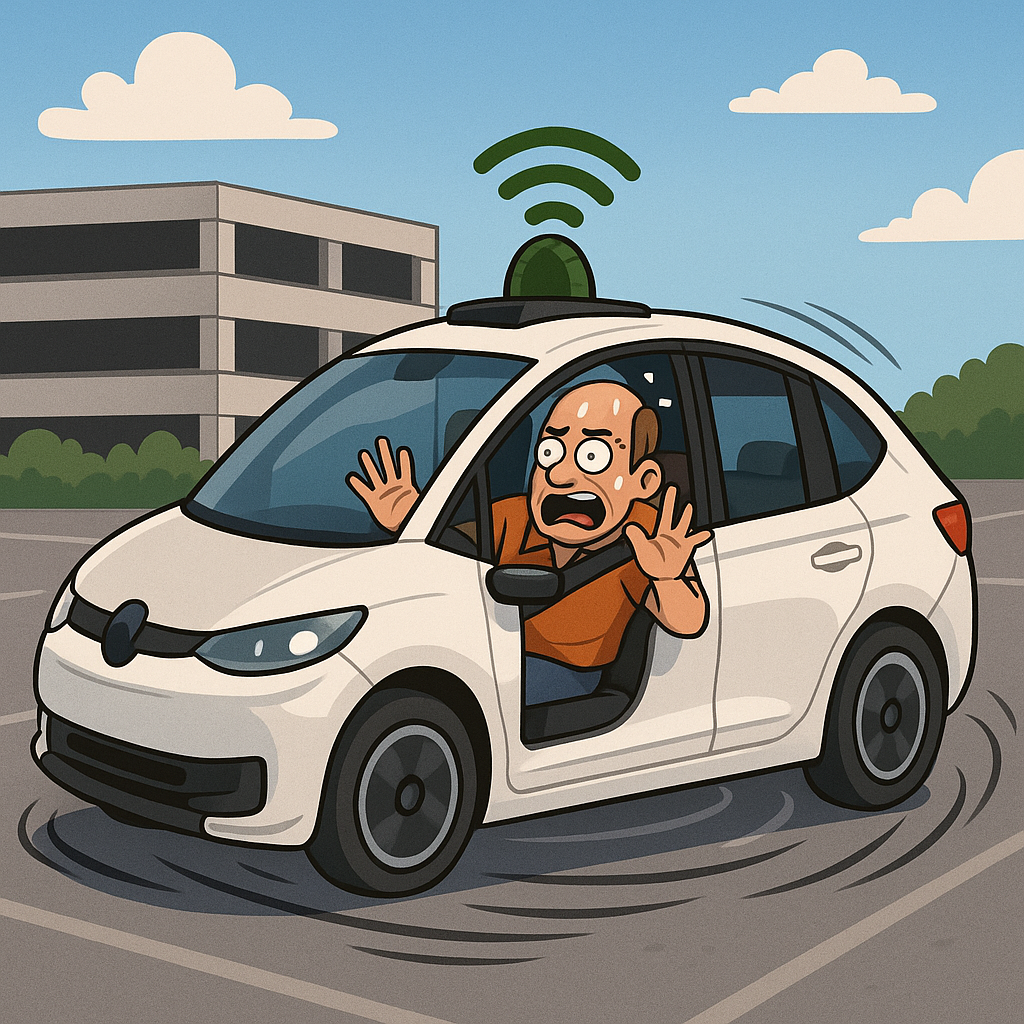
The creation of driverless cars has taken a long time, with both progress and problems along the way. A recent event involving Mike Johns, who had a scary experience in a Waymo driverless taxi, has made people doubt whether these cars are ready for the road. While waiting for his flight from Los Angeles to Scottsdale, Arizona, Mr. Johns found himself stuck in a car that kept spinning in circles in a parking lot. His video of this strange situation went viral, making many wonder if self-driving cars can safely transport people.
Waymo, the company that makes these self-driving cars and is owned by Alphabet, responded to the incident by updating their software to fix the problem. They claim that their technology is better than human drivers at preventing accidents that could cause injuries. However, Waymo has faced issues before, like when they had to recall over 600 cars after one crashed into a street pole. The National Highway Traffic Safety Administration (NHTSA) has also looked into several incidents involving Waymo cars, raising concerns about how safe these autonomous vehicles really are.
Other companies trying to make self-driving cars have also run into trouble. General Motors recently closed its self-driving branch called Cruise because it was too costly to keep going. Apple has reportedly given up on its self-driving car project, and Uber stopped working on it back in 2020. Despite these challenges, Waymo is still a leader in the U.S. market, running self-driving taxis in major cities and planning to grow even more.
Experts believe that Waymo's success comes from its smart strategies, like hiring the best engineers in the field and having strong financial support from Alphabet. Sven Beiker, a lecturer at Stanford, points out that following regulations and having thorough processes are key to keeping their technology safe. As the industry moves forward, areas with good weather are likely to see driverless services first, since these cars work better in those conditions. Looking to the future, the rollout of autonomous vehicles will take time and careful testing, especially for self-driving trucks, which need to be even more reliable than human drivers. Meanwhile, companies like Baidu in China are making great progress, with many driverless cars already operating in cities. Public opinion will be important as people like Mr. Johns share their experiences and the industry continues to experiment.
Original news source: The slow but steady advance of driverless vehicles (BBC)
🎧 Listen:
📖 Vocabulary:
Group or Classroom Activities
Warm-up Activities:
– CHARADES
Instructions: Students will take turns acting out scenarios related to driverless cars without using words, while their classmates guess what they are acting out. Scenarios can include situations like a car malfunctioning, a successful driverless ride, or an accident involving a self-driving car.
– OPINION POLL
Instructions: Students will walk around the classroom and ask their peers questions about driverless cars, such as "Do you think driverless cars are safe?" or "Would you ride in a driverless taxi?" After gathering responses, students will share the results with the class and discuss the varying opinions.
– HEADLINE CREATION
Instructions: After reading the article, students will work in pairs to create catchy headlines that capture the main points of the article. Each pair will then present their headline to the class and explain their reasoning behind it.
– MIND MAP
Instructions: In groups, students will create a mind map on a large piece of paper that outlines the key points from the article, such as challenges faced by driverless cars, companies involved, and public opinion. They will present their mind map to the class.
– TWO TRUTHS AND A LIE
Instructions: Each student will come up with two true statements and one false statement related to the content of the article on driverless cars. They will then share their statements with a partner, who will try to guess which one is the lie. Afterward, they can discuss the truths and lies as a class.
🤔 Comprehension Questions:
Mike Johns had a scary experience in a Waymo driverless taxi when the car kept spinning in circles in a parking lot, which made people question the safety of self-driving cars.
Waymo responded by updating their software to fix the problem that caused the car to spin in circles.
Waymo has faced issues like having to recall over 600 cars after one crashed into a street pole. They addressed these problems by investigating incidents and updating their technology to improve safety.
General Motors closed its self-driving branch called Cruise because it was too costly to keep operating.
Waymo's success comes from hiring top engineers, having strong financial support from Alphabet, and following smart strategies in their development process.
Experts believe that following regulations is key to keeping technology safe and ensuring that self-driving cars operate reliably on the roads.
Driverless services are expected to be introduced first in areas with good weather because self-driving cars perform better in those conditions.
Public opinion can influence the future of self-driving cars by shaping how people feel about their safety and reliability, especially as individuals share their experiences like Mr. Johns did.
🎧✍️ Listen and Fill in the Gaps:
The creation of driverless cars has taken a long time, with both progress and problems along the way. A recent event involving Mike Johns, who had a scary experience in a Waymo driverless taxi, has made people doubt whether these cars are for the road. While waiting for his flight from Los Angeles to Scottsdale, , Mr. Johns himself stuck in a car that kept spinning in in a parking lot. His video of this strange situation went viral, making many wonder if self-driving cars can safely transport people. Waymo, the company that makes these self-driving cars and is owned by Alphabet, responded to the incident by updating their software to fix the problem. They claim that their technology is better than human drivers at preventing accidents that could cause injuries. However, Waymo has faced before, like when they had to recall over 600 cars after one crashed into a street pole. The National Traffic Safety Administration (NHTSA) has also looked into several involving Waymo cars, raising concerns about how safe these autonomous vehicles really are. Other companies trying to make self-driving cars have also run into trouble. Motors recently closed its self-driving branch called Cruise because it was too costly to keep going. Apple has reportedly given up on its self-driving car project, and Uber stopped working on it back in 2020. Despite these challenges, Waymo is still a leader in the U.S. market, running self-driving taxis in major cities and planning to grow even more. Experts that Waymo's comes from its smart strategies, like hiring the best engineers in the field and having strong financial support from Alphabet. Sven Beiker, a lecturer at Stanford, points out that regulations and having processes are key to keeping their technology safe. As the moves forward, areas with good weather are likely to see driverless services first, since these cars work better in those conditions. Looking to the , the rollout of autonomous vehicles will take time and careful testing, especially for self-driving trucks, which need to be even more reliable than human drivers. Meanwhile, companies like in China are making great , with many driverless cars already operating in cities. Public opinion will be important as people like Mr. Johns share their experiences and the industry continues to experiment.
💬 Discussion Questions:
1. What is your opinion on driverless cars? Do you think they are a good idea?
2. How would you feel if you were stuck in a driverless car that wouldn’t stop spinning in circles?
3. Do you like the idea of using technology to drive cars instead of humans? Why or why not?
4. What is a major concern you have about self-driving cars?
5. Do you think self-driving cars will ever be completely safe? Why or why not?
6. How would you feel if you had to ride in a driverless taxi for the first time?
7. Do you think companies should continue to invest in driverless car technology despite the problems they've faced? Why?
8. What is your experience with technology that has made mistakes? How did you feel about it?
9. How do you think public opinion can affect the future of driverless cars?
10. Do you believe that driverless cars could help reduce traffic accidents? Why or why not?
11. What is a benefit of having driverless cars in busy cities?
12. How would you feel if you saw a driverless car on the road next to you?
13. Do you think it’s important for companies to follow strict regulations when creating new technology? Why or why not?
14. What is a challenge you think self-driving trucks would face compared to regular cars?
15. How do you think the weather affects the performance of driverless cars? Would you trust them more in good weather or bad weather? Why?
Individual Activities
📖💭 Vocabulary Meanings:
Click a dot next to a word, then click the dot next to its meaning to draw a line connecting them.
Words
Meanings
🔡 Multiple Choice Questions:
🕵️ True or False Questions:
📝 Write a Summary:
Write a summary of this news article in two sentences.
Check your writing now with the best free AI for English writing!