


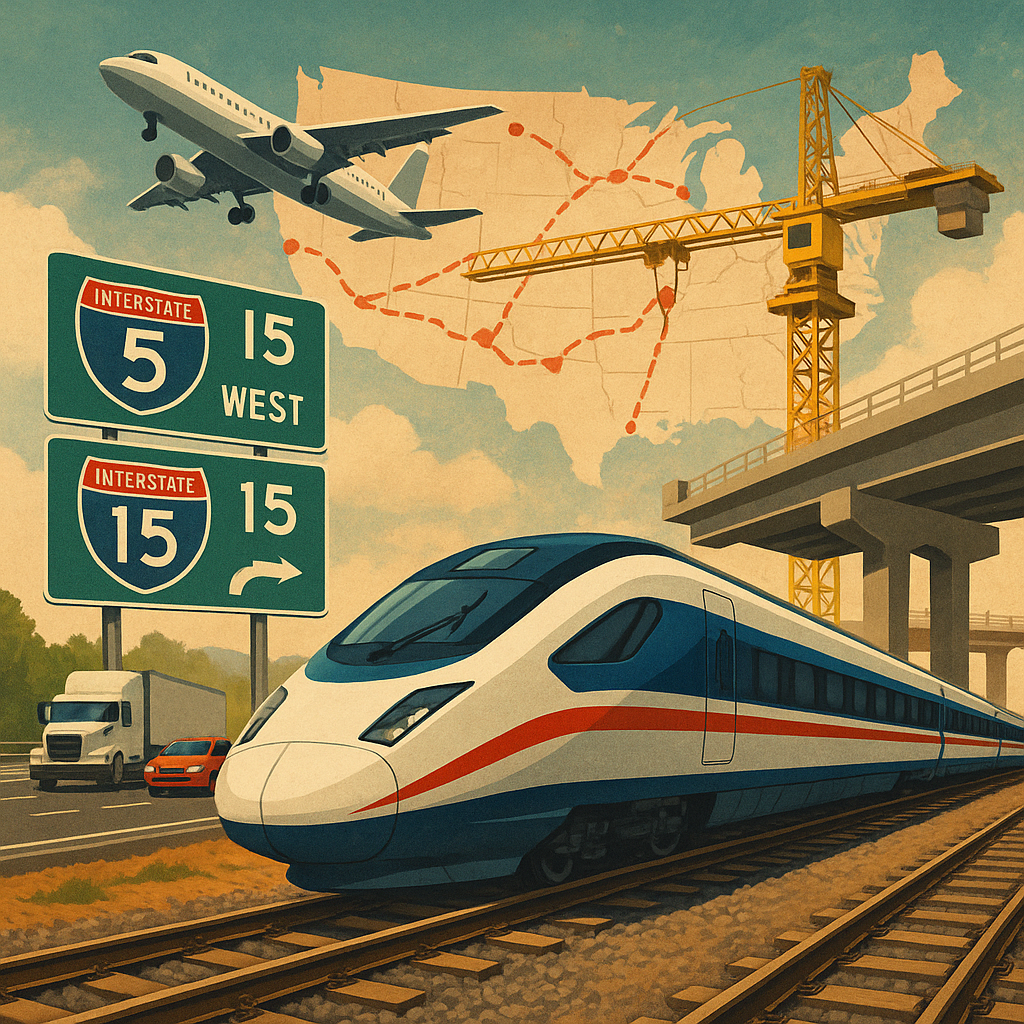
The United States has a population of about 340 million people and a lot of highways and airports, but it doesn't have a high-speed rail (HSR) system yet. Recently, there have been some exciting developments, as the country might soon start building its first high-speed rail lines. Two projects are currently in progress: one is the challenging route from San Francisco to Los Angeles, and the other is the simpler line from Las Vegas to Los Angeles. There are also plans for more connections, like a line from Portland to Seattle and another between Dallas and Houston. However, experts say that progress is slow and uncertain.
Rick Harnish, who works for the High Speed Rail Alliance, believes these projects are important for updating the U.S. rail system. He mentions that the planning for the Portland-Seattle line is moving very slowly, and the Texas line's future is unclear after a big federal grant was canceled. In comparison, China has a high-speed rail network that will reach over 50,000 kilometers this year, and Europe has built more than 8,500 kilometers of HSR lines. This shows that the U.S. is falling behind in investing in rail infrastructure.
One reason the U.S. doesn't have high-speed rail is that many people prefer driving cars and are unsure if such projects are necessary. Will Doig, a journalist who covers the rail industry, points out that many Americans are against high-speed rail, especially if it affects their neighborhoods. Additionally, the U.S. government often cuts funding for rail projects, making it harder to create a strong high-speed rail network.
Amtrak, the government-owned train service, doesn't have any high-speed trains right now, but it plans to introduce new Acela trains later this year. These trains will run on the Northeast Corridor, but only a small part of the route will allow speeds over 150 mph. The California High-Speed Rail project is expected to be finished by 2033 and is managed by California, while the Brightline West line from Los Angeles to Las Vegas is a private project set to open in 2028. Experts believe that for high-speed rail to work in the U.S., people need to change their attitudes towards public transportation, and the federal government must support these projects. However, political issues remain, as recent decisions show a lack of funding for proposed projects.
Original news source: Is the US finally on track to build a high-speed rail network? (BBC)
🎧 Listen:
📖 Vocabulary:
Group or Classroom Activities
Warm-up Activities:
– CHARADES
Instructions: Divide the class into small groups. Each group will take turns acting out key terms related to the article (e.g., high-speed rail, airport, highway, Amtrak). The other groups must guess the term being acted out without using any words.
– OPINION POLL
Instructions: Have students circulate around the room and ask each other whether they support the idea of high-speed rail in the U.S. Students should record the opinions they gather. Afterward, compile the results as a class and discuss any common themes or differences in opinions.
– MIND MAP
Instructions: In pairs, students will create a mind map on a large sheet of paper. The central topic is "High-Speed Rail in the U.S." They will branch out with ideas from the article, such as benefits, challenges, and comparisons with other countries. After 10 minutes, each pair will present their mind map to the class.
– HEADLINE CREATION
Instructions: Students will work individually or in pairs to create catchy headlines for the article. They should focus on summarizing the main points creatively. After they write their headlines, they can share them with the class, and a discussion can follow on which headlines are most effective and why.
– FUTURE PREDICTIONS
Instructions: Students will write a short paragraph predicting what the high-speed rail situation in the U.S. will look like in 10 years. They should consider factors such as technology, public opinion, and government support, using information from the article to support their predictions. After writing, students can share their predictions in small groups.
🤔 Comprehension Questions:
The two high-speed rail projects currently being developed are the route from San Francisco to Los Angeles and the line from Las Vegas to Los Angeles.
Experts believe the progress is slow and uncertain due to slow planning processes, unclear futures for some projects, and a lack of government funding.
China has a high-speed rail network that will reach over 50,000 kilometers this year, while the U.S. has no high-speed rail system yet, showing that the U.S. is falling behind in rail infrastructure investment.
Some Americans oppose high-speed rail projects because they prefer driving cars and are concerned about how such projects might affect their neighborhoods.
Amtrak plans to introduce new Acela trains later this year, which will run on the Northeast Corridor, but only a small part of the route will allow speeds over 150 mph.
The California High-Speed Rail project is expected to be completed by 2033 and is managed by California.
Experts believe that people need to change their attitudes towards public transportation and that the federal government must support these high-speed rail projects.
Government funding impacts the development of high-speed rail systems by making it harder to create a strong network when funding is cut or limited, which slows down progress on these projects.
🎧✍️ Listen and Fill in the Gaps:
The United States has a population of about 340 million people and a lot of highways and airports, but it doesn't have a high-speed rail (HSR) yet. Recently, there have been some exciting developments, as the country might soon start building its high-speed rail lines. Two projects are currently in progress: one is the challenging route from San Francisco to Los Angeles, and the other is the simpler line from Las Vegas to Los Angeles. There are also plans for more connections, like a line from to Seattle and another between Dallas and . However, experts say that progress is slow and . Rick Harnish, who works for the High Speed Rail Alliance, believes these projects are important for updating the U.S. rail system. He mentions that the planning for the Portland-Seattle line is moving very slowly, and the Texas line's is unclear after a big federal grant was canceled. In comparison, China has a high-speed rail network that will reach over 50,000 kilometers this year, and has more than 8,500 kilometers of HSR lines. This shows that the U.S. is falling behind in investing in rail infrastructure. One reason the U.S. doesn't have high-speed rail is that many people prefer driving cars and are unsure if such are necessary. Will Doig, a journalist who covers the rail industry, points out that many Americans are against high-speed rail, especially if it affects their neighborhoods. Additionally, the U.S. government often cuts funding for rail projects, making it harder to create a strong high-speed rail network. Amtrak, the government-owned service, doesn't have any high-speed trains right now, but it plans to new trains later this year. These trains will run on the Northeast , but only a small part of the route will allow over 150 mph. The High-Speed Rail project is expected to be finished by 2033 and is managed by California, while the Brightline West line from Los Angeles to Las Vegas is a private project set to open in 2028. Experts believe that for high-speed rail to work in the U.S., people need to change their attitudes towards public , and the federal government must support these projects. However, political issues remain, as recent decisions show a lack of funding for proposed projects.
💬 Discussion Questions:
1. What is your opinion on high-speed rail systems? Do you think they are necessary in the U.S.?
2. How would you feel if your city started building a high-speed rail line?
3. Do you like traveling by train? Why or why not?
4. What is a benefit of having high-speed trains compared to cars or planes?
5. Do you think the U.S. should invest more in public transportation? Why or why not?
6. How would you feel if high-speed rail construction affected your neighborhood?
7. What is a reason some people might prefer driving cars over taking trains?
8. Do you think more people would use trains if they were faster and more convenient? Why?
9. What is your experience with public transportation in your city or country?
10. How would you feel if you had to choose between taking a train or a plane for a long trip?
11. Do you think the government should prioritize funding for rail projects over other types of infrastructure? Why or why not?
12. What is a challenge that high-speed rail projects might face in the U.S.?
13. How would you feel if you could travel from your city to another city in just a few hours by train?
14. Do you think the U.S. will ever catch up to countries like China and Europe in terms of high-speed rail? Why or why not?
15. What is a way to encourage more people to use public transportation instead of cars?
Individual Activities
📖💭 Vocabulary Meanings:
Click a dot next to a word, then click the dot next to its meaning to draw a line connecting them.
Words
Meanings
🔡 Multiple Choice Questions:
🕵️ True or False Questions:
📝 Write a Summary:
Write a summary of this news article in two sentences.
Check your writing now with the best free AI for English writing!