

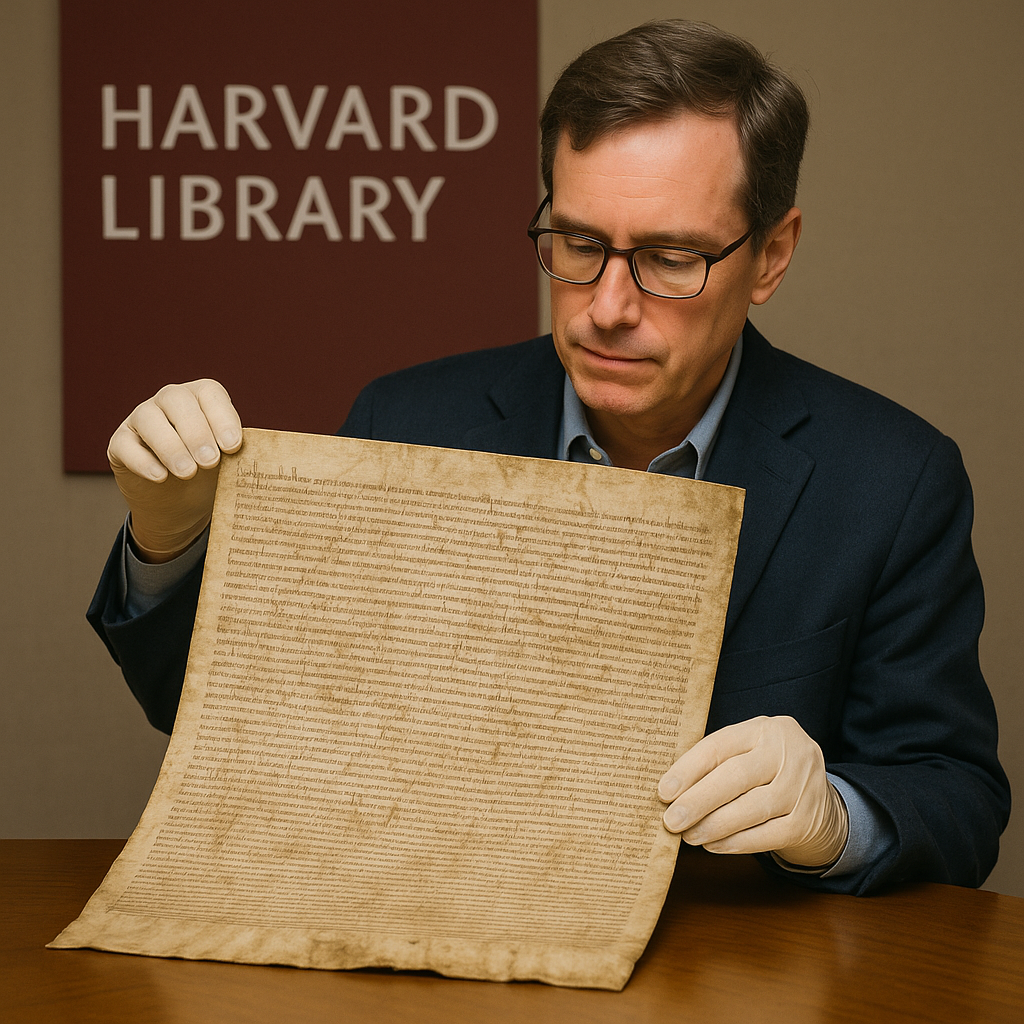
In an exciting discovery, a document that was thought to be just a copy of the Magna Carta has been confirmed as an original. This important finding happened at the Harvard Law School Library, where the document was bought in 1946 for just $27.50 from a London bookshop called Sweet & Maxwell. The library believed it was a faded copy from 1327, during King Edward III's reign, but it turns out they were wrong.
The bookshop had actually bought this document just a month earlier at a Sotheby’s auction, paying £42 to a pilot who served in World War I. Because it was misdated, the document was thought to be a copy, which hid its true historical importance. Recent research has shown that this document is a rare original Magna Carta issued in 1300 by King Edward I, making it worth millions of dollars.
The discovery was made by David Carpenter, a professor of medieval history at King’s College London. While looking at online versions of the Magna Carta in December 2023, he noticed that the document on Harvard's website might be the real deal. Curious, he carefully examined it, comparing the text and doing tests to confirm that it was indeed authentic.
The Magna Carta was first created in 1215 under King John and is a key legal document that explains the rights of regular people under common law. It is important because it helped limit the power of kings and established that everyone, including the king, must follow the law. The 1300 version owned by Harvard Law School adds even more to the history of this document and its impact on legal rights. Even though the document is now very valuable, Harvard Law School plans to keep it safe instead of selling it, as it represents a significant part of history.
Original news source: Magna Carta 'copy' miscatalogued in 1940s found to be original (Sky News)
🎧 Listen:
📖 Vocabulary:
Group or Classroom Activities
Warm-up Activities:
– CHARADES
Instructions: Students will take turns acting out key terms or phrases related to the Magna Carta and its historical significance without speaking. The rest of the class will guess what is being acted out. Terms can include "King John," "legal rights," "original document," etc.
– OPINION POLL
Instructions: Divide students into small groups and give them a list of statements related to the importance of historical documents and their relevance today (e.g., "Historical documents should be preserved for future generations"). Students will discuss and vote on their opinions, then share their group's findings with the class.
– HEADLINE CREATION
Instructions: Ask students to create catchy headlines that could be used for a newspaper article about the discovery of the original Magna Carta. They should think about what aspects of the story are most newsworthy and present their headlines to the class.
– MIND MAP
Instructions: In pairs, students will create a mind map on a large piece of paper or a whiteboard that explores the significance of the Magna Carta. They should include branches for its historical context, key figures, main ideas, and its impact on legal rights today.
– TWO TRUTHS AND A LIE
Instructions: Each student will come up with two true statements and one false statement about the Magna Carta and its recent discovery. They will then share their statements with a partner, who will have to guess which one is the lie. Afterward, students can share some of their statements with the class.
🤔 Comprehension Questions:
The initial belief was that the document was just a faded copy of the Magna Carta from 1327.
Harvard Law School paid $27.50 for the document in 1946.
The professor is David Carpenter, and he works at King’s College London.
The Magna Carta is significant because it helped limit the power of kings and established that everyone, including the king, must follow the law.
The original Magna Carta that Harvard owns was issued in 1300.
The document was misidentified as a copy because it was misdated, leading people to believe it was a faded copy from 1327.
Harvard Law School chooses to keep the document because it represents a significant part of history.
David Carpenter confirmed the document's authenticity by carefully examining it, comparing the text, and doing tests.
🎧✍️ Listen and Fill in the Gaps:
In an discovery, a document that was thought to be just a copy of the Magna has been confirmed as an original. This important finding happened at the Harvard Law Library, where the document was bought in 1946 for just $27.50 from a London bookshop called Sweet & Maxwell. The believed it was a faded copy from 1327, during King Edward III's reign, but it turns out they were wrong. The bookshop had actually bought this just a month earlier at a Sotheby’s auction, paying £42 to a pilot who served in World War I. Because it was misdated, the document was to be a copy, which hid its true historical importance. Recent research has shown that this document is a rare original Magna Carta in 1300 by King Edward I, making it millions of dollars. The discovery was made by David Carpenter, a professor of medieval at King’s College London. While looking at online versions of the Magna Carta in December 2023, he noticed that the document on Harvard's website might be the real deal. Curious, he carefully examined it, the text and tests to confirm that it was indeed . The Magna Carta was first created in 1215 under King John and is a key legal document that explains the rights of regular people under common law. It is because it helped limit the of and established that everyone, including the king, must follow the law. The 1300 version by Harvard Law School adds even more to the history of this document and its impact on legal rights. Even though the document is now very valuable, Harvard Law School plans to keep it safe instead of selling it, as it represents a significant part of history.
💬 Discussion Questions:
1. What is the Magna Carta, and why do you think it is considered an important document in history?
2. How would you feel if you discovered a valuable historical document in your school or community?
3. Do you think it is important for schools to preserve historical documents? Why or why not?
4. What do you think should be done with valuable historical artifacts? Should they be sold or kept in museums?
5. How do you think the discovery of the original Magna Carta will change people's understanding of history?
6. Do you like learning about history? Why or why not?
7. What is a historical figure you admire, and what do you think makes them important?
8. How would you feel if you were the professor who discovered the original Magna Carta?
9. Do you think it is important for people to know about their legal rights? Why?
10. What is a law in your country that you think is particularly important? Why do you think it matters?
11. How would you feel if you had the chance to see the original Magna Carta in person?
12. Do you think technology, like online research, makes it easier to discover historical facts? Why or why not?
13. What role do you think libraries play in preserving history and culture?
14. How do you think history can impact our lives today?
15. Do you think that the value of historical documents should be measured in money? Why or why not?
Individual Activities
📖💭 Vocabulary Meanings:
Click a dot next to a word, then click the dot next to its meaning to draw a line connecting them.
Words
Meanings
🔡 Multiple Choice Questions:
🕵️ True or False Questions:
📝 Write a Summary:
Write a summary of this news article in two sentences.
Check your writing now with the best free AI for English writing!