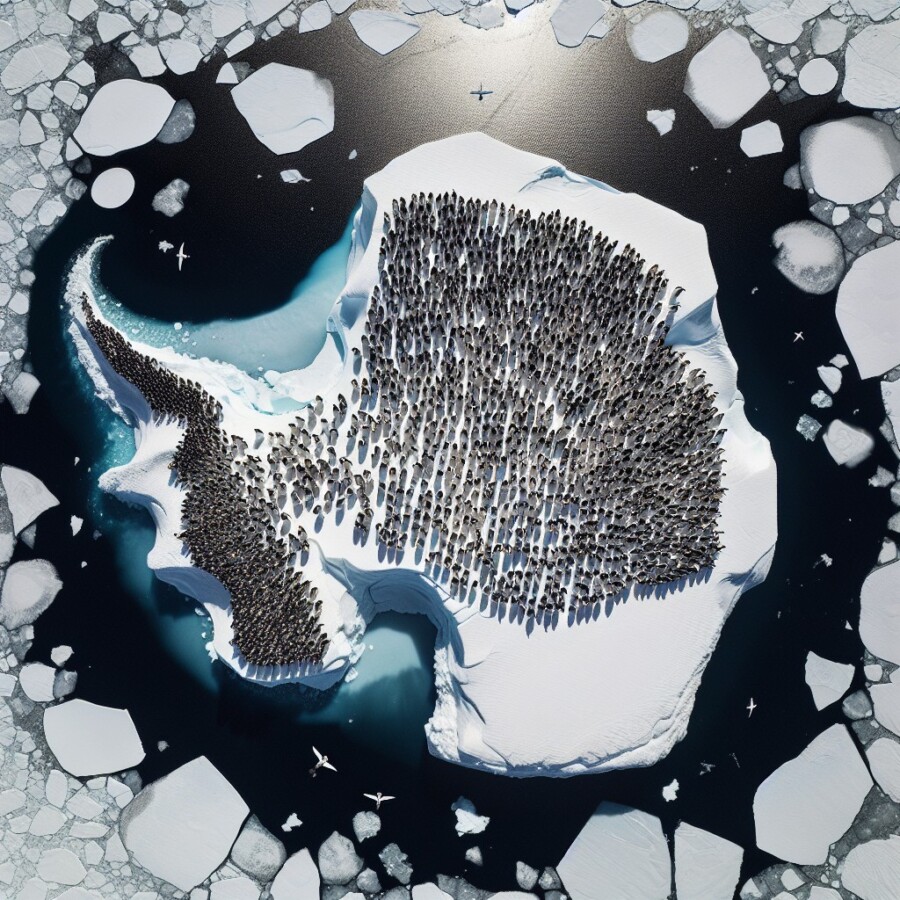
Scientists have found four new groups of emperor penguins in Antarctica using satellite pictures. This means we now know about 66 places where they live. It's really important for people who want to protect these penguins because they're having a tough time because of climate change. These penguins have babies on ice that's not moving, but that kind of ice is getting smaller and changing more. Finding these new groups is good news, but it also shows that the penguins need to be able to change and move to new places as the ice keeps changing.
Emperor penguins are the biggest kind of penguin and they live in really tough conditions in Antarctica. They have babies in groups, and these groups are usually about 250km apart. Scientists have been using satellites to look for new groups of penguins in the spaces between the ones we already know about. The four new groups they found have a few thousand more penguins in them, adding to the total of about 550,000. It's clear that the penguins will have to be able to change and move to new places as the ice keeps changing, because some of the groups we already knew about have moved around.
Satellites are the best way to find emperor penguin groups because Antarctica is so big and far away. Scientists can see the groups because the penguins' poop makes stains on the white ice, and if there are enough penguins in one place, you can even see it from space. Dr. Peter Fretwell from the British Antarctic Survey has found about half of the groups we know about using satellite pictures. The pictures from the EU's Sentinel-2 spacecraft have helped scientists watch the penguins try to start a new group near Britain's Halley research station.
Finding these new groups of emperor penguins shows that they can change and move around when the ice changes. The satellites have also helped scientists see how far the penguins go to find food for their babies. The adults can travel over 100km in one day. The scientists published their findings about the new groups in the journal Antarctic Science.
Original news source: Four new emperor penguin groups found by satellite (BBC)
🎧 Listen:
📖 Vocabulary:
Group or Classroom Activities
Warm-up Activities:
– News Summary
Instructions:
1. Divide the class into groups of 3-4 students.
2. Provide each group with a copy of the article.
3. Instruct the groups to read the article and summarize the main points in 3-4 sentences.
4. Give the groups a few minutes to discuss and write their summaries.
5. Have each group share their summaries with the class.
– Opinion Poll
Instructions:
1. Ask the students to form pairs.
2. Provide each pair with a list of questions related to the article, such as "Do you think the discovery of new penguin groups is a positive or negative development?" or "How important is it to protect emperor penguins?"
3. Instruct the pairs to interview each other and record their partner's opinions.
4. After a few minutes, gather the class together and ask a few pairs to share their partner's opinions.
– Vocabulary Pictionary
Instructions:
1. Write a list of vocabulary words from the article on the board, such as "satellites," "Antarctica," "climate change," "emperor penguins," etc.
2. Divide the class into two teams.
3. Give each team a large piece of paper and a marker.
4. Call out a vocabulary word and have one student from each team come to the front of the class.
5. The students must draw a picture to represent the word and their team must guess the word.
6. The team who guesses correctly gets a point.
7. Repeat with different vocabulary words until all have been used.
– Keyword Hangman
Instructions:
1. Write a sentence from the article on the board, but leave out some of the keywords.
2. Divide the class into two teams.
3. Have one student from the first team come to the front of the class and choose a letter.
4. If the letter is in the sentence, write it in the correct place.
5. If the letter is not in the sentence, draw a part of the hangman.
6. Continue taking turns between the teams until the sentence is complete or the hangman is drawn.
– Future Predictions
Instructions:
1. Ask the students to form pairs.
2. Instruct each pair to discuss and make predictions about what might happen to emperor penguins in the future due to climate change.
3. Give the pairs a few minutes to discuss and write down their predictions.
4. Ask a few pairs to share their predictions with the class and facilitate a short discussion about the topic.
🤔 Comprehension Questions:
It is important for scientists to find new groups of emperor penguins in Antarctica because it helps them understand where the penguins are located and how they are being affected by climate change. This information is crucial for conservation efforts and protecting the penguins.
We now know about 66 places where emperor penguins live in Antarctica.
Emperor penguins are having a tough time because of climate change because the ice they rely on to have their babies is melting and changing. This makes it harder for them to find stable places to lay their eggs and raise their chicks.
Emperor penguins have their babies on ice that is not moving, usually in groups called colonies.
The ice conditions in Antarctica are changing because of climate change. The ice is melting and becoming smaller, making it more difficult for the emperor penguins to find suitable places to have their babies.
Scientists use satellites to find emperor penguins by taking pictures of Antarctica from space. They can see the penguins' poop stains on the white ice, which helps them locate the penguin colonies.
There are about 550,000 emperor penguins in total.
The scientists learned that emperor penguins can change and move around when the ice conditions change. They also discovered that the penguins can travel over 100km in one day to find food for their babies.
🎧✍️ Listen and Fill in the Gaps:
Scientists have found four new groups of emperor in Antarctica using satellite pictures. This we now know about 66 places where they live. It's really important for who want to protect these penguins because they're having a tough time because of climate . These penguins have babies on ice that's not moving, but that kind of ice is getting smaller and changing more. Finding these new groups is good news, but it also shows that the penguins need to be able to change and move to new places as the ice keeps . Emperor s are the biggest kind of penguin and they live in really tough conditions in Antarctica. They have babies in , and these groups are usually about 250km apart. Scientists have been using satellites to look for new groups of penguins in the spaces between the ones we already know about. The four new groups they found have a few thousand more penguins in them, adding to the of about 550,000. It's clear that the penguins will have to be able to change and move to new s as the ice keeps changing, because some of the groups we already knew about have moved around. are the best way to find emperor penguin groups because a is so big and far away. Scientists can see the groups because the penguins' poop makes stains on the white ice, and if there are penguins in one place, you can even see it from space. Dr. Peter Fretwell from the British Antarctic Survey has found about half of the groups we know about using satellite pictures. The pictures from the EU's Sentinel-2 spacecraft have watch the penguins try to start a new group near Britain's Halley research station. Finding these new groups of emperor penguins shows that they can change and move around when the ice changes. The satellites have also helped scientists see how far the penguins go to find food for their babies. The adults can over 100km in one day. The scientists their findings about the new groups in the journal Antarctic Science.
💬 Discussion Questions:
1. What is climate change and why is it affecting the emperor penguins?
2. How do the emperor penguins have their babies?
3. How do scientists use satellites to find new groups of penguins?
4. Do you think it's important to protect the emperor penguins? Why or why not?
5. How do the satellites help scientists understand the penguins' behavior?
6. What do you think it would be like to live in Antarctica?
7. How do the penguins find food for their babies?
8. Do you think it's easy for the penguins to move to new places as the ice changes? Why or why not?
9. How far can the adult penguins travel in one day?
10. How do scientists know where the penguins are based on satellite pictures?
11. What do you think the penguins' poop stains look like on the ice?
12. How do you think the penguins feel when their ice habitat gets smaller and changes?
13. Do you like penguins? Why or why not?
14. How would you feel if you saw a penguin in real life?
15. Do you think it's important to study and learn about animals like the emperor penguins? Why or why not?
Individual Activities
📖💭 Vocabulary Meanings:
Click a dot next to a word, then click the dot next to its meaning to draw a line connecting them.
Words
Meanings
🔡 Multiple Choice Questions:
🕵️ True or False Questions:
📝 Write a Summary:
Write a summary of this news article in two sentences.
Check your writing now with the best free AI for English writing!