

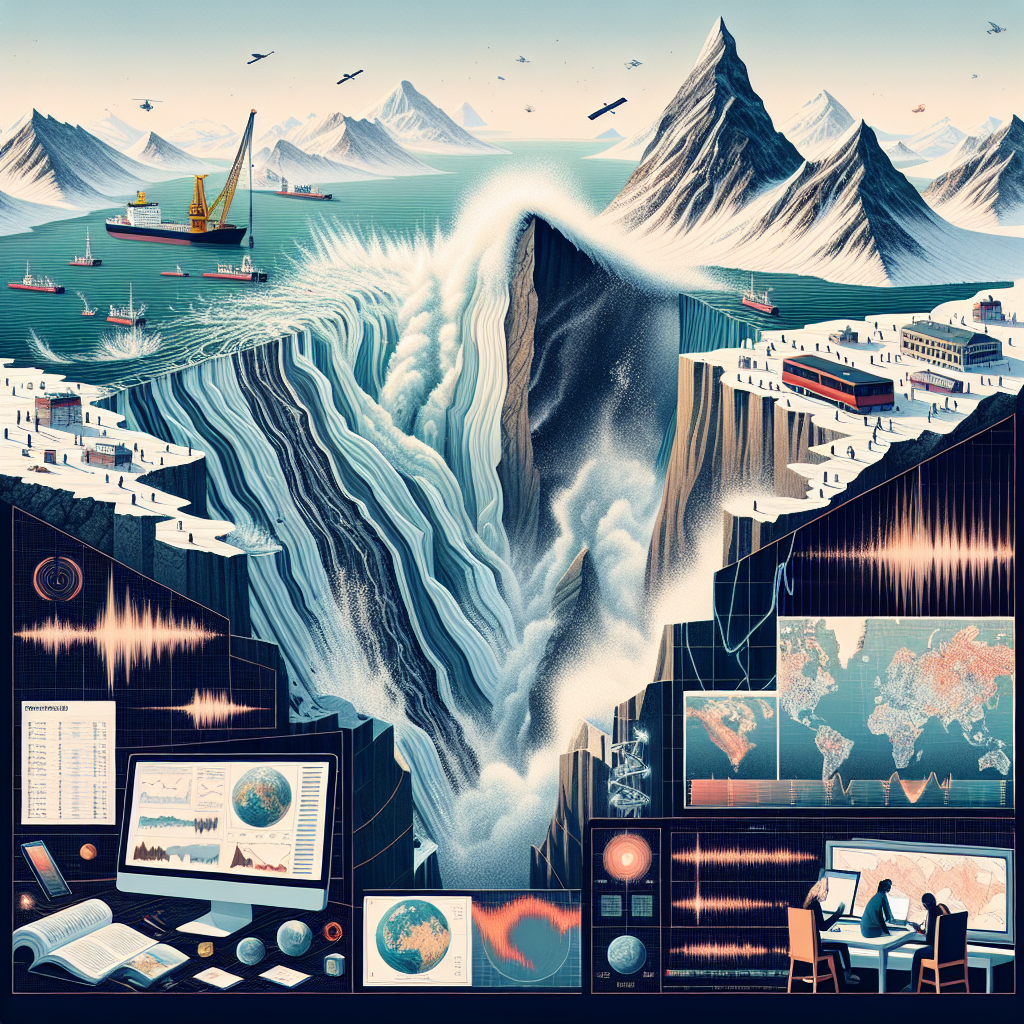
A huge landslide in a far-off fjord in East Greenland set off a tsunami that traveled around the world for nine days. Scientists pinpointed the tsunami's origin using seismic data and satellite images. The landslide, triggered by melting glaciers due to climate change, sent a 200m wave that got stuck in the narrow fjord, causing vibrations detected globally.
An international team of scientists and the Danish Navy worked together to investigate the event. Initially labeled as an "unidentified seismic object," the continuous seismic activity led to the discovery of the tsunami in the remote fjord. By analyzing various data like satellite images and photos, the scientists found that 25 million cubic meters of rock had fallen into the water, causing the mega-tsunami.
The trapped wave in the fjord moved back and forth for nine days, an unprecedented event in terms of its size and duration. Scientists link the landslide to the shrinking glaciers supporting Greenland's mountains, a result of rising temperatures. This occurrence highlights how climate change affects remote areas like Greenland and stresses the need for more research into such incidents.
Although the tsunami hit a sparsely populated area, the rising number of such events in Greenland is worrying. Dr. Kristian Svennevig from the National Geological Surveys for Denmark and Greenland mentioned an increase in large landslides causing tsunamis in the Arctic. The Dickson Fjord incident serves as a strong reminder of climate change's impact on geological events, emphasizing the importance of ongoing scientific exploration in these regions.
Original news source: Mystery tremors were from massive nine-day tsunami (BBC)
🎧 Listen:
📖 Vocabulary:
Group or Classroom Activities
Warm-up Activities:
– Headline Creation
Instructions: Have students work in pairs or small groups to create a catchy headline for the article about the Greenland tsunami. Encourage them to use vocabulary from the article and to make the headline attention-grabbing.
– Vocabulary Pictionary
Instructions: Write down key vocabulary words from the article on separate pieces of paper. Have students pick a word and draw it on the board without using any letters, numbers, or gestures. Their classmates must guess the word based on the drawing.
– Opinion Spectrum
Instructions: Divide the class into two groups: "Agree" and "Disagree". Make a statement related to the article, such as "Climate change is the main cause of natural disasters." Have students move along a line in the classroom to show their level of agreement or disagreement, with one end representing strong disagreement and the other end representing strong agreement. Encourage students to discuss their opinions with their group.
– Pros and Cons
Instructions: Divide the class into small groups and assign each group the task of listing the pros and cons of conducting research in remote areas like Greenland. After a set amount of time, have each group share their lists with the class and facilitate a discussion on the advantages and disadvantages of such research.
– Think-Pair-Share
Instructions: Ask students to think about and write down their response to the following question: "How can scientific exploration help us better understand and address the impact of climate change on geological events?" Then, have them pair up to discuss their answers. Finally, open up the discussion to the whole class and encourage students to share their thoughts.
🤔 Comprehension Questions:
The huge landslide in East Greenland was triggered by melting glaciers due to climate change.
Scientists used seismic data and satellite images to pinpoint the origin of the tsunami that traveled for nine days.
The Danish Navy worked together with an international team of scientists to investigate the tsunami in Greenland.
Initially labeled as an "unidentified seismic object," continuous seismic activity led to the discovery of the tsunami in the remote fjord.
The rock that fell into the water, causing the mega-tsunami, was 25 million cubic meters in size.
The trapped wave moving back and forth for nine days was considered unprecedented due to its size and duration.
Scientists link the landslide in Greenland to climate change, specifically to the shrinking glaciers supporting Greenland's mountains.
The Dickson Fjord incident is seen as an important reminder of the impact of climate change on geological events because it highlights how rising temperatures are causing more frequent large landslides and tsunamis in remote areas like Greenland.
🎧✍️ Listen and Fill in the Gaps:
A huge in a far-off fjord in East Greenland set off a that traveled around the world for nine days. Scientists the tsunami's using seismic data and satellite images. The landslide, triggered by melting glaciers due to climate change, sent a 200m wave that got stuck in the narrow fjord, causing vibrations detected globally. An international team of scientists and the Danish Navy worked together to the . Initially labeled as an "unidentified seismic object," the continuous seismic activity led to the discovery of the tsunami in the remote fjord. By analyzing various data like satellite images and photos, the scientists that 25 million cubic meters of rock had fallen into the water, causing the mega-tsunami. The wave in the fjord moved back and forth for nine days, an unprecedented event in terms of its size and duration. Scientists link the landslide to the shrinking supporting 's mountains, a result of rising temperatures. This occurrence highlights how climate change affects remote areas like Greenland and the need for more research into such . Although the tsunami hit a sparsely populated area, the rising number of such events in Greenland is worrying. Dr. Kristian Svennevig from the National Geological Surveys for and Greenland mentioned an increase in large landslides causing tsunamis in the Arctic. The Dickson Fjord serves as a reminder of climate change's impact on events, emphasizing the importance of ongoing scientific exploration in these regions.
💬 Discussion Questions:
1. What is a tsunami and how is it different from a regular wave?
2. How would you feel if you were living near a fjord and experienced a tsunami like the one in East Greenland?
3. Do you think climate change is a serious issue? Why or why not?
4. Have you ever experienced a natural disaster? How did it make you feel?
5. Do you think scientists play an important role in studying and understanding natural disasters? Why or why not?
6. How do you think the melting glaciers in Greenland are affecting the environment?
7. Do you like learning about natural disasters and the science behind them? Why or why not?
8. What do you think can be done to prevent more tsunamis caused by landslides in remote areas like Greenland?
9. How do you think the people living near the affected fjord in Greenland felt during the nine days of the trapped tsunami?
10. Do you think it is important for countries to work together to study and understand natural disasters? Why or why not?
11. What measures do you think can be taken to reduce the impact of climate change on remote areas like Greenland?
12. Why do you think it is important for scientists to analyze data like satellite images and seismic activity in studying natural disasters?
13. How would you feel if you were a scientist involved in investigating the Dickson Fjord tsunami incident?
14. Do you think the general public is aware enough of the impact of climate change on geological events like landslides and tsunamis? Why or why not?
15. What do you think individuals can do to help combat climate change and its effects on the environment?
Individual Activities
📖💭 Vocabulary Meanings:
Click a dot next to a word, then click the dot next to its meaning to draw a line connecting them.
Words
Meanings
🔡 Multiple Choice Questions:
🕵️ True or False Questions:
📝 Write a Summary:
Write a summary of this news article in two sentences.
Check your writing now with the best free AI for English writing!