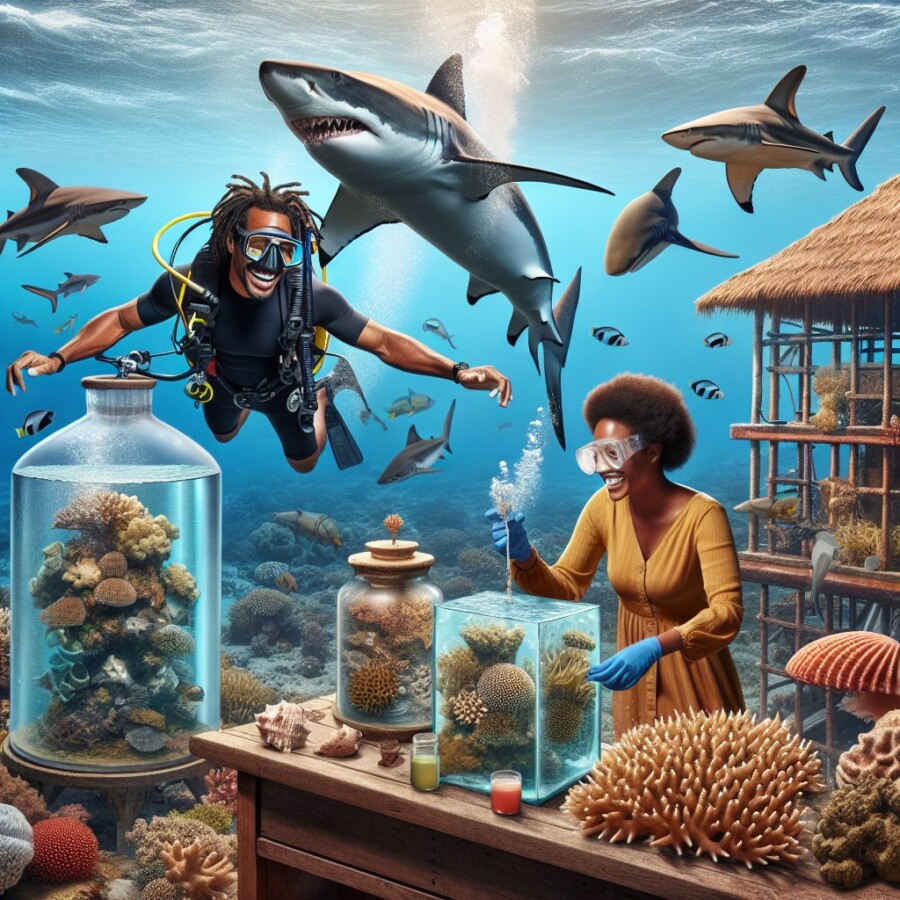
Reginald Beckford used to be scared of sharks, but now he's helping to protect the third-largest barrier reef in the world from a dangerous coral disease. The Turks and Caicos Islands, where Reginald lives, got hit by a disease called stony coral tissue loss disease (SCTLD) in 2019. It spread quickly and is now in 28 countries in the Caribbean. Reginald and other volunteers from the TC Reef Fund are working hard to stop the disease from spreading by putting a special medicine on the infected corals. This medicine doesn't stop the corals from getting sick again, but it gives them enough time to have babies before they die.
Arenthia Baker used to be a teacher, but now she helps fight against SCTLD after moving to the islands from Florida. She volunteers with the Reef Fund as a fish scientist and diving expert. Even though the reef has a lot of problems, like coral bleaching from warm water, Arenthia stays positive about their ability to fight SCTLD. Scientists at the Smithsonian's National Museum of Natural History found a special bacteria that can help treat the disease. This is good news because using antibiotics too much can make bacteria resistant to them.
The Turks and Caicos Islands are doing a lot of research to restore the reef. They made two special places in the water to grow new corals and a special building on land to keep healthy coral pieces. This is the first building like this in the British Caribbean islands. The building, paid for by the John Ellerman Foundation, keeps the coral pieces safe until they can be put back on the reef. It's important to keep different types of corals safe because they have different genes. The Reef Fund's leader, Alizee Zimmermann, makes sure the corals have everything they need to grow. They even made special tanks to hold the most at-risk coral species, like a "coral ark." The team also makes fake seawater with the right stuff to help the corals grow.
Alizee Zimmermann really cares about the corals and can tell if they're happy or hungry. The corals get food from algae that live in them, and the team also feeds them special food made from conch and algae. Even though the reef has a lot of problems, the work of volunteers like Reginald and Arenthia, along with the new discoveries in research, give hope for the future of the coral reef ecosystem.
Original news source: Coral reef: How divers are using antibiotics to save sick corals (BBC)
🎧 Listen:
📖 Vocabulary:
Group or Classroom Activities
Warm-up Activities:
– News Summary
Instructions: Divide the students into pairs. Give each pair a few minutes to read the article. Then, ask them to summarize the main points of the article in their own words. Afterward, have each pair share their summaries with the class.
– Opinion Poll
Instructions: Divide the students into small groups. Assign each group a specific topic related to the article (e.g. coral bleaching, coral restoration, volunteer work). In their groups, have the students discuss their opinions on the topic and come up with a list of reasons to support their opinions. Then, ask each group to present their opinions and reasons to the class, and facilitate a class discussion based on the different viewpoints.
– Vocabulary Pictionary
Instructions: Write a list of key vocabulary words from the article on the board. Divide the students into pairs or small groups. Give each group a set of vocabulary words. One student from each group will choose a word and draw a picture representing that word, while the other student(s) guess what the word is. Encourage the use of English only during the activity.
– Headline Creation
Instructions: Divide the students into pairs or small groups. Ask them to create catchy headlines for the article, using their creativity and the main ideas from the text. Afterward, have each group share their headlines with the class and discuss the different approaches they took.
– Future Predictions
Instructions: Have a class discussion about the future of coral reefs and the actions being taken to protect them. Ask the students to make predictions about the future of coral reefs based on the information in the article. They can discuss potential challenges, advancements in research, or possible outcomes. Encourage the students to provide reasons for their predictions and engage in a lively discussion.
🤔 Comprehension Questions:
🎧✍️ Listen and Fill in the Gaps:
Beckford used to be scared of sharks, but now he's helping to protect the third-largest barrier reef in the world from a dangerous coral . The Turks and Islands, where Reginald lives, got hit by a disease called stony coral tissue loss disease (SCTLD) in 2019. It spread quickly and is now in 28 countries in the Caribbean. Reginald and other volunteers from the TC Reef Fund are working hard to stop the disease from spreading by putting a special medicine on the corals. This medicine doesn't stop the corals from getting sick again, but it gives them enough time to have babies before they die. Arenthia Baker used to be a teacher, but now she helps fight against SCTLD after moving to the islands from . She volunteers with the Reef Fund as a fish scientist and diving expert. Even though the reef has a lot of problems, like coral bleaching from warm water, Arenthia stays positive about their to fight SCTLD. Scientists at the Smithsonian's Museum of Natural History found a special that can help treat the disease. This is good news because using antibiotics too much can make bacteria resistant to them. The and Caicos Islands are doing a lot of research to restore the reef. They made two special places in the water to grow new and a special building on land to keep healthy pieces. This is the first building like this in the British Caribbean islands. The building, paid for by the John Ellerman Foundation, keeps the coral pieces safe until they can be put back on the reef. It's important to keep different types of corals safe because they have different genes. The Reef Fund's , Alizee Zimmermann, makes sure the corals have everything they need to grow. They even made special tanks to hold the most at-risk coral species, like a "coral ark." The team also makes fake seawater with the stuff to help the corals grow. Alizee Zimmermann really about the corals and can tell if they're happy or hungry. The corals get food from algae that live in them, and the team also feeds them special food made from conch and algae. Even though the reef has a lot of problems, the work of volunteers like Reginald and , along with the new discoveries in research, give hope for the of the coral reef ecosystem.
💬 Discussion Questions:
1. What is stony coral tissue loss disease (SCTLD) and why is it dangerous for coral reefs?
2. How do volunteers like Reginald and Arenthia help protect the coral reef ecosystem?
3. Do you think it's important to protect coral reefs? Why or why not?
4. What are some of the problems that the coral reef in the Turks and Caicos Islands face?
5. How do scientists at the Smithsonian's National Museum of Natural History contribute to fighting against SCTLD?
6. What are some ways that the Turks and Caicos Islands are working to restore the reef?
7. Why is it important to keep different types of corals safe?
8. How does the Reef Fund leader, Alizee Zimmermann, ensure that the corals have everything they need to grow?
9. Do you think it's possible to make corals happy or hungry? Why or why not?
10. How do corals get their food and what special food do the volunteers feed them?
11. How does the work of volunteers and new research discoveries give hope for the future of the coral reef ecosystem?
12. Have you ever seen a coral reef in person? If so, what was your experience like?
13. How would you feel if you were a volunteer helping to protect coral reefs?
14. Do you like marine life? Why or why not?
15. What do you think is the biggest threat to coral reefs around the world? Why?
Individual Activities
📖💭 Vocabulary Meanings:
Click a dot next to a word, then click the dot next to its meaning to draw a line connecting them.
Words
Meanings
🔡 Multiple Choice Questions:
🕵️ True or False Questions:
📝 Write a Summary:
Write a summary of this news article in two sentences.
Check your writing now with the best free AI for English writing!