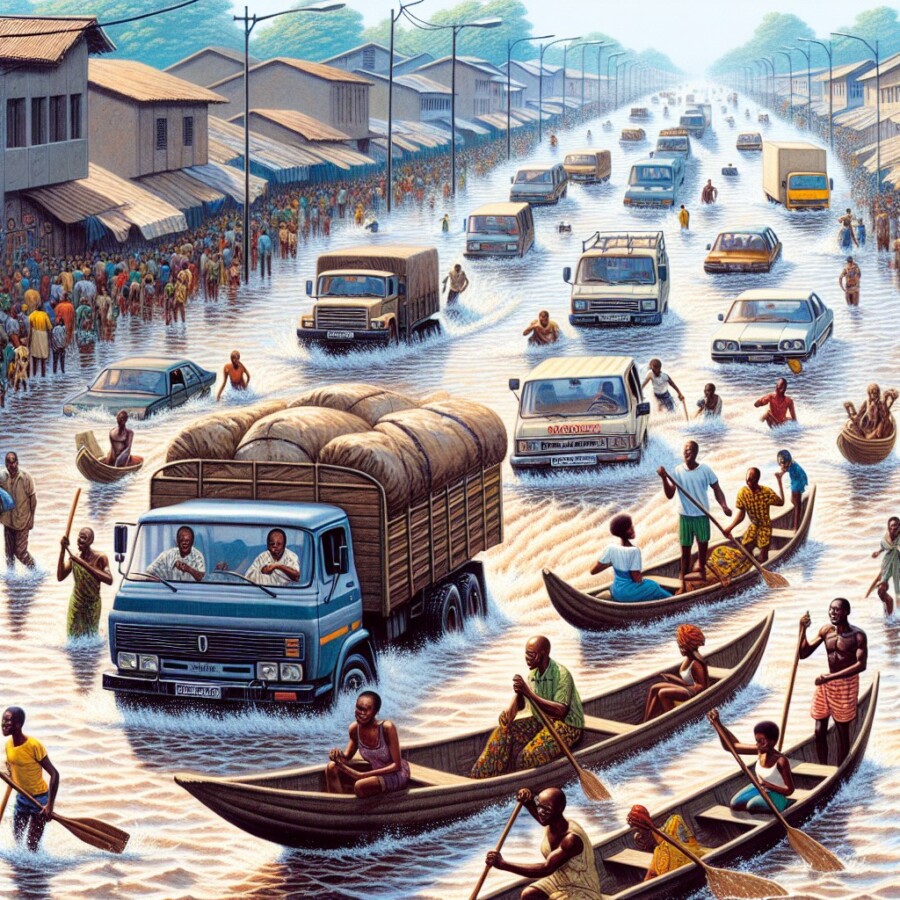
Big water has come to a big city called Kinshasa. The city is in a place called the Democratic Republic of Congo. The water is very high, higher than it has been in a long, long time. People's houses are full of water, and they are using boats on the roads. Many people have died because of the water, and schools and hospitals are gone.
The city has little rivers that are very dirty and make the flooding worse. The big river is almost as high as it was a very long time ago. Houses in another city are under water too. The water has also gone to a place next door and made many people there have problems. The world getting warmer is making it rain too much, and this has happened before in Kinshasa.
Original news source: DR Congo floods: Chaos in Kinshasa as river rises to near-record level (BBC)
🎧 Listen:
📖 Vocabulary:
Group or Classroom Activities
Warm-up Activities:
– Charades
Instructions: Divide the class into two teams. Write down key words from the article on small pieces of paper and put them in a hat. One student from each team will take turns picking a word from the hat and acting it out without speaking. The team members will try to guess the word. The team with the most correct guesses wins.
– Vocabulary Pictionary
Instructions: Divide the class into pairs. Give each pair a list of key vocabulary words from the article. One student will choose a word and draw a picture to represent it, while the other student tries to guess the word. They should switch roles after each word. The pair with the most correct guesses wins.
– Word Association
Instructions: Write down key vocabulary words from the article on the board. Give each student a piece of paper and ask them to write down as many words as they can think of that are associated with the words on the board. For example, if one word is "flooding", students can write down words like "water", "rain", "disaster", etc. After a few minutes, have the students share their lists with a partner. Then, as a class, discuss the different associations and create a word association web on the board.
– Speed Summarizing
Instructions: Divide the class into pairs. Give each pair a copy of the article. One student will have one minute to summarize the article to their partner. The partner should listen and try to summarize it back to the first student. After one minute, they should switch roles. Encourage the students to use their own words and not read directly from the article. After both students have had a turn, ask a few pairs to share their summaries with the class.
– Headline Creation
Instructions: Divide the class into small groups. Give each group a blank sheet of paper and ask them to create a headline for the article. The headline should summarize the main idea of the article in just a few words. After a few minutes, have each group share their headline with the class. Discuss the different headlines and the reasons behind their choices.
🤔 Comprehension Questions:
The city of Kinshasa has been flooded by big water.
People are using boats on the roads because their houses are full of water.
The schools and hospitals in the city are gone because of the flooding.
The little rivers in the city are making the flooding worse because they are dirty and add more water.
The houses in another city are also under water because of the flooding.
People in the place next door are having problems because the water from Kinshasa has reached there too.
It is raining too much in Kinshasa because the world is getting warmer and this has happened before.
🎧✍️ Listen and Fill in the Gaps:
Big water has to a big city called Kinshasa. The city is in a called the Democratic Republic of Congo. The water is very high, higher than it has been in a long, long time. People's are full of water, and they are using boats on the roads. Many people have died because of the water, and schools and are gone. The city has little rivers that are very dirty and make the flooding worse. The big river is almost as high as it was a very time ago. Houses in another are under water too. The water has also to a place next door and made many people there have problems. The world warmer is making it rain too much, and this has happened before in Kinshasa.
💬 Discussion Questions:
1. What is Kinshasa?
2. How do you think people feel when their houses are full of water?
3. Do you like boats? Why or why not?
4. How do you think the flooding affects schools and hospitals?
5. What do you think makes the flooding worse in Kinshasa?
6. Do you know what a river is? Can you describe it?
7. How do you think the people in the other city feel when their houses are under water?
8. Do you think it's good or bad that the world is getting warmer? Why or why not?
9. Have you ever seen rain? How does it make you feel?
10. How do you think the people in the place next door feel about the water problems?
11. Do you think the flooding will happen again in Kinshasa? Why or why not?
12. What do you think can be done to help the people affected by the flooding?
Individual Activities
📖💭 Vocabulary Meanings:
Click a dot next to a word, then click the dot next to its meaning to draw a line connecting them.
Words
Meanings
🔡 Multiple Choice Questions:
🕵️ True or False Questions:
📝 Write a Summary:
Write a summary of this news article in two sentences.
Check your writing now with the best free AI for English writing!