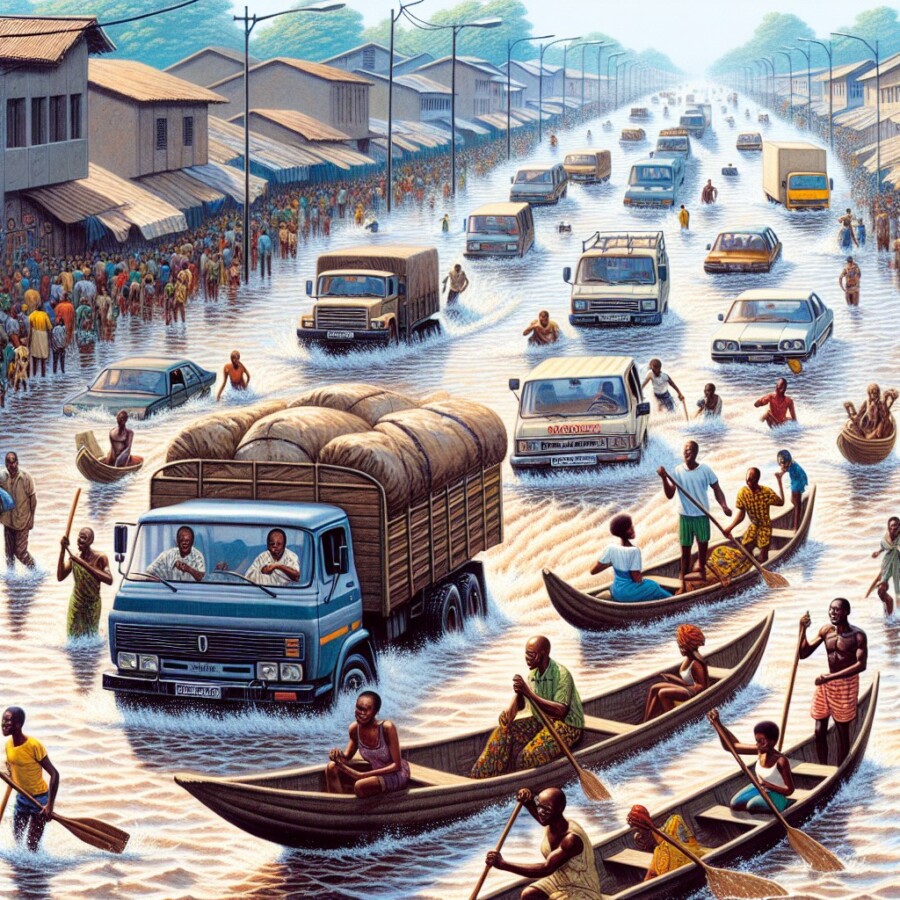
Floods in the Democratic Republic of Congo have caused chaos in the capital city of Kinshasa. The River Congo, which runs through the country, has reached its highest level in 60 years, resulting in water pouring into homes and submerged roads. Outside of the capital, other areas have also been affected by the flooding. Over 300 people have lost their lives in the floods over the past few months. Residents in Kinshasa have reported the destruction of schools, hospitals, and churches, with many losing their homes and belongings.
The situation in Kinshasa is dire, with residents describing their houses as being filled with water and essential facilities being destroyed. The city is home to several small rivers and streams that often double as open sewers, and many of these have now overflowed. People are using canoes to navigate the flooded streets, while trucks drive cautiously through the water. The River Congo has risen to a level just below the record flooding in 1961, causing further damage in other cities like Kisangani.
The flooding has not only affected the Democratic Republic of Congo but also neighboring Congo-Brazzaville. More than 336,000 people and 34 health facilities have been impacted by the floods in Congo-Brazzaville. Climate change is believed to be a contributing factor to the increased likelihood of extreme rainfall, which has led to the flooding. This is not the first time Kinshasa has experienced such devastating floods, as a similar event occurred just over a year ago, resulting in the loss of over 120 lives.
The situation in the Democratic Republic of Congo is a reminder of the devastating impact that climate change can have on vulnerable communities. It highlights the urgent need for global action to address climate change and mitigate its effects.
Original news source: DR Congo floods: Chaos in Kinshasa as river rises to near-record level (BBC)
🎧 Listen:
📖 Vocabulary:
Group or Classroom Activities
Warm-up Activities:
– News Summary
Instructions: Divide the class into small groups. Provide each group with a summary of the article, leaving out key details. Instruct each group to read the summary and fill in the missing information based on their understanding of the article. After a set amount of time, have each group share their completed summary with the class.
– Opinion Poll
Instructions: Instruct the students to form pairs or small groups. Assign each group a different topic related to the article, such as "The Impact of Climate Change" or "The Role of Government in Disaster Relief." Each group should brainstorm a set of questions related to their assigned topic. Then, have the groups conduct an opinion poll within the class, asking their classmates the questions they came up with. After gathering the responses, each group should analyze and present the results to the class.
– Sketch It
Instructions: Provide each student with a piece of paper and a pencil. Instruct them to choose a scene or aspect of the article that stood out to them and sketch it on the paper. After a set amount of time, have the students share their sketches with a partner or small group. Each student should then explain the significance of their chosen scene or aspect and engage in a discussion about the article based on their sketches.
– Vocabulary Pictionary
Instructions: Write a list of vocabulary words from the article on the board. Divide the class into two teams. One student from each team will come to the front of the class and choose a word from the list. Without speaking, the student must draw a picture that represents the word while their teammates try to guess what it is. The team that correctly guesses the word earns a point. Continue with different students and words until all the vocabulary words have been used.
– Pros and Cons
Instructions: Divide the class into two groups. Assign one group to argue the pros of taking immediate action to address climate change, and assign the other group to argue the cons. Give each group time to brainstorm their arguments and gather evidence from the article. Then, have a debate where each group takes turns presenting their points and countering the opposing group's arguments. Encourage the students to use persuasive language and evidence from the article to support their claims.
🤔 Comprehension Questions:
The flooding in the Democratic Republic of Congo has caused chaos in the capital city of Kinshasa, with water pouring into homes and submerged roads.
The River Congo has reached its highest level in 60 years due to extreme rainfall, which is believed to be a result of climate change.
Residents in Kinshasa have reported the destruction of schools, hospitals, and churches, with many losing their homes and belongings.
People in Kinshasa are using canoes to navigate the flooded streets, while trucks drive cautiously through the water.
Other cities, such as Kisangani, have also been affected by the flooding in the Democratic Republic of Congo.
In Congo-Brazzaville, more than 336,000 people and 34 health facilities have been impacted by the floods.
Climate change is believed to be a contributing factor to the increased likelihood of extreme rainfall and flooding.
The situation in the Democratic Republic of Congo is a reminder of the impact of climate change because it highlights the devastating effects it can have on vulnerable communities and the urgent need for global action to address it.
🎧✍️ Listen and Fill in the Gaps:
Floods in the Democratic Republic of have caused chaos in the capital city of Kinshasa. The River Congo, which runs through the country, has its highest level in 60 years, resulting in pouring into homes and submerged roads. Outside of the capital, other have also been affected by the flooding. Over 300 people have lost their lives in the floods over the past few months. Residents in Kinshasa have reported the destruction of schools, hospitals, and churches, with many losing their homes and belongings. The situation in Kinshasa is dire, with residents describing their houses as being filled with water and facilities being destroyed. The city is home to several small rivers and streams that often double as open sewers, and many of these have now . are using canoes to navigate the flooded streets, while trucks cautiously through the water. The River Congo has risen to a level just below the record in 1961, causing further damage in other cities like Kisangani. The flooding has not only affected the Republic of Congo but also Congo-Brazzaville. More than 336,000 people and 34 health facilities have been impacted by the floods in Congo-Brazzaville. Climate change is believed to be a contributing to the increased likelihood of extreme rainfall, which has led to the flooding. This is not the first time Kinshasa has experienced such devastating , as a similar event occurred just over a year ago, resulting in the loss of over 120 lives. The situation in the Democratic Republic of Congo is a reminder of the devastating impact that climate change can have on communities. It highlights the need for global to address climate change and mitigate its effects.
💬 Discussion Questions:
1. How do you think the residents of Kinshasa are feeling right now?
2. What do you think is the biggest challenge for the people affected by the flooding?
3. How would you feel if your home was destroyed by a natural disaster like a flood?
4. Do you think enough is being done to address climate change and prevent these types of disasters? Why or why not?
5. What do you think are the long-term effects of flooding on a community?
6. How would you feel if you lost all of your belongings in a flood?
7. Do you think the government should provide assistance to the people affected by the flooding? Why or why not?
8. What measures do you think could be taken to prevent or minimize the impact of flooding in vulnerable areas?
9. How do you think the flooding in the Democratic Republic of Congo will affect the economy of the country?
10. Have you ever experienced a natural disaster? If so, how did it impact your life?
11. What do you think are the most important things for a community to do after a natural disaster like a flood?
12. How would you feel if you had to evacuate your home because of a flood?
13. Do you think the international community has a responsibility to help countries affected by climate change-related disasters? Why or why not?
14. What do you think are the biggest challenges in rebuilding a community after a natural disaster?
15. How do you think the flooding in the Democratic Republic of Congo will impact the mental health of the affected residents?
Individual Activities
📖💭 Vocabulary Meanings:
Click a dot next to a word, then click the dot next to its meaning to draw a line connecting them.
Words
Meanings
🔡 Multiple Choice Questions:
🕵️ True or False Questions:
📝 Write a Summary:
Write a summary of this news article in two sentences.
Check your writing now with the best free AI for English writing!