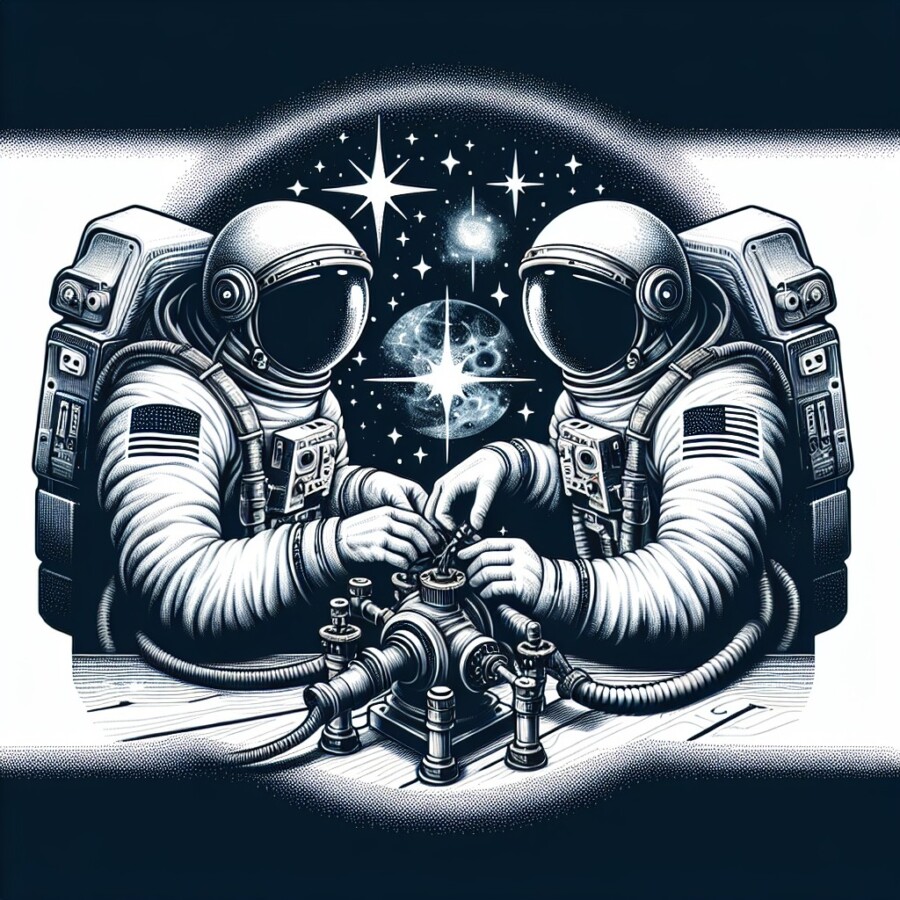
Some men who flew very far away from our world, farther than anyone else, are now very old or have passed away. There are only eight of these space travelers left. One of them, Buzz Aldrin, was the second man to walk on the Moon. He likes to talk about space and has traveled to very cold places on Earth. Another man, Bill Anders, took a very famous picture of our world from space that made many people want to take care of the Earth.
Charlie Duke walked on the Moon and helped his friends land there safely. Fred Haise was on a space trip that had a big problem, but he was okay. James Lovell is the oldest of these space travelers now. Harrison Schmitt studied rocks and was the last to go to the Moon, and he also helped make laws. David Scott drove a special car on the Moon, and Tom Stafford made sure everything was ready for the first Moon landing.
Original news source: The last of the Moon men: the stories of the surviving Apollo astronauts (BBC)
🎧 Listen:
📖 Vocabulary:
Group or Classroom Activities
Warm-up Activities:
– Charades
Instructions: Divide the class into two teams. Write the names of the space travelers on separate pieces of paper and put them in a hat. One student from each team will take turns picking a name from the hat and acting out the space traveler without speaking. The team members will try to guess the name of the space traveler before the time runs out.
– Vocabulary Pictionary
Instructions: Give each student a piece of paper and ask them to draw a picture that represents one of the space travelers. They should not write any words or letters on their drawing. After a few minutes, collect the drawings and display them for the class. Have the students take turns guessing which space traveler each drawing represents.
– Keyword Hangman
Instructions: Write the names of the space travelers on the board, leaving out some of the letters. Divide the class into two teams. Call on one student from each team to guess a letter. If the letter is in the name, write it in the correct place. If not, draw one part of the hangman. The team that correctly guesses the name first wins.
– Speed Summarizing
Instructions: Divide the class into pairs. Give each pair a copy of the article. Set a timer for two minutes and have the students take turns summarizing the article to their partner. After the two minutes, have the pairs switch roles and summarize again. Repeat this process a few times, gradually reducing the time to challenge the students to summarize faster.
– Think-Pair-Share
Instructions: Ask the students to think about one thing they found interesting or surprising in the article. Then, have them pair up with a partner and share their thoughts. After a few minutes, ask some pairs to share their discussions with the whole class. Encourage the students to ask questions or make comments about their classmates' thoughts.
🤔 Comprehension Questions:
Buzz Aldrin.
He took a famous picture of our world from space.
Charlie Duke.
James Lovell.
He studied rocks.
He drove a special car.
He made sure everything was ready.
🎧✍️ Listen and Fill in the Gaps:
Some men who flew very far away from our world, farther than anyone else, are now very old or have passed away. There are only eight of these space travelers left. One of them, , was the second man to walk on the Moon. He likes to talk about space and has traveled to very cold places on Earth. Another man, Bill , took a very famous picture of our world from space that made many people want to take of the Earth. Charlie Duke walked on the Moon and helped his friends land there safely. Fred Haise was on a trip that had a big problem, but he was okay. Lovell is the oldest of these space travelers now. Harrison Schmitt studied rocks and was the last to go to the Moon, and he also helped make laws. David Scott drove a special car on the Moon, and Tom Stafford made sure everything was for the Moon landing.
💬 Discussion Questions:
1. What is a space traveler?
2. How would you feel if you could travel to space?
3. Do you like looking at pictures of space?
4. What do you think it would be like to walk on the Moon?
5. Why do you think Buzz Aldrin likes to talk about space?
6. What is a famous picture of our world from space?
7. How would you feel if you saw the Earth from space?
8. Why do you think many people want to take care of the Earth after seeing the picture from space?
9. What do you think it means to help your friends land safely on the Moon?
10. Do you think it would be scary to be in space if there was a big problem?
11. Why do you think Harrison Schmitt studied rocks on the Moon?
12. What do you think it means to make laws?
Individual Activities
📖💭 Vocabulary Meanings:
Click a dot next to a word, then click the dot next to its meaning to draw a line connecting them.
Words
Meanings
🔡 Multiple Choice Questions:
🕵️ True or False Questions:
📝 Write a Summary:
Write a summary of this news article in two sentences.
Check your writing now with the best free AI for English writing!