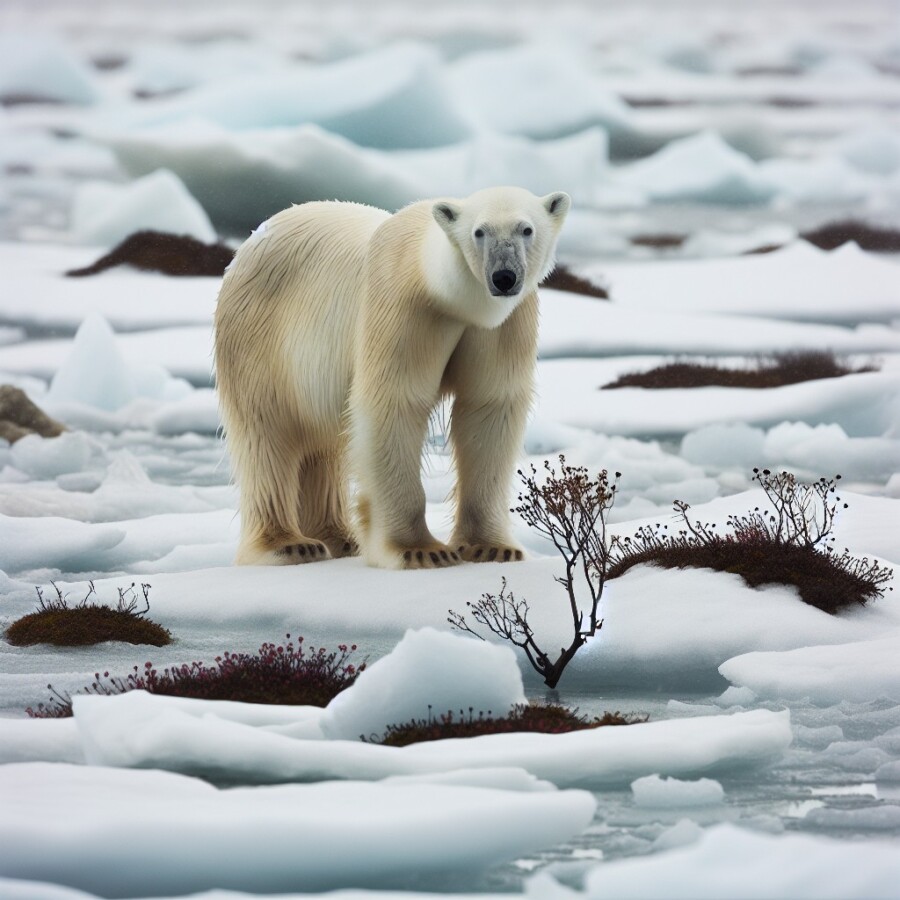
Scientists have found that polar bears are in danger of starving because the ice in the Arctic is melting. These bears usually eat seals that they catch on ice floes, but as the ice melts, they are spending more time on land and eating things like bird's eggs, berries, and grass. Unfortunately, these alternative foods are not enough for the bears to stay healthy, and they are losing weight quickly. The loss of sea ice is the biggest threat to polar bears and their survival.
A recent study in Western Manitoba showed that the time without ice has increased by three weeks between 1979 and 2015. To understand how polar bears are surviving without ice, scientists tracked the activities of 20 bears for three years. The bears had GPS-equipped cameras on their collars, which allowed the scientists to see where they went, what they did, and what they ate. During the summer months without ice, the bears tried different ways to survive, like conserving energy or looking for plants and berries. But none of these strategies worked, and 19 out of 20 bears lost weight.
Dr. Anthony Pagano, the lead author of the study, said that no matter what the bears did, it didn't help them survive on land. Polar bears can't adapt to eating plants like other bears can, so their situation is very serious. The study also found that two out of three bears that went into the water found dead animals to eat, but they were too tired to eat for a long time. These findings show that polar bears are having a hard time dealing with climate change.
Although this study focused on one area, scientists think that the effects of climate change on polar bears will be different in other places. It's likely that polar bears will disappear from areas where the ice is lost in the future, but it's hard to say when and where this will happen. Some places may still be good for bears for many years. However, if the ice keeps melting like it's predicted to, the conditions in the study area will become very difficult for bears very soon. This study shows that we need to take action to stop climate change and protect the Arctic.
Original news source: Polar bears face starvation threat as ice melts (BBC)
🎧 Listen:
📖 Vocabulary:
Group or Classroom Activities
Warm-up Activities:
– News Summary
Instructions:
1. Divide the class into small groups.
2. Give each group a copy of the article.
3. Instruct the groups to read the article and summarize the main points in 3-4 sentences.
4. Each group will then present their summary to the class.
– Vocabulary Pictionary
Instructions:
1. Write down 10 key vocabulary words from the article on separate pieces of paper.
2. Divide the class into pairs.
3. Give each pair a set of vocabulary words.
4. One student from each pair will choose a word and draw a picture to represent that word, while the other student guesses the word.
5. Set a time limit for each round and have the pairs switch roles after each round.
6. The pair with the most correct guesses wins.
– Sketch It
Instructions:
1. Divide the class into small groups.
2. Give each group a whiteboard or a large piece of paper and markers.
3. Instruct the groups to choose a scene or moment from the article and sketch it on the whiteboard or paper.
4. Each group will then present their sketch to the class and explain the significance of their chosen scene.
– Pros and Cons
Instructions:
1. Divide the class into small groups.
2. Assign each group a specific role: scientists, environmentalists, policymakers, or local communities.
3. Instruct each group to discuss and list the pros and cons of taking action to stop climate change and protect the Arctic from the perspective of their assigned role.
4. After the discussion, each group will present their pros and cons to the class and engage in a debate.
– Opinion Poll
Instructions:
1. Divide the class into pairs or small groups.
2. Give each pair/group a set of statements related to climate change and the protection of the Arctic.
3. Instruct the pairs/groups to discuss each statement and decide whether they agree or disagree.
4. After the discussion, conduct a class poll by having each pair/group share their opinions and tallying the number of agree and disagree responses for each statement.
5. Discuss the results as a class and encourage students to explain their reasoning.
🤔 Comprehension Questions:
Polar bears are in danger of starving because the ice in the Arctic is melting, which means they have less time to catch seals, their main source of food.
As the ice melts, polar bears are eating things like bird's eggs, berries, and grass as alternative foods.
These alternative foods are not enough for the bears to stay healthy because they don't provide the same amount of nutrients and energy as seals do.
The time without ice in Western Manitoba has increased by three weeks between 1979 and 2015.
Scientists tracked the activities of the polar bears in the study by attaching GPS-equipped cameras to their collars, which allowed them to see where the bears went, what they did, and what they ate.
During the summer months without ice, the bears tried strategies like conserving energy and looking for plants and berries to survive.
The bears couldn't adapt to eating plants like other bears because polar bears have a different digestive system and cannot get enough nutrients from plants alone.
Scientists think that polar bears will disappear from areas where the ice is lost in the future. However, it is difficult to predict exactly when and where this will happen. Some areas may still be suitable for polar bears for many years, but if the ice continues to melt, conditions will become very difficult for them.
🎧✍️ Listen and Fill in the Gaps:
Scientists have that polar bears are in danger of because the ice in the Arctic is melting. These bears usually eat that they catch on ice floes, but as the ice melts, they are more time on land and eating things like bird's eggs, berries, and grass. Unfortunately, these alternative foods are not enough for the bears to stay healthy, and they are losing weight quickly. The loss of sea ice is the biggest threat to polar bears and their survival. A recent study in Western Manitoba showed that the time without ice has increased by three weeks between 1979 and 2015. To understand how polar bears are without ice, scientists tracked the activities of 20 bears for three years. The bears had GPS-equipped cameras on their collars, which allowed the scientists to see where they went, what they did, and what they ate. During the summer months without ice, the bears different ways to survive, like conserving or looking for plants and . But none of these strategies worked, and 19 out of 20 bears lost . Dr. Anthony Pagano, the lead author of the study, said that no matter what the bears did, it didn't help them survive on land. Polar bears can't to eating plants like other bears can, so their situation is very serious. The study also found that two out of three bears that went into the water found dead animals to eat, but they were too tired to eat for a long time. These findings show that polar bears are having a hard time with change. Although this study focused on one area, scientists think that the effects of climate change on bears will be different in other places. It's likely that polar bears will disappear from areas where the ice is lost in the future, but it's hard to say when and where this will happen. Some places may still be good for bears for many . However, if the ice keeps like it's predicted to, the in the study area will become very difficult for bears very soon. This study shows that we need to take action to stop climate change and protect the Arctic.
💬 Discussion Questions:
1. What is a polar bear?
2. How would you feel if you were a polar bear and couldn't find enough food to eat?
3. Do you like studying about animals? Why or why not?
4. Do you think it's important to protect the Arctic? Why or why not?
5. How do you think climate change affects animals?
6. What do you think can be done to stop climate change?
7. Have you ever seen a polar bear? If so, where and when?
8. How do you think the loss of sea ice affects the polar bear's ability to hunt?
9. What are some alternative foods that polar bears eat when there is no ice?
10. How do you think the loss of sea ice affects the polar bear's weight?
11. Do you think it's fair that polar bears are losing their habitat because of climate change? Why or why not?
12. What do you think would happen if polar bears disappeared from the Arctic?
13. Have you ever seen any effects of climate change in your own country? If so, what were they?
14. How do you think climate change affects other animals besides polar bears?
15. What can individuals do to help protect the Arctic and stop climate change?
Individual Activities
📖💭 Vocabulary Meanings:
Click a dot next to a word, then click the dot next to its meaning to draw a line connecting them.
Words
Meanings
🔡 Multiple Choice Questions:
🕵️ True or False Questions:
📝 Write a Summary:
Write a summary of this news article in two sentences.
Check your writing now with the best free AI for English writing!