

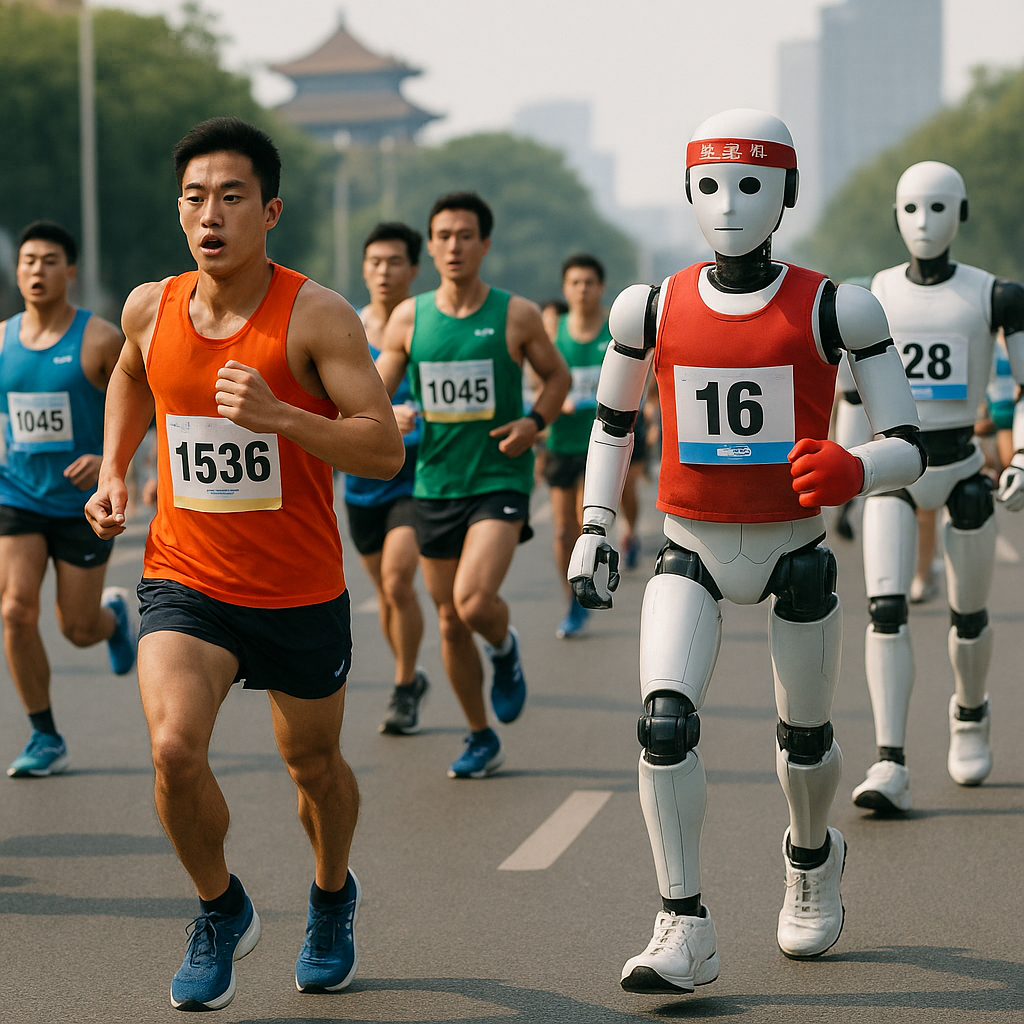
In China, there was a special race with people and robot runners. The race was very long, 21 kilometers, and happened in Beijing. Robots looked like people and couldn't use wheels to move. They ran just like humans do. This race showed how smart and advanced robots are becoming.
One robot named Tiangong Ultra did really well. It finished the race in two hours and 40 minutes. The fastest person finished much quicker, in one hour and two minutes. Tiangong was special because it had long legs and a smart way of running. People in China are excited about how good their robots are getting.
During the race, some robots had little accidents. One fell at the start, and another bumped into a railing. People helped the robots when they needed it. Some robots wore funny things like boxing gloves or a headband that said "Bound to Win." This race showed how China is making cool new robots that can do many things.
Original news source: China hosts world's first half-marathon race between humans and robots (Sky News)
🎧 Listen:
📖 Vocabulary:
Group or Classroom Activities
Warm-up Activities:
– CHARADES
Instructions: Students will act out different actions related to the article without speaking, such as "running," "helping a robot," or "wearing a headband." The other students will guess what they are acting out.
– OPINION POLL
Instructions: Students will walk around the classroom asking their classmates if they think robots will be better runners than humans in the future. They will collect answers and share the results with the class.
– VOCABULARY PICTIONARY
Instructions: Students will draw key vocabulary words from the article, such as "robot," "race," and "accident," on the board. The other students will guess the words based on the drawings.
– THINK-PAIR-SHARE
Instructions: Students will think about what they would like to see robots do in the future. They will pair up to discuss their ideas and then share them with the whole class.
– HEADLINE CREATION
Instructions: Students will work in small groups to create a catchy headline for the article, such as "Robots Race Humans in Beijing!" They will then present their headlines to the class.
🤔 Comprehension Questions:
The race happened in Beijing, China.
The race was 21 kilometers long.
The robot's name is Tiangong Ultra.
Tiangong Ultra took two hours and 40 minutes to finish.
Some robots wore boxing gloves and a headband that said "Bound to Win."
People helped the robots when they had accidents.
People in China are excited because their robots are getting better and smarter.
🎧✍️ Listen and Fill in the Gaps:
In China, there was a special race with people and robot . The race was very long, 21 kilometers, and happened in Beijing. Robots looked like people and couldn't use wheels to . They ran just like humans do. This race showed how smart and advanced s are becoming. One robot named Tiangong Ultra did really well. It finished the race in two s and 40 minutes. The fastest person finished much quicker, in one hour and two minutes. Tiangong was special because it had long legs and a smart way of running. People in China are excited about how their are getting. During the race, some robots had little accidents. One fell at the start, and another bumped into a railing. People helped the robots when they needed it. Some robots wore funny things like boxing or a headband that said "Bound to Win." This showed how China is making cool new robots that can do many things.
💬 Discussion Questions:
1. What is a robot?
2. Do you like robots? Why or why not?
3. How would you feel if you saw a robot running?
4. What is your favorite sport?
5. Do you think robots can be good at sports? Why?
6. Have you ever seen a race? What was it like?
7. How would you feel if a robot fell down during a race?
8. Do you think it is fun to help a robot? Why or why not?
9. What is something funny you have seen?
10. Do you like running? Why or why not?
11. How would you feel if you could race a robot?
12. Do you think robots will be better than people at running one day? Why?
Individual Activities
📖💭 Vocabulary Meanings:
Click a dot next to a word, then click the dot next to its meaning to draw a line connecting them.
Words
Meanings
🔡 Multiple Choice Questions:
🕵️ True or False Questions:
📝 Write a Summary:
Write a summary of this news article in two sentences.
Check your writing now with the best free AI for English writing!