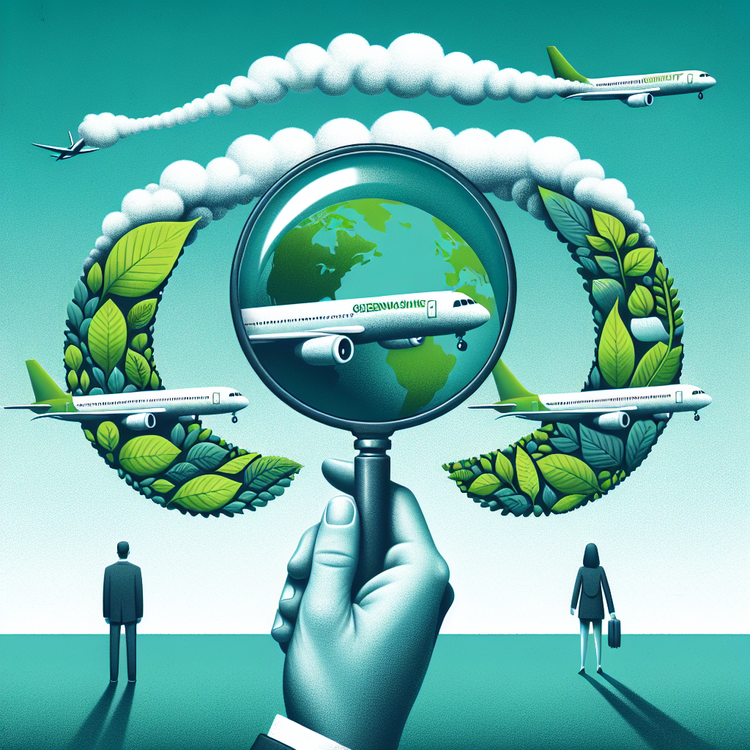
Adverts for Air France, Lufthansa, and Etihad have been banned by the Advertising Standards Authority (ASA) for misleading consumers about the airlines' environmental impact. The ASA found that the ads did not accurately depict the airlines' contribution to climate change. Air France's ad claimed to be committed to protecting the environment, while Lufthansa urged passengers to "fly more sustainably." Etihad's ad used the words "environmental advocacy." The ASA investigates companies suspected of "corporate greenwashing," which is when companies overstate their environmental friendliness.
Lufthansa explained that the phrase "fly more sustainably" referred to its "Green Fares" option, which uses sustainable aviation fuel and contributes to climate protection projects. The airline aims to be carbon neutral by 2050 and has decided to remove the phrase from future ads. Etihad Airways immediately removed all references to "environmental advocacy" from its ads after receiving the complaint. The ASA detected the misleading adverts using an artificial intelligence system designed to identify potential rule violations.
This is not the first time Lufthansa has been called out for greenwashing. In a previous campaign, the airline misled consumers into thinking it had already taken steps to minimize its environmental impact. The ASA upheld the decision, stating that air travel produces high levels of CO2 and non-CO2 emissions that contribute significantly to climate change. The ASA has also banned adverts from other companies, including Persil, HSBC, Shell, Innocent, Oatly, Golden Leaves, and JC Atkinson & Son, for greenwashing.
Companies are facing increasing scrutiny to reduce their carbon emissions, with airlines being particularly pressured to lower their environmental footprint. In November, a transatlantic flight powered solely by sustainable aviation fuels demonstrated that greener flying is possible. However, sustainable aviation fuels currently account for less than 0.1% of global aviation fuel consumption, and there are no dedicated commercial plants in the UK. The UK government plans to require 10% of aviation fuel to be sustainable by 2030.
Original news source: Airline adverts banned over 'greenwashing' claims (BBC)
🎧 Listen:
📖 Vocabulary:
Group or Classroom Activities
Warm-up Activities:
– News Summary
Instructions: Divide the class into pairs. Give each pair a few minutes to read the article. Then, have one person in each pair summarize the main points of the article to their partner. Afterward, have the pairs switch roles and summarize the article again. Encourage them to use their own words and focus on the key information.
– Opinion Poll
Instructions: Divide the class into small groups. Assign each group a specific airline from the article (Air France, Lufthansa, or Etihad). Have the groups discuss and debate their opinions on whether they believe the airline's advertisements were misleading or not. Each group should come up with at least three reasons to support their opinion. Then, have each group share their opinions and reasons with the rest of the class.
– Vocabulary Pictionary
Instructions: Write down 10 key vocabulary words from the article on separate pieces of paper. Divide the class into teams. One person from each team will come to the front of the class and choose a word from the pile without showing it to their team. They must then draw a picture to represent the word while their team tries to guess the word. The first team to correctly guess the word gets a point. Continue until all the words have been drawn.
– Pros and Cons
Instructions: Divide the class into two groups. Assign one group to argue the pros of advertising an airline's environmental friendliness, while the other group argues the cons. Give each group a few minutes to brainstorm their arguments. Then, have a debate where each group presents their arguments and counters the other group's points. Encourage critical thinking and the use of evidence to support their claims.
– Future Predictions
Instructions: In pairs, have students discuss and make predictions about the future of airline advertising and environmental impact. They should consider how the pressure to reduce carbon emissions might affect the way airlines promote themselves. After a few minutes, have pairs share their predictions with the rest of the class. Encourage them to support their predictions with reasoning based on the article and their own knowledge.
🤔 Comprehension Questions:
🎧✍️ Listen and Fill in the Gaps:
Adverts for Air France, Lufthansa, and have been banned by the Advertising Standards Authority (ASA) for misleading consumers about the airlines' environmental . The ASA found that the ads did not accurately depict the airlines' contribution to climate change. Air France's ad to be committed to protecting the environment, while Lufthansa urged passengers to "fly more sustainably." Etihad's ad used the words "environmental advocacy." The ASA investigates suspected of "corporate greenwashing," which is when companies overstate their environmental friendliness. Lufthansa that the phrase "fly more sustainably" referred to its "Green Fares" , which uses sustainable aviation fuel and contributes to protection projects. The airline aims to be carbon by 2050 and has decided to remove the phrase from future ads. Etihad Airways immediately removed all references to "environmental advocacy" from its ads after receiving the complaint. The ASA detected the misleading adverts using an artificial intelligence system designed to identify potential rule violations. This is not the first time Lufthansa has been called out for greenwashing. In a previous campaign, the misled consumers into thinking it had already steps to minimize its environmental impact. The ASA upheld the decision, stating that air travel produces high of CO2 and non-CO2 emissions that contribute significantly to climate change. The ASA has also banned adverts from other companies, including Persil, HSBC, , Innocent, Oatly, Golden Leaves, and JC Atkinson & Son, for greenwashing. Companies are increasing scrutiny to reduce their carbon emissions, with airlines being particularly pressured to lower their environmental . In November, a transatlantic flight solely by sustainable aviation fuels demonstrated that flying is possible. However, sustainable aviation fuels currently account for less than 0.1% of global aviation fuel consumption, and there are no dedicated commercial plants in the UK. The UK government plans to require 10% of aviation fuel to be sustainable by 2030.
💬 Discussion Questions:
1. What is your opinion on companies that engage in greenwashing?
2. How would you feel if you discovered that an advertisement you believed was environmentally friendly was actually misleading?
3. Do you think it's important for companies to be transparent about their environmental impact? Why or why not?
4. Have you ever been influenced by an advertisement that claimed to be environmentally friendly? How did you feel when you found out it was misleading?
5. What steps do you think companies should take to ensure they are not engaging in greenwashing?
6. How do you think the use of artificial intelligence to detect misleading advertisements will impact the advertising industry?
7. Do you think the ASA's decision to ban these advertisements will have a significant impact on the airlines' reputations? Why or why not?
8. How do you think the increasing scrutiny on companies to reduce their carbon emissions will affect the future of advertising?
9. What measures do you think airlines should take to lower their environmental footprint?
10. Have you ever made a purchasing decision based on a company's environmental claims? How important are these claims to you?
11. Do you think sustainable aviation fuels will become more widely used in the future? Why or why not?
12. How do you think the UK government's plan to require 10% of aviation fuel to be sustainable by 2030 will impact the airline industry?
13. How would you feel if you discovered that a company you regularly supported was engaging in greenwashing?
14. Do you think consumers have a responsibility to research and verify companies' environmental claims before making a purchase? Why or why not?
15. What role do you think advertising plays in shaping public perception of a company's environmental impact?
Individual Activities
📖💭 Vocabulary Meanings:
Click a dot next to a word, then click the dot next to its meaning to draw a line connecting them.
Words
Meanings
🔡 Multiple Choice Questions:
🕵️ True or False Questions:
📝 Write a Summary:
Write a summary of this news article in two sentences.
Check your writing now with the best free AI for English writing!