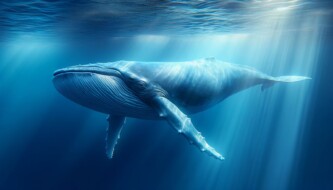
The researchers used underwater audio recording to study the blue whales. They fixed a "sound trap" to the seabed near the Seychelles and left it in place for a year, recording 15 minutes of every hour, every day. Although they did not hear the blue whales during their expedition, analysis of the recordings revealed that the whales were present and communicating during certain months, particularly March and April. The researchers believe that the Seychelles could be an important breeding or nursery area for the blue whales.
The blue whale's song is so deep and low-frequency that it is beyond the range of human hearing. However, researchers can detect the higher frequency sounds, known as harmonics, that accompany the whale's song. These harmonics create a low, deep, and consistent pulse that is the loudest sustained sound in the animal kingdom. Blue whales use these sounds to communicate over long distances in the water.
Conservation scientists are interested in understanding the importance of the Seychelles for blue whales. The area around the islands has been protected, and the Seychelles government has committed to protecting 30% of its national waters. This is crucial for safeguarding important areas for blue whales and other marine species. Noise pollution from human activities is a major concern, as it can disrupt the communication and behavior of blue whales. The Seychelles, with its relatively low ship traffic, could provide a safe and quiet haven for these magnificent creatures.
Original news source: Blue whales: Ocean giants return to 'safe' tropical haven (BBC)
📖 Vocabulary:
Group or Classroom Activities
Warm-up Activities:
– Charades
Instructions: Divide the class into small groups. Give each group a slip of paper with a word or phrase related to the article (e.g. blue whale, whaling, Seychelles). One person from each group will act out the word or phrase without speaking, and the rest of the group has to guess what it is.
– News Summary
Instructions: Ask the students to read the article individually. After they have finished, have them write a summary of the article in their own words. Then, divide the class into pairs and have them share and compare their summaries. Finally, ask a few pairs to share their summaries with the whole class.
– Opinion Poll
Instructions: Write a question related to the article on the board (e.g. "Do you think the discovery of blue whales in the Seychelles is a significant conservation win?"). Ask each student to write down their opinion and a brief explanation. Then, have them pair up and share their opinions and explanations. After that, conduct a class discussion where students can share their opinions and debate the topic.
– Vocabulary Pictionary
Instructions: Divide the class into pairs. Give each pair a list of vocabulary words from the article (e.g. whaling, decimated, harmonics). One person from each pair will choose a word and draw a picture to represent it, while the other person has to guess the word. Set a time limit for each round and rotate roles after each round. The pair with the most correct guesses wins.
– Two Truths and a Lie
Instructions: Ask each student to come up with two true statements and one false statement related to the article. Then, divide the class into small groups and have them take turns sharing their statements. The other group members have to guess which statement is the lie. This activity encourages students to use their comprehension skills and think critically about the content of the article.
🤔 Comprehension Questions:
🎧✍️ Listen and Fill in the Gaps:
Blue whales, the largest animals on Earth, have returned to a part of the Ocean where they were previously out by whaling. Researchers and filmmakers in the Seychelles captured footage of the whales in 2020 and 2021, suggesting that they may be in the region. This is a significant conservation win, as the blue whale population was decimated by the Soviet whaling fleet in the 1960s. Blue whales are still endangered, with their being only a fraction of what they once were. However, the discovery of their presence in the Seychelles is incredibly exciting. The used underwater audio recording to study the blue . They fixed a "sound trap" to the seabed near the Seychelles and left it in place for a year, recording 15 minutes of every hour, every day. Although they did not hear the blue whales during their expedition, analysis of the recordings that the whales were present and communicating during certain , particularly March and April. The researchers believe that the Seychelles could be an breeding or nursery area for the blue whales. The blue whale's song is so deep and low-frequency that it is beyond the range of human hearing. However, researchers can detect the higher frequency , known as harmonics, that the whale's song. These harmonics create a low, deep, and consistent pulse that is the sustained sound in the animal kingdom. Blue whales use these sounds to communicate over long distances in the water. Conservation scientists are interested in understanding the importance of the Seychelles for blue whales. The area around the islands has been protected, and the Seychelles government has to protecting 30% of its national waters. This is crucial for safeguarding important areas for blue whales and other species. Noise pollution from human activities is a concern, as it can disrupt the communication and behavior of blue whales. The Seychelles, with its relatively low ship traffic, could a safe and quiet haven for these magnificent creatures.
💬 Discussion Questions:
1. What is your opinion on the return of blue whales to the Seychelles?
2. How would you feel if you had the opportunity to see a blue whale in person?
3. Do you think the protection of the Seychelles' national waters is an effective way to conserve blue whales? Why or why not?
4. Have you ever seen a documentary or film about blue whales? If so, what did you learn from it?
5. What do you think is the significance of the discovery that blue whales may be breeding in the Seychelles?
6. How do you think noise pollution from human activities can affect the communication and behavior of blue whales?
7. Do you believe that the Seychelles can provide a safe and quiet haven for blue whales? Why or why not?
8. What measures do you think can be taken to further protect blue whales and their breeding areas?
9. Have you ever been on a boat or ship in the ocean? How do you think this experience compares to being in the presence of a blue whale?
10. How do you think the presence of blue whales in the Seychelles can impact eco-tourism in the region?
11. Have you ever heard any sounds from marine animals in the ocean? If so, what were they like?
12. Do you think it is important for governments to commit to protecting a certain percentage of their national waters? Why or why not?
13. What other endangered species do you think can benefit from the protection of marine areas?
14. How do you think the discovery of blue whales breeding in the Seychelles can impact scientific research and understanding of these animals?
15. Do you like watching nature documentaries? If so, what is your favorite documentary about marine life? Why?
Individual Activities
📖💭 Vocabulary Meanings:
Click a dot next to a word, then click the dot next to its meaning to draw a line connecting them.
Words
Meanings
🔡 Multiple Choice Questions:
🕵️ True or False Questions:
📝 Write a Summary:
Write a summary of this news article in two sentences.
Check your writing now with the best free AI for English writing!