
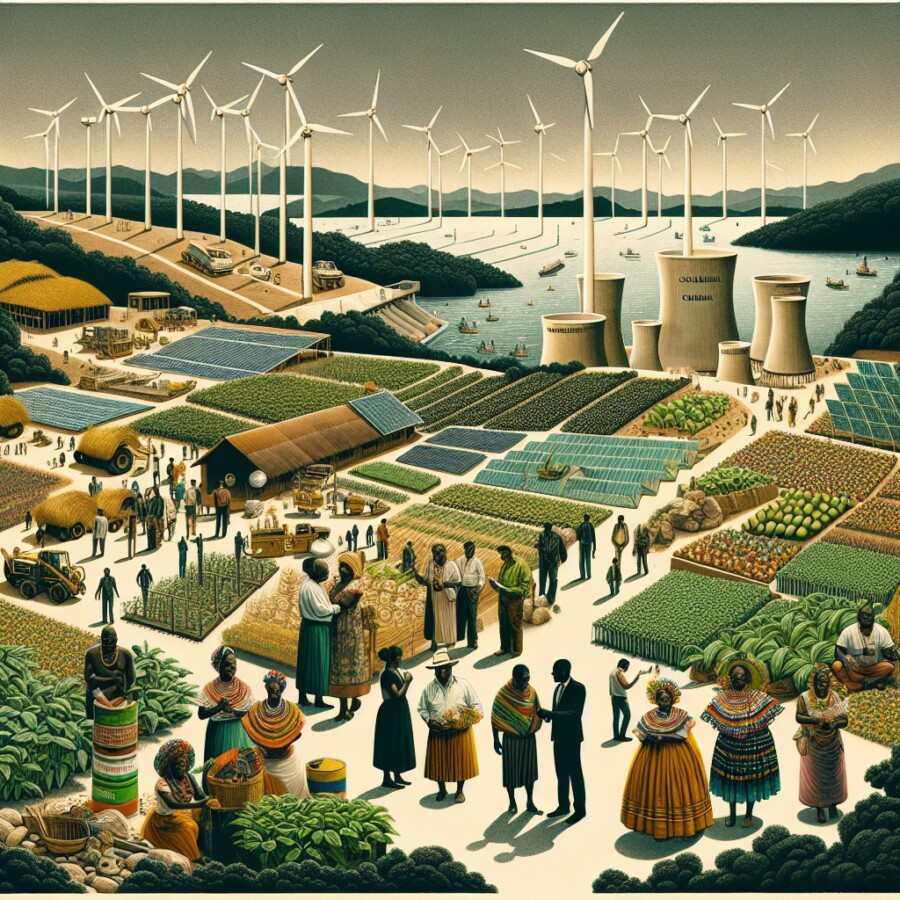
Colombia has recently implemented regulations to promote renewable energy production among local communities and indigenous groups. Currently, only 1% of the country's energy comes from alternative sources. Under the new regulations, community leaders, including Afro-Colombians, can form partnerships with public and private companies to generate power from wind farms, small hydroelectric projects, and biofuels. The aim is to diversify Colombia's energy matrix, which is currently dominated by large hydroelectric dams that have negative impacts on communities and the environment.
Since 2019, over 50 wind and solar projects have been announced in Colombia, with a planned generation capacity of 2.43 gigawatts in wind energy and 0.1 gigawatts in solar energy. However, none of these projects are currently operational. Some companies, such as Italy's Enel, have indefinitely postponed their projects, citing local protests as a hindrance to their investments.
Colombia has been recognized as one of the deadliest countries for environmentalists, with numerous activists being killed in recent years. This highlights the importance of promoting renewable energy as a sustainable and environmentally friendly alternative. By encouraging local communities and indigenous groups to participate in renewable energy production, Colombia aims to empower these marginalized groups and reduce its reliance on fossil fuels.
In addition to the new regulations, the Colombian government has also opened bids for its first offshore wind farms, signaling its commitment to expanding renewable energy sources. With more than 70% of the country's power currently being generated by large hydroelectric dams, diversifying the energy mix is crucial for the long-term sustainability of Colombia's energy sector. By embracing renewable energy, Colombia can reduce its carbon footprint, protect the environment, and promote social and economic development in indigenous communities and local areas.
Original news source: Renewable energy drive for indigenous groups in Colombia (BBC)
🎧 Listen:
📖 Vocabulary:
Group or Classroom Activities
Warm-up Activities:
– News Summary
Instructions: Students will read the article and then write a summary of the main points in their own words. They should focus on the key information, such as the new regulations in Colombia, the current energy sources, and the goals for renewable energy production.
– Opinion Poll
Instructions: Divide the class into pairs or small groups. Each group will discuss their opinions on renewable energy and its importance in Colombia. They can use the information from the article to support their arguments. After the discussion, each group will present their opinions to the class, and a poll will be conducted to see which opinion is the most popular.
– Vocabulary Pictionary
Instructions: Give each student a list of vocabulary words from the article, such as renewable energy, indigenous groups, hydroelectric dams, etc. Students will take turns drawing a picture to represent one of the words, while the rest of the class guesses what the word is. This activity will help students practice their vocabulary and comprehension skills.
– Pros and Cons
Instructions: Divide the class into two groups. One group will list the pros of promoting renewable energy in Colombia, while the other group will list the cons. After brainstorming, each group will present their arguments to the class, and a debate can be held to discuss the different perspectives.
– Future Predictions
Instructions: Students will work in pairs or small groups to discuss and predict the future of renewable energy in Colombia. They should consider the current situation, the new regulations, and any challenges or opportunities that may arise. Each group will present their predictions to the class, and a discussion can be held to explore different possibilities.
🤔 Comprehension Questions:
🎧✍️ Listen and Fill in the Gaps:
Colombia has recently implemented to promote renewable energy production among local communities and groups. Currently, only 1% of the country's energy comes from alternative sources. Under the new regulations, community leaders, including Afro-Colombians, can form partnerships with public and private companies to generate power from wind , small hydroelectric , and biofuels. The aim is to diversify Colombia's energy matrix, which is currently dominated by large dams that have negative impacts on communities and the environment. Since 2019, over 50 wind and solar projects have been announced in , with a planned generation of 2.43 gigawatts in wind energy and 0.1 gigawatts in solar energy. However, none of these projects are currently operational. Some companies, such as Italy's Enel, have indefinitely postponed their projects, citing local protests as a to their investments. Colombia has been recognized as one of the deadliest for environmentalists, with numerous being killed in recent years. This highlights the importance of promoting renewable energy as a sustainable and environmentally friendly alternative. By local communities and indigenous groups to participate in renewable energy production, Colombia aims to empower these marginalized groups and reduce its reliance on fossil fuels. In addition to the new regulations, the Colombian has also opened bids for its first offshore wind farms, signaling its commitment to renewable sources. With more than 70% of the country's currently being generated by large hydroelectric dams, diversifying the energy mix is crucial for the long-term of Colombia's energy sector. By embracing renewable energy, Colombia can reduce its carbon footprint, protect the environment, and promote social and economic development in indigenous communities and local areas.
💬 Discussion Questions:
1. What is your opinion on Colombia's new regulations to promote renewable energy production among local communities and indigenous groups?
2. How would you feel if your community formed partnerships with public and private companies to generate power from renewable sources?
3. Do you think it is important for countries to diversify their energy matrix? Why or why not?
4. What are some potential benefits of promoting renewable energy as a sustainable alternative to fossil fuels?
5. How do you think empowering marginalized groups through renewable energy production can contribute to social and economic development?
6. Do you believe that local protests should be a hindrance to renewable energy projects? Why or why not?
7. What steps do you think the Colombian government should take to ensure the success of its wind and solar projects?
8. How do you think the recognition of Colombia as one of the deadliest countries for environmentalists affects the promotion of renewable energy in the country?
9. What are some potential challenges that Colombia may face in reducing its reliance on fossil fuels?
10. How do you think the opening of bids for offshore wind farms will impact Colombia's renewable energy sector?
11. Do you think it is important for countries to reduce their carbon footprint? Why or why not?
12. What role do you think renewable energy can play in protecting the environment?
13. How do you think the promotion of renewable energy can contribute to the overall sustainability of a country's energy sector?
14. What are some potential benefits and drawbacks of relying heavily on large hydroelectric dams for energy generation?
15. Do you believe that promoting renewable energy can help address the issue of climate change? Why or why not?
Individual Activities
📖💭 Vocabulary Meanings:
Click a dot next to a word, then click the dot next to its meaning to draw a line connecting them.
Words
Meanings
🔡 Multiple Choice Questions:
🕵️ True or False Questions:
📝 Write a Summary:
Write a summary of this news article in two sentences.
Check your writing now with the best free AI for English writing!