

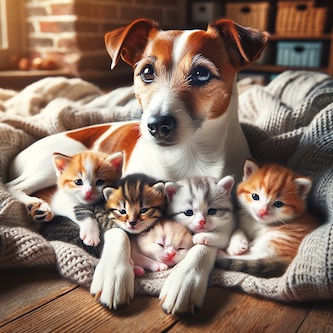
Teasel's maternal instincts extended beyond feeding and cleaning the kittens. She also showed protective behavior, picking up any stray kittens and returning them to their bed. This unusual behavior of a dog nurturing kittens is not unheard of, as there have been instances of cats and dogs adopting each other's young, as well as other interspecies adoptions.
Biologist Dr. Rachel Grant explained that such interspecies adoptions are likely the result of "fixed action patterns," where the adopting animal responds to specific triggers from the adoptee. These patterns elicit a cascade of behaviors in the brain, leading to maternal care. Dr. Grant also highlighted that the closer species are to one another, the more likely cross-species adoptions will occur.
While cross-species nursing is heartwarming, it challenges our understanding of evolution. Dr. Grant explained that such behaviors are driven by instinct and specific cues, which are not under conscious control. However, as long as these behaviors are successful most of the time, they are likely to be selected by evolution.
As for Teasel and the kittens, once weaning occurs, the bond between them is likely to lessen. However, all the kittens have new families lined up to give them homes, and Teasel's strong maternal instincts will serve her well should she have her own pups in the future.
Original news source: Why did a dog in Newmarket end up nursing a litter of kittens? (BBC)
📖 Vocabulary:
Group or Classroom Activities
Warm-up Activities:
– News Summary
Instructions: Pair up with a partner and take turns summarizing the heartwarming story of Teasel and the kittens using your own words. Try to condense the article into just five sentences, capturing the main points. Then, share your summaries with the class and discuss the differences in what details each pair considered most important.
– Opinion Spectrum
Instructions: Stand on a line in the classroom with one end representing 'strongly agree' and the other 'strongly disagree'. The teacher will read statements related to the article, such as "Interspecies adoption is natural and should be encouraged" or "Maternal instincts are powerful enough to cross species barriers". Students will place themselves along the line according to their opinion and then discuss their reasoning with the person standing next to them.
– Vocabulary Pictionary
Instructions: Split into two teams. Write down key terms from the article (e.g., "nursing", "maternal instincts", "fixed action patterns", "interspecies adoption", "evolution") on slips of paper and place them in a bowl. Teams take turns drawing a slip and then one member has to illustrate the term without using words or gestures while their team guesses. Set a timer for each turn to make it more challenging.
– Think-Pair-Share
Instructions: Reflect on the article individually and think about the following question: "What implications does cross-species nursing have on our understanding of animal behavior and evolution?" After a few minutes, pair up with another student and share your thoughts. Finally, come together as a class and have a group discussion on the different viewpoints and insights.
– Future Predictions
Instructions: Discuss in small groups what you think will happen to the relationship between Teasel and the kittens as they grow older and once they have been adopted by new families. Consider the biological explanations provided in the article for maternal behavior and how this might influence their future interaction. Afterward, each group will present their predictions and reasoning to the class.
🤔 Comprehension Questions:
Teasel took on the role of nursing and caring for the abandoned kittens, even producing milk to feed them, cleaning them, and showing protective behavior.
Sue Stubley's initial plan was to look after the kittens for a night before taking them to a local cat rescue.
Teasel demonstrated protective behavior by picking up any stray kittens and returning them to their bed.
Dr. Rachel Grant explains that interspecies adoptions are likely the result of "fixed action patterns," where the adopting animal responds to specific triggers from the adoptee, leading to maternal care.
The closer species are to one another, the more likely cross-species adoptions will occur.
Cross-species nursing challenges our understanding of evolution because it is driven by instinct and specific cues that are not under conscious control, yet these behaviors are selected by evolution as long as they are successful most of the time.
Once weaning occurs, the bond between Teasel and the kittens is likely to lessen.
All the kittens have new families lined up to give them homes, and Teasel's strong maternal instincts will serve her well should she have her own pups in the future.
🎧✍️ Listen and Fill in the Gaps:
A heartwarming story emerged in Newmarket when a dog, Teasel, took on the role of nursing and caring for a litter of abandoned kittens. The dog's , Sue Stubley, initially planned to look after the kittens for a before them to a local cat rescue. However, Teasel had other plans and began caring for the kittens, even producing milk to feed them. Teasel's maternal extended beyond feeding and cleaning the . She also showed protective behavior, picking up any stray kittens and returning them to their bed. This behavior of a dog nurturing kittens is not unheard of, as there have been instances of cats and dogs adopting each 's young, as well as other interspecies adoptions. Biologist Dr. Rachel explained that such interspecies adoptions are likely the result of "fixed action patterns," where the adopting animal responds to specific triggers from the . These patterns elicit a cascade of in the brain, leading to maternal care. Dr. Grant also highlighted that the are to one another, the more likely cross-species adoptions will occur. While cross-species nursing is heartwarming, it challenges our understanding of evolution. Dr. Grant explained that such behaviors are driven by instinct and specific cues, which are not under conscious control. However, as long as these behaviors are most of the time, they are to be selected by evolution. As for Teasel and the kittens, once weaning occurs, the bond between them is likely to lessen. However, all the kittens have new families up to give them homes, and Teasel's strong maternal instincts will her well should she have her own pups in the future.
💬 Discussion Questions:
1. What is your personal view on animals adopting those of another species, and why do you feel that way?
2. Have you ever witnessed or heard about an animal displaying nurturing behavior towards another species? Can you share the story?
3. How would you feel if you saw a dog nursing kittens in real life? Would you be surprised or touched, and why?
4. Do you think that such instances of interspecies adoption challenge the traditional view of animal behavior? Why or why not?
5. What is a "fixed action pattern" in your own words, and can you think of any other examples where this might occur in the animal kingdom?
6. Do you like the idea of different animal species living together harmoniously? Why do you find it appealing or not?
7. How do you think the maternal instincts of animals like Teasel compare to those of humans? Are there any similarities or differences that stand out to you?
8. Do you believe that animals have emotions similar to humans, such as love and empathy, especially in cases like Teasel and the kittens?
9. What do you think drives an animal to care for young that are not their own? Is it purely instinctual, or could there be more to it?
10. How would you feel if you had to take care of an animal from a different species? Do you think you would be able to do it, and why?
11. Do you think that the bond formed between Teasel and the kittens will have a lasting impact on their behavior as they grow older? Why or why not?
12. Why do you think evolution might select for behaviors such as cross-species nursing, even though they are not the norm?
13. Do you think that stories like Teasel's should be shared widely to promote the idea of compassion across species? Why or why not?
14. Have you ever had a pet that displayed protective or nurturing behavior towards you or another animal? Can you describe that experience?
15. Do you think that the kittens being raised by Teasel will exhibit any dog-like behaviors as they grow up, and why might that be interesting to observe?
Individual Activities
📖💭 Vocabulary Meanings:
Click a dot next to a word, then click the dot next to its meaning to draw a line connecting them.
Words
Meanings
🔡 Multiple Choice Questions:
🕵️ True or False Questions:
📝 Write a Summary:
Write a summary of this news article in two sentences.
Check your writing now with the best free AI for English writing!