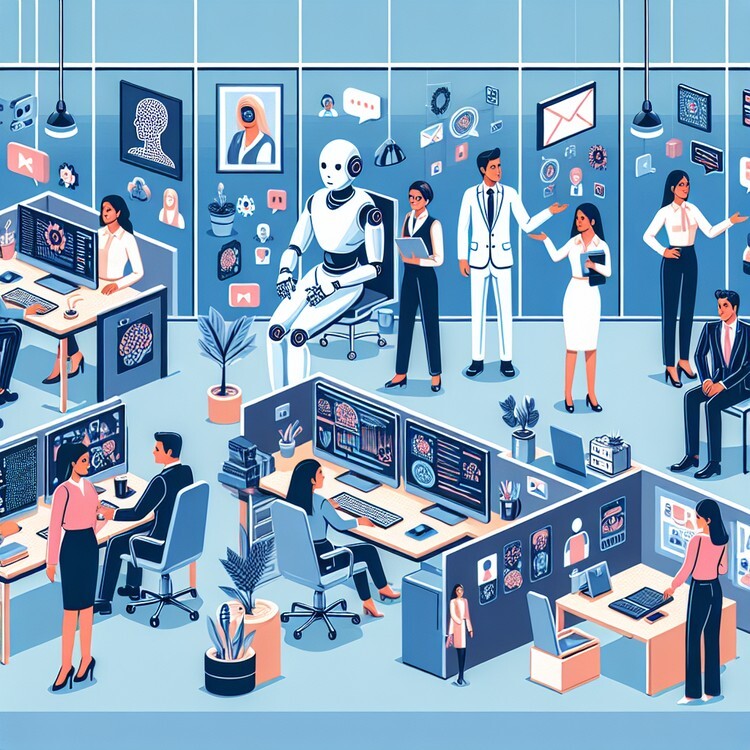
Employers are increasingly seeking employees with artificial intelligence (AI) skills. Companies like Deel, a software company in San Francisco, are looking for individuals who can bring AI skills into various roles, including HR. The use of AI tools, such as ChatGPT, can streamline administrative tasks and improve efficiency. Job postings mentioning AI have more than doubled in the past two years, indicating a growing demand for AI-literate professionals. However, many workers feel overwhelmed by the amount they need to learn about AI.
AI can bring significant benefits to businesses, particularly smaller ones with limited resources. It can help increase output without requiring additional resources and can be used for tasks like content creation and software development. AI tools are also being used to support managers and staff in writing performance reviews, allowing for more in-depth responses. However, it is important to strike a balance between AI and human input to avoid robotic and generic responses. Companies must also be cautious about potential legal or security breaches and the loss of organizational culture and human expertise.
AI systems are only as good as the data they are based on, which means there is a risk of replicating human biases and discrimination. Therefore, AI should be seen as a tool to enhance job performance rather than replace human workers. While most professionals have not received formal AI training from their employers, it is important for individuals to become AI-literate and understand how to make use of AI tools. Workers can experiment with free versions of AI tools available online and take online courses to learn about different AI tools and their applications. Ultimately, businesses should focus on how AI can make things better rather than just more efficient, and strive for a hybrid human-AI workforce.
Original news source: What do employers expect staff to know about AI? (BBC)
🎧 Listen:
Group or Classroom Activities
Warm-up Activities:
– News Summary
Instructions: Divide the class into small groups. Give each group a few minutes to read the article individually. Then, have the groups work together to create a concise summary of the article. They should focus on the main points and key ideas. Afterward, have each group share their summaries with the class.
– Opinion Poll
Instructions: Ask the students to form pairs or small groups. Assign each group a specific question related to the article, such as "Do you think AI will replace human workers in the future?" or "What are the potential risks of relying too heavily on AI in the workplace?" Give the groups a few minutes to discuss their opinions and come up with arguments to support their views. Then, have each group present their opinions to the class and facilitate a class discussion.
– Vocabulary Pictionary
Instructions: Prepare a list of key vocabulary words from the article, such as "artificial intelligence," "streamline," "discrimination," etc. Divide the class into teams and give each team a set of vocabulary words. One member of each team should come to the front of the class and draw a picture representing one of the words, while their teammates try to guess the word. The team that guesses correctly gets a point. Continue until all the words have been drawn.
– Pros and Cons
Instructions: Split the class into two groups. Assign one group to discuss the pros of using AI tools in the workplace, and the other group to discuss the cons. Give the groups a few minutes to brainstorm their ideas. Then, have each group take turns presenting their arguments to the class. Encourage the students to ask questions and engage in a respectful debate.
– Future Predictions
Instructions: Ask the students to individually write down their predictions about how AI will impact the workplace in the next 10 years. They should consider both positive and negative effects. Afterward, divide the class into pairs or small groups and have the students share and discuss their predictions. Encourage them to provide reasons and evidence to support their predictions. Finally, have a class discussion to share and compare the different predictions.
🤔 Comprehension Questions:
Employers are seeking individuals with AI skills for various roles, including HR.
AI tools like ChatGPT can streamline administrative tasks by automating processes and improving efficiency.
The demand for AI-literate professionals has more than doubled in the past two years, as indicated by the increase in job postings mentioning AI.
AI can help increase output without requiring additional resources, be used for tasks like content creation and software development, and support managers and staff in writing performance reviews.
AI tools are being used to support managers and staff in writing performance reviews by providing more in-depth responses and feedback.
Potential risks or concerns associated with AI in the workplace include replicating human biases and discrimination, potential legal or security breaches, and the loss of organizational culture and human expertise.
It is important for individuals to become AI-literate because AI is increasingly being used in various industries, and having AI skills can enhance job performance and career prospects.
Businesses should focus on how AI can make things better rather than just more efficient, and strive for a hybrid human-AI workforce.
🎧✍️ Listen and Fill in the Gaps:
Employers are increasingly seeking employees with artificial intelligence (AI) skills. Companies like Deel, a software company in San Francisco, are looking for individuals who can AI skills into various roles, including HR. The use of AI tools, such as ChatGPT, can streamline tasks and improve . Job postings mentioning AI have more than doubled in the past two years, indicating a growing demand for AI-literate . However, many workers feel by the amount they need to learn about AI. AI can bring significant benefits to businesses, particularly smaller ones with limited resources. It can help increase output without requiring additional resources and can be used for tasks like content and development. AI are also being used to support managers and staff in writing performance reviews, allowing for more in-depth responses. However, it is important to strike a balance between AI and to avoid robotic and generic responses. Companies must also be cautious about legal or security and the loss of organizational culture and human expertise. AI systems are only as good as the data they are based on, which means there is a risk of replicating human biases and discrimination. Therefore, AI should be seen as a tool to enhance job performance rather than replace human workers. While most professionals have not formal AI training from their , it is for individuals to become AI-literate and understand how to make use of AI tools. Workers can experiment with free versions of AI tools available online and take online courses to learn about different AI tools and their applications. Ultimately, businesses should focus on how AI can make things better rather than just more efficient, and for a hybrid human-AI workforce.
💬 Discussion Questions:
1. What is the role of artificial intelligence (AI) in the workplace?
2. How would you feel if your job required you to have AI skills?
3. Do you think AI tools can improve efficiency in the workplace? Why or why not?
4. What are the potential benefits of using AI in smaller businesses with limited resources?
5. How can AI tools be used to support managers and staff in performance reviews?
6. Do you think there is a risk of AI systems replicating human biases and discrimination? Why or why not?
7. Why is it important for individuals to become AI-literate and understand how to use AI tools?
8. Have you ever experimented with AI tools? If so, what was your experience like?
9. What do you think are the potential legal and security risks associated with AI in the workplace?
10. How can a balance be struck between AI and human input to avoid robotic and generic responses?
11. Do you believe that AI should enhance job performance rather than replace human workers? Why or why not?
12. How do you think businesses can focus on making things better rather than just more efficient with AI?
13. Have you ever taken an online course to learn about AI tools? If so, what did you learn?
14. What do you think are the advantages and disadvantages of having a hybrid human-AI workforce?
15. How do you think the demand for AI-literate professionals will continue to grow in the future?
Individual Activities
🔡 Multiple Choice Questions:
🕵️ True or False Questions:
📝 Write a Summary:
Write a summary of this news article in two sentences.
Check your writing now with the best free AI for English writing!