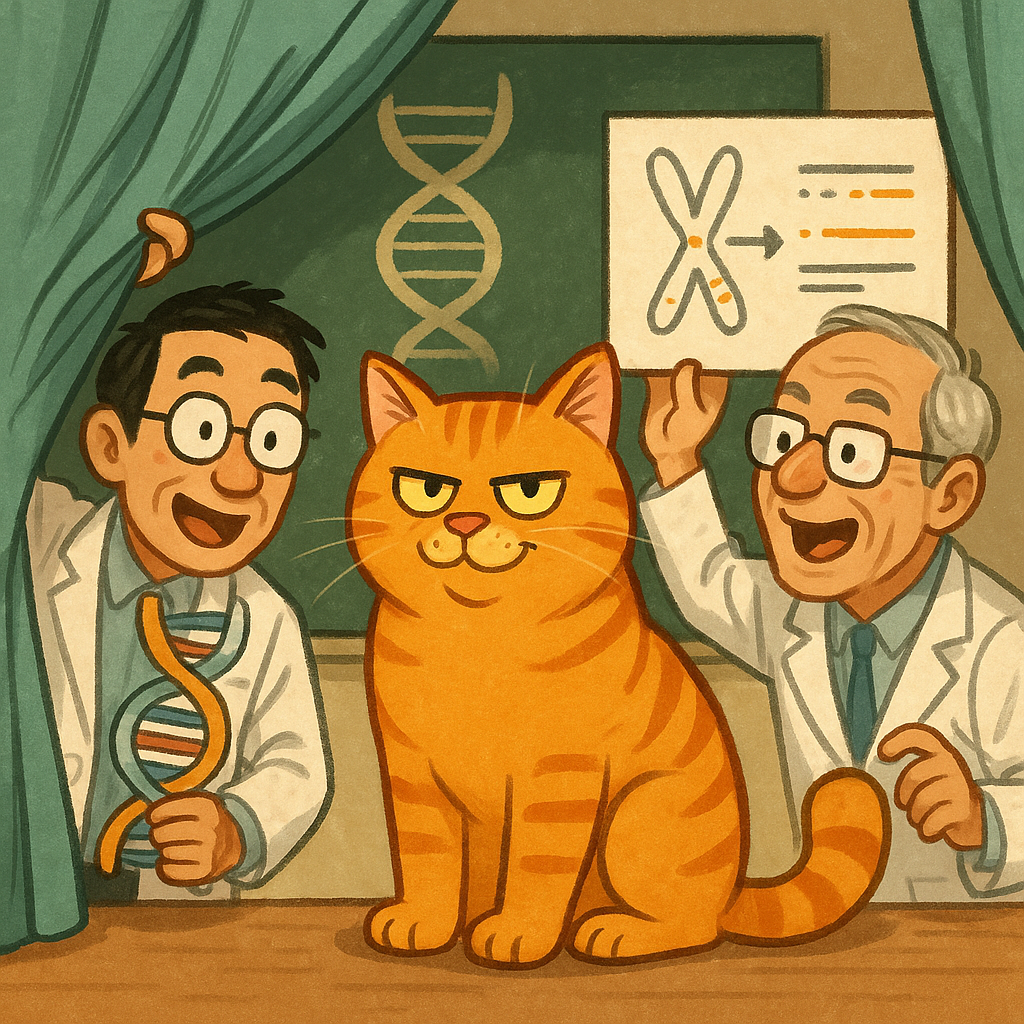
A long-standing mystery regarding the genetic basis of ginger cats has recently been unraveled by scientists from Japan and the United States. Iconic characters such as Garfield and Puss in Boots have popularized ginger cats, but the scientific community has struggled to pinpoint the genetic factors responsible for their distinctive orange coloring. Through collaborative research, the teams discovered that ginger cats, particularly males, lack a specific section of their DNA that influences the production of pigments in their skin, eyes, and fur. This breakthrough not only excites researchers but also resonates with the many cat enthusiasts who supported the study through crowdfunding.
For many years, it has been understood that genetics play a crucial role in the coloration of orange tabby cats. However, the precise location of the genetic code responsible for this trait remained elusive until now. The research teams from Kyushu University and Stanford University published their findings simultaneously, revealing that a gene known as ARHGAP36 is significantly more active in the melanocytes, the cells responsible for pigmentation. By comparing the DNA of various cats, they found that those with ginger fur had a missing segment within the ARHGAP36 gene, leading to increased pigment production.
Interestingly, the research also confirmed a long-held observation that ginger cats are predominantly male. This phenomenon is linked to the gene being located on the X chromosome. Male cats possess one X and one Y chromosome, meaning that the absence of the DNA segment on the X chromosome is sufficient to produce a fully ginger coat. In contrast, female cats have two X chromosomes, requiring both to be missing the segment for the same level of pigmentation, which often results in mixed coloring.
The study, while grounded in scientific inquiry, began as a passion project for Professor Hiroyuki Sasaki, who, despite being retired, sought to investigate the genetics of orange cats. His efforts were supported by crowdfunding, raising over 10 million yen from cat lovers who shared his enthusiasm. This collaborative spirit highlights the connection between scientific research and community engagement, as many contributors expressed their desire to support studies that could lead to a better understanding of cat health.
The implications of the ARHGAP36 gene extend beyond fur color; it is also active in various parts of the body, including the brain and hormonal glands. Researchers speculate that mutations in this gene may be linked to other health issues or behavioral traits in cats. While some cat owners believe that coat color influences personality, scientific evidence remains limited. Nonetheless, the findings open new avenues for exploration into the relationship between genetics and feline behavior, promising further insights into the lives of our beloved pets.
Original news source: Decades-long mystery of ginger cats revealed (BBC)
🎧 Listen:
📖 Vocabulary:
Group or Classroom Activities
Warm-up Activities:
– CHARADES
Instructions: In pairs, students will act out various terms related to the article without using any words. Terms might include "ginger cat," "genetics," "crowdfunding," and "melanocytes." The rest of the class will guess the term being acted out.
– OPINION POLL
Instructions: Students will discuss their views on whether they believe a cat's fur color can influence its personality. After a brief discussion, they will take a poll, and the results will be shared with the class.
– MIND MAP
Instructions: In small groups, students will create a mind map that outlines the key points from the article, including the genetics of ginger cats, the role of the ARHGAP36 gene, and the impact of crowdfunding on scientific research. Each group will present their mind map to the class.
– FUTURE PREDICTIONS
Instructions: Students will write down predictions about how this genetic discovery might influence future research in feline health or breeding practices. After writing, they will share their predictions in small groups.
– HEADLINE CREATION
Instructions: Students will brainstorm and create catchy headlines that could be used for a news article about the findings on ginger cats. They will then share their headlines with the class and vote on the most engaging one.
🤔 Comprehension Questions:
Scientists discovered that ginger cats, particularly males, lack a specific section of their DNA that influences the production of pigments in their skin, eyes, and fur.
The research teams compared the DNA of various cats and found that those with ginger fur had a missing segment within the ARHGAP36 gene, which is significantly more active in the melanocytes responsible for pigmentation.
The ARHGAP36 gene is significant because it influences pigment production in ginger cats, and its absence leads to the distinctive orange coloring.
Ginger cats are predominantly male because the gene responsible for their coloration is located on the X chromosome, and males have one X and one Y chromosome, allowing them to express the ginger coloration with just one missing DNA segment.
Professor Hiroyuki Sasaki's research project gained financial support through crowdfunding, raising over 10 million yen from cat lovers who were enthusiastic about the study.
The article suggests that there is a strong connection between scientific research and community engagement, as many contributors to the crowdfunding expressed their desire to support studies that could improve understanding of cat health.
The ARHGAP36 gene is also active in various parts of the body, including the brain and hormonal glands.
The findings suggest potential future research areas related to the relationship between genetics and feline behavior, as well as exploring possible links between mutations in the ARHGAP36 gene and other health issues or behavioral traits in cats.
🎧✍️ Listen and Fill in the Gaps:
A long-standing mystery regarding the genetic basis of ginger cats has recently been unraveled by scientists from Japan and the States. Iconic characters such as Garfield and Puss in Boots have popularized ginger cats, but the scientific community has struggled to pinpoint the genetic factors responsible for their distinctive coloring. Through research, the teams discovered that ginger cats, particularly males, lack a specific section of their DNA that influences the production of pigments in their skin, eyes, and fur. This breakthrough not only excites but also resonates with the many cat enthusiasts who supported the study through crowdfunding. For many years, it has been understood that s play a crucial role in the coloration of orange cats. However, the precise location of the genetic code responsible for this trait remained elusive until now. The research teams from Kyushu University and Stanford University published their findings simultaneously, revealing that a gene known as ARHGAP36 is significantly more active in the , the cells responsible for pigmentation. By comparing the DNA of various cats, they found that those with ginger fur had a missing segment within the ARHGAP36 gene, leading to pigment production. Interestingly, the research also confirmed a long-held observation that ginger cats are predominantly male. This phenomenon is linked to the gene being located on the X . Male cats possess one X and one Y chromosome, meaning that the absence of the DNA segment on the X chromosome is sufficient to produce a fully ginger coat. In , female cats have two X chromosomes, requiring both to be missing the segment for the same level of pigmentation, which often results in mixed coloring. The study, while grounded in scientific inquiry, began as a passion project for Professor Hiroyuki Sasaki, who, despite being retired, sought to the genetics of orange cats. His efforts were supported by crowdfunding, raising over 10 million yen from cat lovers who shared his enthusiasm. This collaborative spirit highlights the between scientific research and engagement, as many contributors expressed their desire to support studies that could lead to a better understanding of cat health. The implications of the ARHGAP36 gene extend beyond fur color; it is also active in various parts of the body, including the brain and glands. Researchers speculate that mutations in this gene may be linked to other health issues or behavioral traits in cats. While some cat owners believe that coat color influences personality, scientific evidence remains limited. Nonetheless, the open new avenues for exploration into the between genetics and feline behavior, promising further insights into the lives of our beloved pets.
💬 Discussion Questions:
1. What is your opinion on the role of genetics in determining physical traits in animals?
2. How would you feel if scientists discovered a gene that influenced your own physical appearance?
3. Do you think that the color of a pet's fur can affect its personality? Why or why not?
4. What is a unique feature of any pet you have owned or known, and how do you think it affects their behavior?
5. How do you feel about crowdfunding for scientific research? Do you think it is a good way to support projects? Why?
6. Do you think that popular culture, like movies or cartoons, influences our perceptions of certain animals, such as cats? Why or why not?
7. What is your experience with pets? Have you ever noticed a difference in personality among pets of different colors or breeds?
8. How would you feel if your favorite pet had a genetic condition that affected its health?
9. Do you think it is important for scientists to engage with the community when conducting research? Why or why not?
10. What is a behavior in animals that you find particularly interesting, and do you think it could be linked to genetics?
11. How do you think advancements in genetics could change the way we care for pets in the future?
12. Do you believe that certain colors in animals are more appealing to people? Why do you think that is?
13. What is a scientific discovery that you think has had a significant impact on society, and why?
14. How would you feel if you learned that your pet's behavior was influenced by its genetics rather than its environment?
15. Do you think that the relationship between science and community support is essential for successful research? Why or why not?
Individual Activities
📖💭 Vocabulary Meanings:
Click a dot next to a word, then click the dot next to its meaning to draw a line connecting them.
Words
Meanings
🔡 Multiple Choice Questions:
🕵️ True or False Questions:
📝 Write a Summary:
Write a summary of this news article in two sentences.
Check your writing now with the best free AI for English writing!