


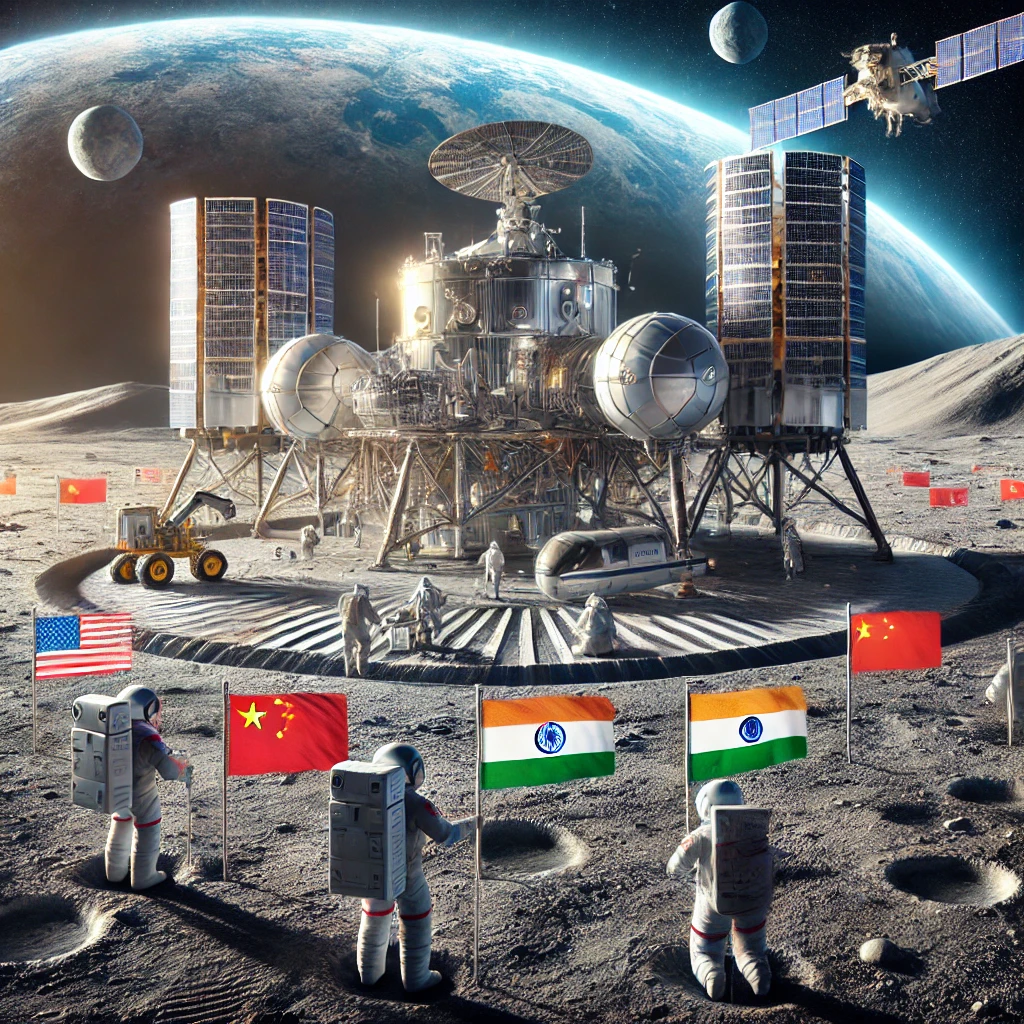
The Moon has become a hot topic in recent years, as more countries and companies set their sights on exploring its surface and harnessing its resources. This new era of lunar exploration has sparked a race for dominance in space. China, India, Japan, and the US are among the nations and companies that have successfully landed spacecraft on the Moon. Plans are also underway to establish permanent bases and send humans back to the Moon. However, this space race could potentially lead to tensions and conflicts, as the laws governing space exploration are struggling to keep up with the rapid progress.
According to the Outer Space Treaty of 1967, no nation can claim ownership of the Moon. Instead, it is considered the property of all humankind and should be explored for the benefit of all nations. However, the driving force behind this treaty was the fear of space becoming a military battleground during the Cold War. The current space race is different, as it involves not only nations but also private companies. This raises questions about how the exploration and exploitation of the Moon's resources should be regulated.
While nations ultimately remain the key players in lunar exploration, private companies are increasingly involved. However, these companies still need authorization from a state to go into space, which is limited by international treaties. The prestige and economic benefits of joining the elite club of Moon landers are significant. Additionally, the Moon's resources, including minerals and water, hold great value. Water, in particular, is in high demand as it can be used for drinking, generating oxygen, and making rocket fuel.
The US has attempted to establish new principles for lunar exploration through the Artemis Accords. These principles state that the extraction and use of resources on the Moon should comply with international treaties, but some new rules may be necessary. Over 40 countries have signed up to these non-binding agreements, but China is notably absent. Some argue that new rules for lunar exploration should be led by the United Nations to ensure the involvement of all countries.
Access to resources on the Moon could potentially lead to conflicts, especially in areas close to ice-filled craters. The first-mover advantage will play a significant role in determining the size and location of future lunar bases. The US and China are likely to be the first settlers, adding a new layer of rivalry to their already tense relationship. The rules established by the first settlers may shape future regulations for lunar exploration.
In conclusion, the Moon is becoming a contested space as more countries and companies aim to explore its surface and exploit its resources. The current laws governing space exploration are struggling to keep up with the rapid progress, leading to tensions and conflicts. The establishment of new principles and regulations for lunar exploration is necessary to ensure the fair and peaceful utilization of the Moon's resources. The involvement of the United Nations and international cooperation will be crucial in shaping the future of lunar exploration.
Original news source: Who owns the Moon? A new space race means it could be up for grabs (BBC)
🎧 Listen:
📖 Vocabulary:
Group or Classroom Activities
Warm-up Activities:
– News Summary
Instructions: In pairs or small groups, students will read the article and then write a summary of the main points. They should include information about the current space race, the laws governing space exploration, the involvement of private companies, and the potential conflicts over lunar resources. After writing their summaries, students can share and compare their responses with the rest of the class.
– Opinion Poll
Instructions: Students will form pairs and take turns asking each other questions related to the article. They should ask for opinions on topics such as the ownership of the Moon, the involvement of private companies, and the role of international cooperation. Each student should record their partner's responses and then summarize the overall opinions in the class.
– Word Association
Instructions: Write the word "Moon" on the board. Students will then take turns saying a word or phrase that they associate with the Moon. The associations can be related to the article or personal connections. Encourage students to explain their associations to the class. This activity can generate discussion and help students make connections to the topic.
– Sketch It
Instructions: Provide each student with a piece of paper and a pencil. In pairs, one student will describe a scene or concept related to lunar exploration while the other student sketches it. The students can switch roles and repeat the activity. Afterward, students can share their sketches with the class and explain the scene or concept they were trying to depict.
– Pros and Cons
Instructions: Divide the class into two groups: one in favor of lunar exploration and the other against it. Each group will brainstorm and discuss the pros and cons of lunar exploration. Afterward, each group will present their arguments to the class. Encourage students to consider the economic, scientific, environmental, and geopolitical aspects of the issue.
🤔 Comprehension Questions:
🎧✍️ Listen and Fill in the Gaps:
The Moon has become a hot topic in recent years, as more countries and companies set their sights on exploring its surface and harnessing its resources. This new era of lunar exploration has sparked a race for dominance in . China, India, Japan, and the US are among the nations and companies that have successfully landed spacecraft on the Moon. Plans are also to establish permanent bases and send humans back to the Moon. However, this space race could potentially lead to tensions and , as the laws governing space exploration are struggling to keep up with the rapid progress. According to the Outer Space of 1967, no nation can claim ownership of the Moon. Instead, it is considered the property of all humankind and should be explored for the benefit of all nations. However, the driving force behind this treaty was the fear of space becoming a military battleground during the Cold War. The space race is different, as it not only nations but also private . This raises questions about how the exploration and exploitation of the Moon's resources should be regulated. While nations ultimately remain the key players in lunar exploration, private companies are increasingly involved. However, these companies still need authorization from a state to go into space, which is limited by treaties. The prestige and economic benefits of joining the elite club of Moon landers are significant. Additionally, the Moon's resources, including minerals and water, hold great value. Water, in particular, is in high demand as it can be used for drinking, generating oxygen, and making rocket fuel. The US has attempted to establish new principles for exploration through the Accords. These principles state that the extraction and use of on the Moon should comply with international treaties, but some new rules may be necessary. Over 40 have signed up to these non-binding agreements, but China is notably absent. Some argue that new rules for lunar exploration should be led by the United Nations to ensure the involvement of all countries. Access to resources on the Moon could potentially lead to conflicts, especially in areas close to ice-filled craters. The first-mover advantage will play a significant role in determining the size and location of future lunar bases. The US and China are likely to be the first settlers, adding a new layer of rivalry to their already tense relationship. The rules established by the first settlers may shape future regulations for lunar exploration. In conclusion, the Moon is becoming a contested space as more countries and companies aim to explore its surface and exploit its resources. The current laws governing space exploration are to keep up with the rapid progress, leading to tensions and conflicts. The establishment of new principles and regulations for lunar exploration is to ensure the fair and peaceful utilization of the Moon's resources. The involvement of the Nations and international will be crucial in shaping the future of lunar exploration.
💬 Discussion Questions:
1. What do you think about the idea of establishing permanent bases on the Moon?
2. How would you feel if private companies were the main players in lunar exploration, rather than nations?
3. Do you think it is fair that no nation can claim ownership of the Moon? Why or why not?
4. What is your opinion on the involvement of the United Nations in regulating lunar exploration?
5. How do you think conflicts over access to resources on the Moon could be resolved?
6. Do you think the first-mover advantage in lunar exploration is important? Why or why not?
7. What are your thoughts on the US and China potentially becoming the first settlers on the Moon?
8. How would you feel if new rules for lunar exploration were led by the United Nations?
9. What do you think are the potential benefits and drawbacks of extracting and using resources on the Moon?
10. How do you think the involvement of private companies in lunar exploration will impact the future of space exploration?
11. Do you think it is important for all countries to be involved in shaping the regulations for lunar exploration? Why or why not?
12. How would you feel if conflicts over lunar resources escalated into military conflicts?
13. What are your thoughts on the economic benefits of joining the elite club of Moon landers?
14. Do you believe that the laws governing space exploration should be updated to keep up with rapid progress? Why or why not?
15. How do you think international cooperation can ensure the fair and peaceful utilization of the Moon's resources?
Individual Activities
📖💭 Vocabulary Meanings:
Click a dot next to a word, then click the dot next to its meaning to draw a line connecting them.
Words
Meanings
🔡 Multiple Choice Questions:
🕵️ True or False Questions:
📝 Write a Summary:
Write a summary of this news article in two sentences.
Check your writing now with the best free AI for English writing!