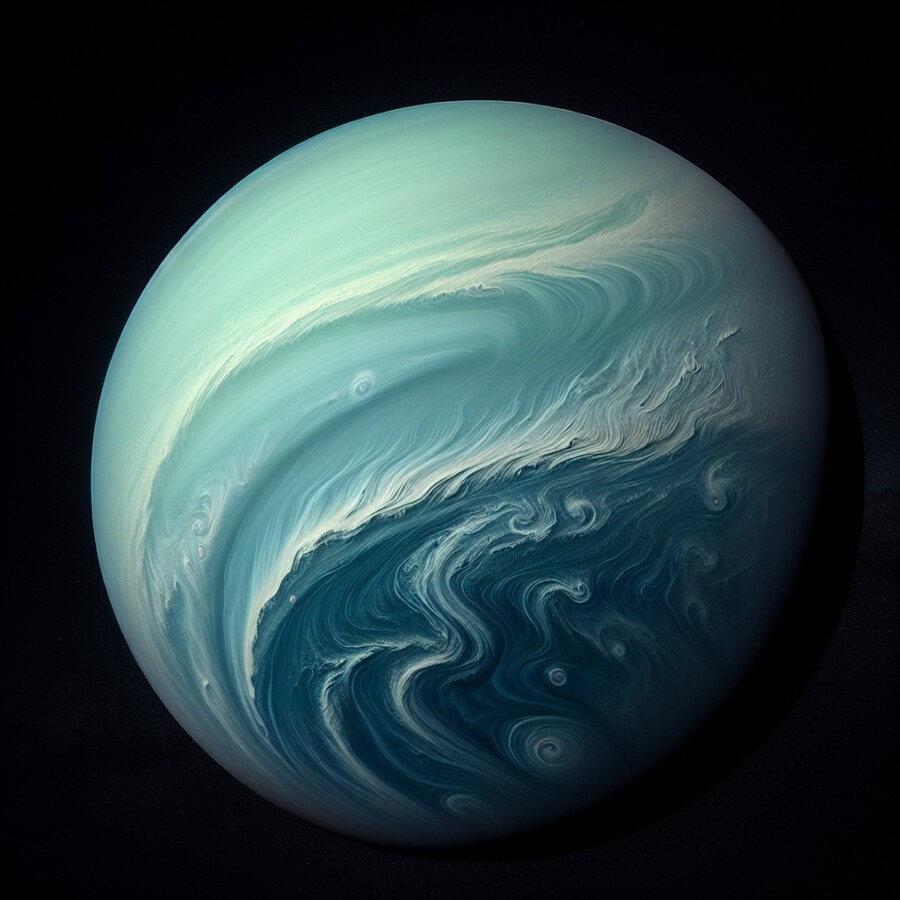
A new study led by UK astronomers has revealed that our previous understanding of the colors of the planets Neptune and Uranus was incorrect. Images from a space mission in the 1980s showed Neptune as a rich blue and Uranus as green. However, it has now been discovered that both ice giant planets are actually similar shades of greenish blue. The earlier images of Neptune had been enhanced to show details of the planet's atmosphere, which altered its true color. This discovery was made by analyzing data from the Hubble Space Telescope and the European Southern Observatory's Very Large Telescope.
According to Professor Catherine Heymans, an astrophysics professor at the University of Edinburgh, the earlier images of Neptune were enhanced to reveal the features in its atmosphere, resulting in a blue appearance. In reality, Neptune is similar in color to Uranus. Professor Patrick Irwin from the University of Oxford, who led the research, explained that most modern images of the two planets do not accurately represent their true colors. The artificially saturated color of the earlier images was known among planetary scientists, but this distinction had been lost over time.
Enhancing images is a normal procedure in astronomical research, as it allows scientists to see details that would otherwise be difficult to observe. The researchers processed the original data to create the most accurate representation yet of the colors of Neptune and Uranus. The initial misconception arose because the images captured by NASA's Voyager 2 spacecraft recorded the planets in three separate colors, which were then recombined to create composite color images. However, the balancing and contrast enhancement processes sometimes made Neptune appear bluer than it actually is.
The recent study used data from the Hubble Space Telescope and the European Southern Observatory's Very Large Telescope to produce the true colors of both planets. The analysis revealed that Uranus and Neptune are a similar shade of greenish blue, with a slight difference. Neptune has a hint of additional blue due to a thinner haze layer on the planet. The study also showed that Uranus appears greener during its summer and winter, when one of its poles is pointed towards the Sun, while it has a bluer tinge during spring and autumn when the Sun is over the equator.
The research, which has been published in the Monthly Notices of the Royal Astronomical Society, provides a more accurate understanding of the true colors of Neptune and Uranus. This study highlights the importance of analyzing data from multiple sources to obtain a comprehensive understanding of celestial objects.
Original news source: Neptune and Uranus seen in true colours for first time (BBC)
🎧 Listen:
📖 Vocabulary:
Group or Classroom Activities
Warm-up Activities:
– News Summary
Instructions: In pairs or small groups, students will read the article and work together to create a concise summary of the main points. They should focus on the discovery that the true colors of Neptune and Uranus are greenish blue, and the method used to analyze the data from the Hubble Space Telescope and the European Southern Observatory's Very Large Telescope. After creating their summaries, each group will present their findings to the class.
– Opinion Poll
Instructions: Students will form pairs or small groups and discuss their opinions on the article. They can discuss topics such as the importance of accurate representation in scientific research, the use of enhanced images in space exploration, or the impact of this discovery on our understanding of the planets. After their discussion, each group will conduct an opinion poll, asking other classmates for their opinions on the same topics. They will then present their findings to the class.
– Headline Creation
Instructions: In pairs or small groups, students will create catchy and informative headlines for the article. They should aim to capture the main points of the discovery and the method used to analyze the data. After creating their headlines, each group will present their best headline to the class. The class can then vote on the most creative or attention-grabbing headline.
– Vocabulary Pictionary
Instructions: In pairs or small groups, students will select 5-10 key vocabulary words from the article. They will take turns drawing pictures to represent each word, while their partner(s) guess the word based on the drawing. This activity will help students practice their vocabulary and reinforce their understanding of the article.
– Future Predictions
Instructions: In pairs or small groups, students will discuss and make predictions about the future implications of this discovery. They can consider questions such as how this new understanding of the colors of Neptune and Uranus might impact future space exploration, what other misconceptions in astronomy might be discovered, or how this discovery might change our perception of these planets. Each group will then present their predictions to the class.
🤔 Comprehension Questions:
The earlier images showed Neptune as a rich blue and Uranus as green.
The true colors were discovered by analyzing data from the Hubble Space Telescope and the European Southern Observatory's Very Large Telescope.
The earlier images were enhanced to reveal the features in Neptune's atmosphere, resulting in a blue appearance.
The researchers processed the original data from the space telescopes to create the most accurate representation of the colors.
The initial misconception was caused by the balancing and contrast enhancement processes used to create composite color images from the three separate colors captured by NASA's Voyager 2 spacecraft.
The recent study revealed that both Neptune and Uranus are similar shades of greenish blue, with Neptune having a slight additional blue tint due to a thinner haze layer.
Neptune has a hint of additional blue due to a thinner haze layer, while Uranus appears greener during its summer and winter and has a bluer tinge during spring and autumn.
Analyzing data from multiple sources allows for a more comprehensive understanding of celestial objects, as different telescopes and instruments can provide different perspectives and information.
🎧✍️ Listen and Fill in the Gaps:
A new study led by UK astronomers has revealed that our previous understanding of the colors of the planets and Uranus was incorrect. Images from a space mission in the 1980s showed Neptune as a rich blue and Uranus as . However, it has now been discovered that both ice giant planets are actually similar shades of greenish blue. The earlier images of Neptune had been enhanced to show of the planet's atmosphere, which altered its true color. This discovery was made by analyzing data from the Space Telescope and the European Southern Observatory's Very Large Telescope. According to Professor Catherine Heymans, an astrophysics professor at the University of Edinburgh, the earlier images of Neptune were enhanced to reveal the features in its atmosphere, resulting in a blue appearance. In reality, Neptune is similar in color to Uranus. Professor Patrick Irwin from the University of Oxford, who led the research, explained that most images of the two planets do not accurately represent their true . The artificially color of the earlier images was known among planetary scientists, but this had been lost over time. Enhancing images is a normal procedure in astronomical research, as it allows scientists to see details that would otherwise be difficult to observe. The researchers processed the data to create the most accurate representation yet of the colors of Neptune and Uranus. The initial misconception arose because the images captured by NASA's Voyager 2 recorded the planets in three separate colors, which were then to create composite color images. However, the balancing and contrast enhancement processes sometimes made Neptune appear bluer than it actually is. The recent study used data from the Hubble Telescope and the European Southern Observatory's Very Large Telescope to produce the true colors of both planets. The analysis revealed that Uranus and Neptune are a similar shade of greenish blue, with a difference. Neptune has a hint of additional blue due to a thinner haze layer on the planet. The study also showed that Uranus appears greener during its and winter, when one of its poles is towards the Sun, while it has a bluer tinge during spring and autumn when the Sun is over the equator. The research, which has been published in the Monthly Notices of the Royal Society, provides a more accurate understanding of the true colors of Neptune and Uranus. This study highlights the importance of analyzing data from multiple sources to obtain a comprehensive understanding of celestial objects.
💬 Discussion Questions:
1. What is your first reaction to the news that the colors of Neptune and Uranus were previously misunderstood?
2. How would you feel if you were an astronomer who had been studying these planets for years, only to find out that your understanding of their colors was incorrect?
3. Do you think it is important for scientists to have an accurate understanding of the true colors of celestial objects? Why or why not?
4. How do you think the misconception about the colors of Neptune and Uranus occurred in the first place?
5. What other misconceptions do you think could exist in the field of astronomy?
6. How do you think the discovery of the true colors of Neptune and Uranus will impact future research on these planets?
7. Do you think the general public is interested in the true colors of celestial objects? Why or why not?
8. How do you think the enhanced images of Neptune and Uranus influenced public perception of these planets?
9. What other factors do you think could influence the colors of celestial objects?
10. How do you think the colors of Neptune and Uranus were perceived by people before the recent study?
11. Do you think the true colors of Neptune and Uranus will change the way they are depicted in popular culture? Why or why not?
12. How would you feel if you were an artist who had previously depicted Neptune as blue, only to find out it is actually greenish blue?
13. What other discoveries do you think could be made about the colors of celestial objects in the future?
14. How do you think the study's findings could impact our understanding of other planets in our solar system?
15. Do you think the study's findings will change the way we view and appreciate the beauty of the universe? Why or why not?
Individual Activities
📖💭 Vocabulary Meanings:
Click a dot next to a word, then click the dot next to its meaning to draw a line connecting them.
Words
Meanings
🔡 Multiple Choice Questions:
🕵️ True or False Questions:
📝 Write a Summary:
Write a summary of this news article in two sentences.
Check your writing now with the best free AI for English writing!