

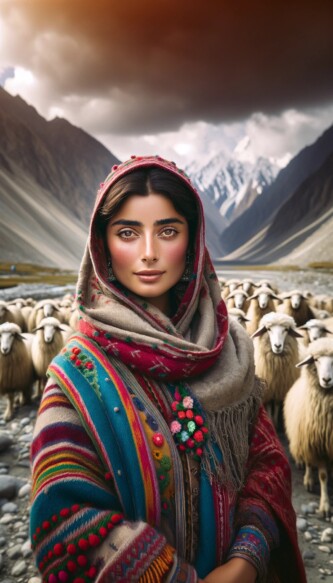
The journey to the Pamir pastures is treacherous, with steep mountain trails and the constant threat of landslides. The shepherdesses whistle and holler at their animals to keep them on the narrow paths. In the past, dozens of shepherdesses would make this trek every summer, but now it takes five days instead of three. The elderly shepherdesses are always ahead of the rest of the group as they are acclimated to the altitude.
The shepherdesses recall the hardships they faced in the past, when they didn't have proper clothing and shoes for the journey. They used to wear simple robes and walk on ice without shoes. They have also faced personal hardships, such as the lack of healthcare facilities in the mountains, resulting in the loss of children. Despite these challenges, they have become successful businesswomen, collecting milk from their animals to make dairy products and trading them for goods and services.
The combination of the women's shepherding and the men's farming has brought significant changes to the community. The income generated by the shepherdesses helped fund the construction of the only road out of the valley, improving access to healthcare, education, and new opportunities. The younger generation has embraced these opportunities, pursuing education and starting businesses in tourism and hospitality.
While the shepherdesses are proud of their children's achievements, there is sadness that the trips to the pastures are no longer viable. Shepherding is more than just a job for them; it is a deep connection to the land and a cherished part of their heritage. As one shepherdess expresses her desire to be buried next to her children in the pastures, it is clear that their bond with the land is profound.
The story of the Wakhi shepherdesses highlights the unique and disappearing way of life in Pakistan's mountainous regions. Their resilience, hard work, and contribution to their community serve as an inspiration, and their story sheds light on the challenges faced by rural communities in the face of modernization and changing lifestyles.
Original news source: The last of their kind: The unique life of Pakistan's Wakhi shepherdesses (BBC)
📖 Vocabulary:
Group or Classroom Activities
Warm-up Activities:
– News Summary
Instructions: Divide the class into small groups. Give each group a few minutes to read the article. Then, ask each group to create a summary of the article, highlighting the main points and key details. Afterward, have each group share their summaries with the class.
– Opinion Poll
Instructions: Create a list of questions related to the article. For example: "Do you think the government should do more to support traditional industries in rural areas?" or "Should the younger generation prioritize education and business opportunities over traditional ways of life?" Divide the class into pairs or small groups and have them discuss the questions and share their opinions. Afterwards, conduct a class-wide poll to see the general consensus on each question.
– Sketch It
Instructions: Choose a scene or moment from the article and have the students sketch it on a piece of paper. Encourage them to include as many details as possible. Afterward, have each student share their sketch with a partner and explain what they drew and why.
– Vocabulary Pictionary
Instructions: Choose 10-15 key vocabulary words from the article and write them on separate slips of paper. Divide the class into two teams. One student from each team will take turns picking a word and drawing it on the board without using any letters or numbers. The team must guess the word within a certain time limit. If they are unable to guess, the other team has a chance to steal.
– Future Predictions
Instructions: In pairs or small groups, have the students discuss and make predictions about the future of the Wakhi shepherdesses and their community. For example, "What do you think will happen to the shepherdesses' way of life in the next 10 years?" or "How do you think the community will continue to evolve and adapt to modernization?" Afterward, have each group share their predictions with the class and facilitate a discussion.
🤔 Comprehension Questions:
🎧✍️ Listen and Fill in the Gaps:
The Wakhi shepherdesses of Pakistan have played a vital role in their community for centuries. These women have trekked to remote mountain pastures to graze their flocks, generating income that has helped their community by funding healthcare, education, and infrastructure development. However, their way of life is out, and there are now only seven shepherdesses left. BBC 100 Women joined them on one of their last trips to the pastures. The journey to the Pamir pastures is treacherous, with steep mountain and the constant threat of landslides. The shepherdesses whistle and at their animals to keep them on the narrow paths. In the past, dozens of would make this trek every summer, but now it takes five days instead of three. The elderly shepherdesses are always ahead of the rest of the group as they are acclimated to the . The shepherdesses recall the hardships they faced in the past, when they didn't have proper clothing and shoes for the journey. They used to wear simple and walk on ice without shoes. They have also faced personal hardships, such as the lack of healthcare facilities in the mountains, in the loss of children. Despite these challenges, they have become successful businesswomen, milk from their animals to make dairy products and trading them for goods and services. The combination of the women's and the men's farming has brought significant changes to the community. The income generated by the shepherdesses helped fund the construction of the only road out of the valley, improving access to , education, and new opportunities. The younger generation has embraced these opportunities, pursuing education and starting businesses in tourism and . While the shepherdesses are proud of their children's achievements, there is sadness that the trips to the pastures are no longer viable. is more than just a job for them; it is a deep connection to the land and a cherished part of their heritage. As one expresses her desire to be buried next to her children in the pastures, it is clear that their bond with the land is profound. The story of the Wakhi shepherdesses the unique and disappearing way of life in Pakistan's mountainous regions. Their resilience, hard work, and contribution to their community serve as an , and their story sheds light on the challenges faced by rural communities in the face of modernization and changing lifestyles.
💬 Discussion Questions:
1. What is the role of the Wakhi shepherdesses in their community?
2. How would you feel if your way of life was dying out?
3. Do you think it is important to preserve traditional ways of life? Why or why not?
4. What challenges do you think the shepherdesses face on their journey to the pastures?
5. How do you think the shepherdesses feel about the changes in their community brought about by their income generation?
6. What do you think are some of the personal hardships the shepherdesses have faced?
7. Do you think it is important for communities to have access to healthcare and education? Why or why not?
8. How do you think the younger generation in the community has benefited from the income generated by the shepherdesses?
9. What do you think it means for the shepherdesses to have a deep connection to the land?
10. How do you think the shepherdesses feel about the trips to the pastures no longer being viable?
11. Do you think it is important for people to preserve their heritage? Why or why not?
12. How do you think the shepherdesses' story can serve as an inspiration?
13. What challenges do you think rural communities face in the face of modernization and changing lifestyles?
14. How do you think the disappearance of traditional ways of life impacts a community?
15. Do you think it is possible to balance modernization and the preservation of traditional ways of life? Why or why not?
Individual Activities
📖💭 Vocabulary Meanings:
Click a dot next to a word, then click the dot next to its meaning to draw a line connecting them.
Words
Meanings
🔡 Multiple Choice Questions:
🕵️ True or False Questions:
📝 Write a Summary:
Write a summary of this news article in two sentences.
Check your writing now with the best free AI for English writing!