

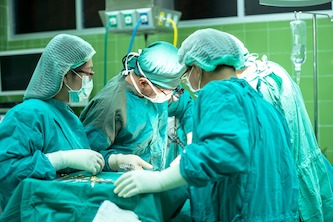
Mr. James, a high-voltage utility line worker from Arkansas, suffered severe facial injuries in an electrical accident. The surgery, performed by over 140 healthcare professionals at NYU Langone Health, has been described as a pivotal moment in medical history. Although his right eye remains functional, the success of the eye transplant offers hope for future advancements in vision restoration.
The surgery provides valuable insights into the healing process of the human eye, with doctors emphasizing that the goal is not to guarantee restored vision but to pave the way for further progress. While there is no certainty regarding Mr. James regaining vision in his new eye, doctors remain optimistic about the potential outcomes. The donated face and eye came from a single male donor in his 30s, and adult stem cells were injected into the optic nerve during the surgery to aid in its repair.
As the 19th person in the US to undergo a face transplant, Mr. James' progress is being closely monitored by medical professionals. His wife expressed a mix of emotions upon seeing him after the surgery, emphasizing her relief and happiness at his successful recovery. Mr. James, a military veteran, expressed gratitude towards the donor and their family for making the life-changing surgery possible, highlighting the transformative impact it has had on his life.
This groundbreaking achievement in the field of surgery and transplants offers hope for individuals with similar medical challenges and sets the stage for further advancements in restoring vision.
Original news source: US veteran gets world's first eye transplant (BBC)
📖 Vocabulary:
Group or Classroom Activities
Warm-up Activities:
– Opinion Spectrum
Instructions: Place a line of tape on the floor to represent an 'opinion spectrum' from 'strongly agree' to 'strongly disagree.' Read out statements related to the article such as "The possibility of restoring vision with eye transplants is worth any risk." Students place themselves along the spectrum according to their opinion and then discuss their reasons with the class.
– News Reporter Role-play
Instructions: Divide the class into pairs. One person is the reporter, the other is a medical expert. The reporter interviews the expert about the groundbreaking eye transplant surgery, its implications, and potential future advancements. Encourage the use of medical and scientific vocabulary from the article.
– Vocabulary Pictionary
Instructions: Write down key vocabulary from the article on slips of paper, such as 'transplant,' 'optic nerve,' 'stem cells,' 'pivotal,' etc. Students take turns drawing the words for their team to guess, without speaking or writing any part of the word.
– Speed Summarizing
Instructions: In pairs or small groups, students have 5 minutes to summarize the article, capturing all the key points. They can then present their summaries to the class, and the rest of the students can evaluate the summaries for completeness and accuracy.
– Future Predictions
Instructions: Ask students to write down their predictions about the future of eye transplants and vision restoration based on the information from the article. They can consider technological, ethical, and medical aspects. Then, they share their predictions with the class or in small groups, discussing the likelihood and potential impact of these predictions coming true.
🤔 Comprehension Questions:
The world's first complete eye transplant was successfully performed on a man named Aaron James, which also involved a rare partial face transplant.
The surgery lasted 21 hours.
A rare partial face transplant was performed alongside the eye transplant.
Mr. James suffered severe facial injuries in an electrical accident while working as a high-voltage utility line worker.
Over 140 healthcare professionals were involved in the surgery.
The primary goal of the surgery is to pave the way for further progress in vision restoration, rather than guaranteeing restored vision.
Mr. James is the 19th person in the US to undergo a face transplant.
Mr. James expressed gratitude towards the donor and their family for making the life-changing surgery possible.
🎧✍️ Listen and Fill in the Gaps:
A groundbreaking achievement has taken place in New York, where surgeons successfully performed the world's first complete eye on a man named Aaron James. This procedure, which lasted 21 hours, also involved a rare face transplant. Despite the uncertainty of regaining vision, experts view this breakthrough as a significant step towards restoring sight for millions of people. Mr. James, a high-voltage utility line worker from Arkansas, suffered severe facial injuries in an electrical accident. The , performed by over 140 healthcare professionals at NYU Langone Health, has been described as a pivotal moment in medical history. Although his right eye functional, the of the eye transplant offers hope for advancements in vision restoration. The surgery provides valuable insights into the healing process of the human eye, with doctors emphasizing that the goal is not to guarantee restored vision but to pave the way for further progress. While there is no certainty regarding Mr. James vision in his new eye, doctors optimistic about the potential outcomes. The donated face and eye came from a single male donor in his 30s, and adult stem cells were injected into the nerve during the surgery to aid in its repair. As the 19th person in the US to undergo a face transplant, Mr. James' progress is being closely by medical professionals. His wife expressed a mix of emotions upon seeing him after the surgery, emphasizing her relief and at his successful recovery. Mr. James, a military veteran, expressed gratitude towards the donor and their family for the life-changing surgery possible, highlighting the impact it has had on his life. This groundbreaking achievement in the field of surgery and transplants offers hope for individuals with similar medical challenges and sets the stage for further advancements in vision.
💬 Discussion Questions:
1. What do you think are the ethical considerations involved in performing experimental surgeries like the eye transplant described in the article?
2. How would you feel if a family member decided to donate their organs, including their eyes, after passing away?
3. Do you believe that the potential benefits of groundbreaking medical procedures outweigh the risks involved? Why or why not?
4. What is your opinion on the importance of medical research in improving the quality of life for individuals with disabilities?
5. Can you imagine the emotional impact of undergoing a surgery that could potentially restore one of your senses? How do you think you would react?
6. How do you think society's view on organ donation might change with more successful surgeries like this one?
7. Do you think that all individuals should automatically be considered organ donors unless they opt out? Why or why not?
8. What is your stance on the use of stem cells in medical treatments and surgeries?
9. How would you feel about receiving a transplant that includes a visible part of another person's body, such as a face transplant?
10. Do you think that surgeries like this should be funded by the government or health insurance? Why or why not?
11. If you had a chance to meet the first person to have a successful eye transplant, what questions would you ask them about their experience?
12. How do you think the advancements in medical technology will shape the future of healthcare?
13. Do you like the idea of living in a world where most injuries and disabilities can be treated with transplants and advanced surgeries? Why or why not?
14. What is your perception of the psychological challenges that might come with adapting to a new body part from a donor?
15. Do you think that the success of such a complex surgery as the eye transplant can inspire people in other fields to push the boundaries of what's possible? How so?
Individual Activities
📖💭 Vocabulary Meanings:
Click a dot next to a word, then click the dot next to its meaning to draw a line connecting them.
Words
Meanings
🔡 Multiple Choice Questions:
🕵️ True or False Questions:
📝 Write a Summary:
Write a summary of this news article in two sentences.
Check your writing now with the best free AI for English writing!