


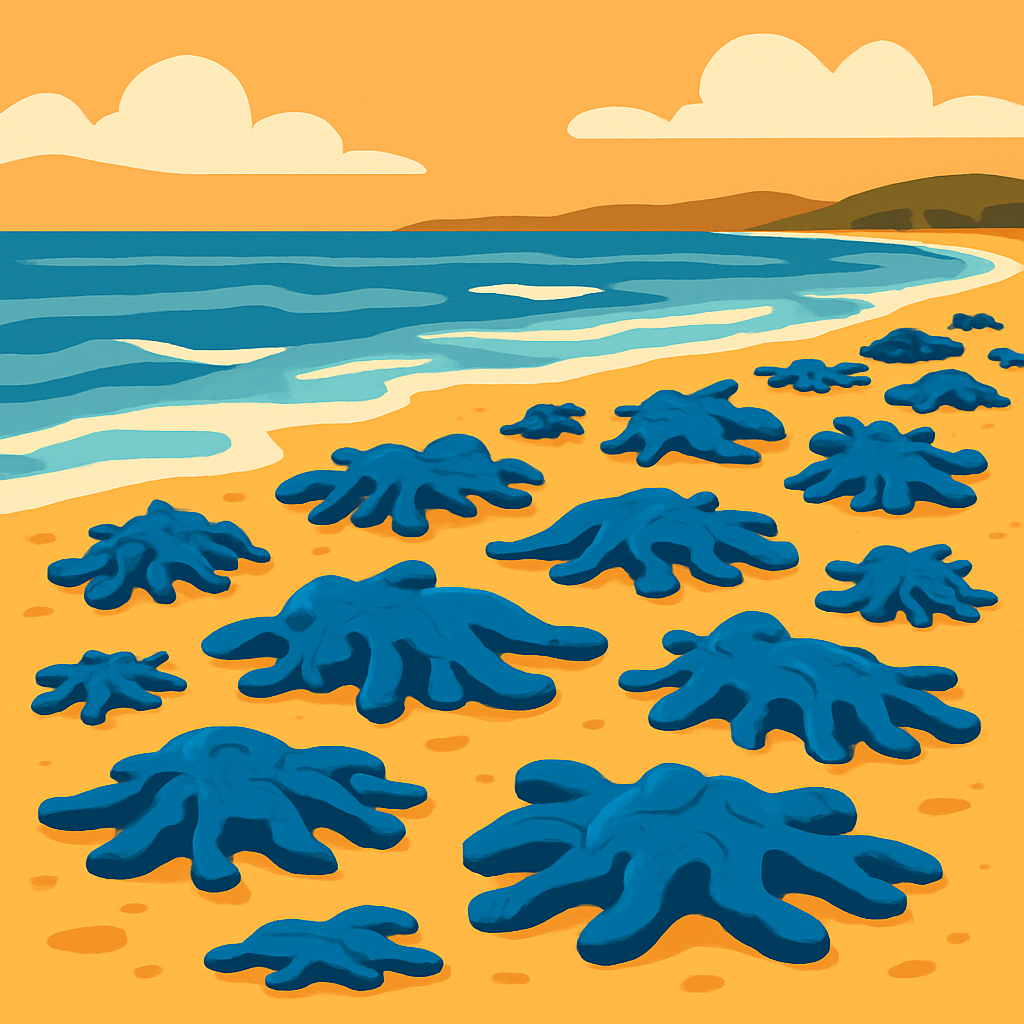
On the shores of St Bees beach in Cumbria, an astonishing marine occurrence has taken place, as hundreds of peculiar blue creatures called by-the-wind sailors have washed ashore. These remarkable entities, scientifically known as Velella velella, are characterized by their striking blue hue and distinctive translucent sails that enable them to cover great distances across the ocean's surface. Though closely akin to the Portuguese man o' war, they are not genuine jellyfish but share a similar appearance and stinging capability.
Louise Nicholson, a local who discovered the beach littered with these organisms, initially mistook them for seaweed. Her inquisitiveness led her to capture the event through photographs, a sentiment echoed by the many visitors drawn to the scene. The by-the-wind sailors, measuring about 5 cm in length, are especially susceptible to washing up during strong onshore winds, as noted by specialists.
Georgia de Jong Cleyndert, the Head of Marine at the Cumbria Wildlife Trust, elucidated the biological sophistication of these creatures. They are colonial hydrozoans, comprised of numerous tiny specialized animals functioning together, gliding gracefully on their blue sails. Although they contribute an enchanting aspect to the beach landscape, caution is advised due to their mild sting, which remains even after they have landed on the beach.
This phenomenon highlights not only the extraordinary adaptability and mobility of marine life but also underscores the broader environmental patterns affecting shorelines. The washed-up Velella velella exemplifies marine biogeography and the dynamic processes that govern oceanic life.
As crowds gather to witness this exceptional natural event, there is a subtle reminder of the continual interplay between wind patterns, ocean currents, and the life thriving within these systems. Observing with engagement and respecting the delicate balance of marine ecology presents both an educational prospect and a stewardship challenge, urging thoughtful interaction with the ocean's fragile marvels.
Original news source: Hundreds of by-the-wind-sailors wash up on St Bees beach – BBC News (BBC)
🎧 Listen:
📖 Vocabulary:
Group or Classroom Activities
Warm-up Activities:
1. Describe an unusual event you witnessed in nature.
2. Share experiences of visiting a beach and what you noticed about marine life.
3. Have you ever mistaken something in nature for something else? Tell us about it.
4. Discuss the role of wind in sea and land activities you know of.
5. What do you think makes a natural event fascinating to people?
🤔 Comprehension Questions:
The creatures that washed ashore are called by-the-wind sailors, or Velella velella.
They are distinguished by their vibrant blue color and unique translucent sails.
She initially mistook them for seaweed but then documented them with photographs.
They are about 5 cm in length.
Caution is advised because they possess a mild sting.
It illustrates the influence of wind patterns and ocean currents on marine life along shorelines.
Georgia de Jong Cleyndert from the Cumbria Wildlife Trust provided expert commentary.
🎧✍️ Listen and Fill in the Gaps:
On the shores of St Bees beach in Cumbria, an astonishing marine occurrence has taken , as hundreds of peculiar blue creatures called sailors have washed . These remarkable , scientifically known as Velella velella, are characterized by their striking blue hue and distinctive translucent sails that enable them to cover great distances across the ocean's surface. Though closely akin to the Portuguese man o' war, they are not genuine jellyfish but share a appearance and stinging capability. Louise Nicholson, a local who discovered the beach littered with these organisms, initially mistook them for seaweed. Her inquisitiveness led her to capture the through photographs, a sentiment echoed by the many visitors drawn to the scene. The by-the-wind sailors, measuring about 5 cm in length, are susceptible to washing up strong onshore winds, as noted by specialists. Georgia de Jong Cleyndert, the Head of Marine at the Cumbria Wildlife Trust, elucidated the sophistication of these . They are colonial hydrozoans, comprised of numerous tiny specialized animals functioning together, gliding gracefully on their blue sails. Although they an enchanting aspect to the beach landscape, caution is advised due to their mild , which remains even after they have landed on the beach. This phenomenon highlights not only the extraordinary adaptability and mobility of marine life but also underscores the broader environmental patterns affecting shorelines. The washed-up Velella exemplifies marine biogeography and the dynamic processes that govern oceanic life. As crowds gather to witness this exceptional natural event, there is a subtle reminder of the continual interplay between wind patterns, ocean currents, and the life thriving within these systems. Observing with engagement and respecting the delicate balance of marine ecology presents both an prospect and a stewardship challenge, interaction with the ocean's fragile marvels.
💬 Discussion Questions:
1. What environmental patterns influence marine life on beaches?
2. How would you explain the adaptability of marine organisms?
3. In your opinion, how important is it to protect marine life?
4. How can human activities affect marine ecosystems?
5. What did you learn from the recent natural events in the news?
6. Discuss the impact of photography on documenting wildlife.
7. What challenges do you think beachgoers face in maintaining marine ecology?
8. How do wind patterns contribute to oceanic processes?
9. Share your thoughts on the role of beach events in raising environmental awareness.
10. Why is it important to study events like those with Velella velella?
11. How do you perceive the relationship between humans and marine life?
12. What measures can be taken to ensure marine life is respected and protected?
Individual Activities
📖💭 Vocabulary Meanings:
Click a dot next to a word, then click the dot next to its meaning to draw a line connecting them.