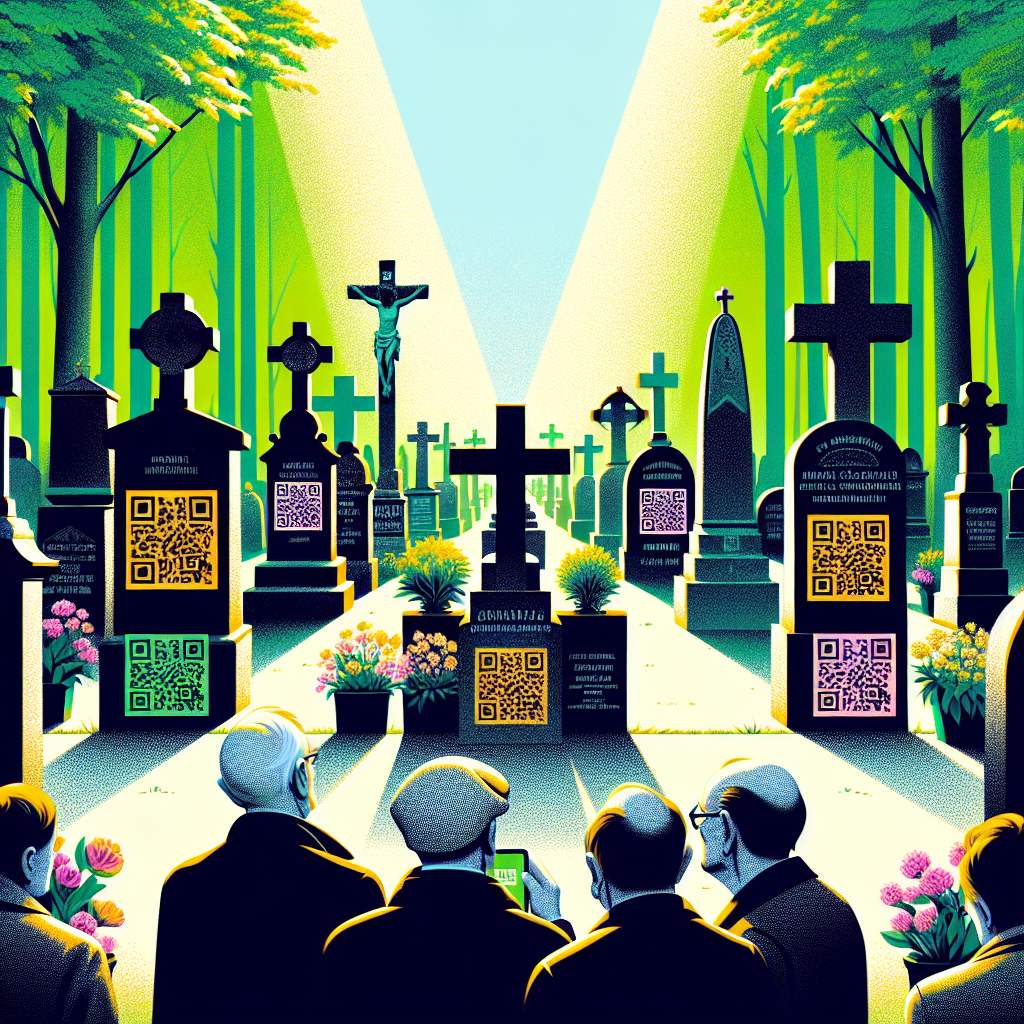
In the city of Munich, Germany, a peculiar incident has occurred at three cemeteries: Waldfriedhof, Sendlinger Friedhof, and Friedhof Solln. Over 1,000 stickers have been affixed to gravestones and wooden crosses, prompting an investigation by local police. The stickers feature QR codes that, when scanned, provide information about the deceased, including their name and the exact location of their grave within the cemetery.
The stickers, measuring 5×3.5 centimeters (approximately 1.95×1.2 inches), have appeared on both older gravestones and more recent burials, which often only have a simple wooden cross marking the grave. This unusual act has raised questions among the community and authorities alike, as there seems to be no clear motive or pattern behind the placement of these stickers.
Police spokesperson Christian Drexler has stated that the investigation is ongoing, and they have yet to identify any connections between the graves that received stickers. He emphasized the randomness of the placements, noting that some stickers were found on gravestones that have been in place for decades, while others were on much newer graves. This lack of a discernible pattern has made the investigation more challenging.
Authorities are appealing to the public for assistance. They are encouraging anyone who may have witnessed the application of these stickers to contact the administration of the respective cemeteries. This outreach aims to gather more information that could help in identifying the individuals responsible for this act.
As the investigation unfolds, the community remains curious about the intentions behind these stickers. The use of QR codes in such a solemn setting raises ethical questions about respect for the deceased and their families. The outcome of this investigation may provide clarity on the motivations behind this unusual phenomenon in Munich's cemeteries.
Original news source: Mysterious QR code stickers appear on more than 1,000 graves in Munich (Sky News)
🎧 Listen:
📖 Vocabulary:
Group or Classroom Activities
Warm-up Activities:
– CHARADES
Instructions: Divide the students into two teams. Each team takes turns selecting a word or phrase related to the article (e.g., "QR code," "cemetery," "investigation"). One student from the team acts out the word or phrase without speaking, while their teammates guess what it is. Set a timer for each turn to keep the game fast-paced.
– OPINION POLL
Instructions: Present the students with a series of statements related to the ethical questions raised in the article (e.g., "Using QR codes on gravestones is respectful" or "The investigation is important for community safety"). Students will move to different corners of the classroom to indicate their agreement or disagreement with each statement. After each poll, have a brief discussion on their opinions.
– HEADLINE CREATION
Instructions: Ask students to come up with catchy headlines for the article. They should focus on summarizing the key points and engaging the reader's interest. Once they have created their headlines, students can share them with the class, and a few can be selected for a class display.
– MIND MAP
Instructions: In groups, students will create a mind map based on the article. They should include key themes such as "cemeteries," "stickers," "investigation," and "community reaction." Each group will present their mind map to the class, explaining their connections and ideas.
– TWO TRUTHS AND A LIE
Instructions: Each student will write down two true statements and one false statement related to the article's content. For example, they might say, "The stickers were placed randomly," "The investigation is complete," and "Police are asking for public assistance." Students will share their statements with a partner, who must identify the lie among the three.
🤔 Comprehension Questions:
The specific locations mentioned are Waldfriedhof, Sendlinger Friedhof, and Friedhof Solln.
The QR codes provide information about the deceased, including their name and the exact location of their grave within the cemetery when scanned.
The stickers measure 5×3.5 centimeters (approximately 1.95×1.2 inches) and have been found on both older gravestones and more recent burials, which often have simple wooden crosses.
The investigation has faced challenges due to the randomness of the placements, with no clear motive or pattern identified, making it difficult to connect the graves that received stickers.
Christian Drexler is a police spokesperson who has stated that the investigation is ongoing and has emphasized the randomness of the sticker placements.
Authorities are appealing to the public for assistance by encouraging anyone who may have witnessed the application of the stickers to contact the administration of the respective cemeteries.
The use of QR codes in such a solemn setting raises ethical questions about respect for the deceased and their families.
The outcome of the investigation may provide clarity on the motivations behind the unusual phenomenon, potentially affecting how the community perceives the act of placing stickers in cemeteries.
🎧✍️ Listen and Fill in the Gaps:
In the city of Munich, Germany, a peculiar has occurred at three cemeteries: Waldfriedhof, Sendlinger Friedhof, and Friedhof Solln. Over 1,000 stickers have been affixed to stones and wooden , prompting an by local police. The stickers feature QR codes that, when scanned, provide information about the deceased, including their name and the exact location of their grave within the cemetery. The stickers, measuring 5×3.5 centimeters (approximately 1.95×1.2 inches), have appeared on both older gravestones and more recent , which often only have a simple cross the grave. This unusual act has raised questions among the community and authorities alike, as there seems to be no clear motive or pattern behind the placement of these stickers. Police spokesperson Christian Drexler has stated that the investigation is ongoing, and they have yet to identify any between the graves that received . He emphasized the randomness of the placements, noting that some stickers were found on gravestones that have been in place for , while others were on much newer graves. This lack of a discernible pattern has made the investigation more challenging. are appealing to the public for assistance. They are encouraging anyone who may have the application of these stickers to contact the administration of the respective cemeteries. This outreach aims to gather more information that could help in identifying the individuals responsible for this act. As the investigation unfolds, the community remains about the intentions behind these stickers. The use of QR codes in such a setting raises ethical about for the deceased and their families. The outcome of this investigation may provide clarity on the motivations behind this unusual phenomenon in Munich's cemeteries.
💬 Discussion Questions:
1. What is your opinion on the use of technology, like QR codes, in places typically associated with mourning and remembrance?
2. How would you feel if you discovered a sticker with a QR code on a grave of someone you loved?
3. Do you think that placing stickers on gravestones is a respectful way to remember the deceased? Why or why not?
4. What is a meaningful way you think people can honor their loved ones who have passed away?
5. How would you react if you found out that the stickers were placed there with good intentions, such as to preserve memories?
6. Do you like the idea of using technology to share information about people who have died? Why or why not?
7. How do you think the families of the deceased might feel about the stickers being placed on their loved ones' graves?
8. Do you think this incident could lead to more people using technology to remember their loved ones? Why or why not?
9. What is a cultural practice in your country regarding honoring the deceased that you find particularly meaningful?
10. How would you feel if a similar incident occurred in your hometown? Would it spark curiosity or concern?
11. Do you think the investigation into the stickers will reveal something positive or negative? Why?
12. What is your view on the balance between technology and tradition in modern society, especially in sensitive areas like cemeteries?
13. How would you feel if someone you knew was involved in placing the stickers? Would your feelings change based on their intentions?
14. Do you think the community's response to this incident reflects a broader attitude towards death and remembrance? Why or why not?
15. What is a positive way to use technology in memorializing loved ones that you would support?
Individual Activities
📖💭 Vocabulary Meanings:
Click a dot next to a word, then click the dot next to its meaning to draw a line connecting them.
Words
Meanings
🔡 Multiple Choice Questions:
🕵️ True or False Questions:
📝 Write a Summary:
Write a summary of this news article in two sentences.
Check your writing now with the best free AI for English writing!