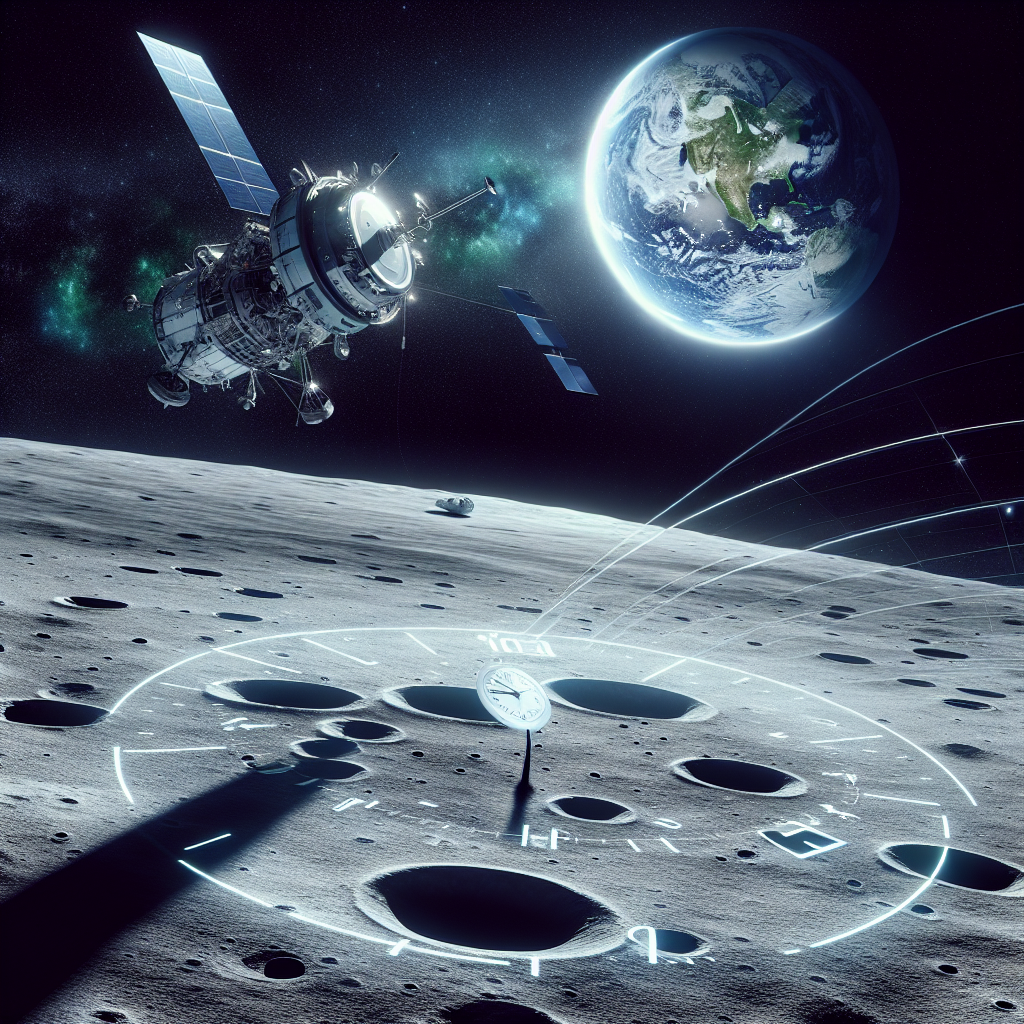
The White House is urging NASA to develop a new time zone for the Moon called Coordinated Lunar Time (LTC). Due to the Moon's different gravitational field strength, time moves faster there compared to Earth, with a difference of 58.7 microseconds per day. While this may seem insignificant, it can have a significant impact on synchronizing spacecraft. The US government hopes that implementing a new time zone will help coordinate national and private efforts to reach the Moon.
According to Professor Catherine Heymans, Scotland's Astronomer Royal, the theory of gravity in our Universe states that time runs differently in different places. The gravity on the Moon is slightly weaker, causing clocks to run differently. Currently, time is measured on Earth using atomic clocks that measure the changing energy state of atoms to record time to the nanosecond. If these clocks were placed on the Moon, they would run one second faster over a span of 50 years.
NASA is not the only organization working on creating a lunar time system. The European Space Agency is also developing its own time system. However, for a new time zone to be established, there needs to be agreement between countries and a centralized coordinating body. Currently, the International Bureau of Weights and Measures is responsible for coordinating time on Earth. The starting point and extent of the new time frame will also need to be determined through international consensus.
The US aims to have LTC ready by 2026 for its manned mission to the Moon, known as Artemis-3. This mission will be the first to return to the Moon's surface since Apollo 17 in 1972. Precision is crucial in locating and directing this mission, as errors in navigation could result in spacecraft entering the wrong orbits. Additionally, if time is not coordinated between different missions, it could pose challenges in sending data and communication between spacecraft, satellites, and Earth.
In conclusion, the White House is pushing for the development of a new time zone for the Moon to ensure better coordination and synchronization of spacecraft missions. The different gravitational field on the Moon causes time to move faster there compared to Earth. Establishing a new time zone requires international agreement and a centralized coordinating body. The US aims to have this new time zone ready by 2026 for its manned mission to the Moon.
Original news source: White House wants Moon to have its own time zone (BBC)
🎧 Listen:
📖 Vocabulary:
Group or Classroom Activities
Warm-up Activities:
– News Summary
Instructions: In pairs or small groups, students will read the article and then work together to create a concise summary of the main points. They should focus on capturing the key information and presenting it in a clear and organized manner. Afterward, groups can take turns sharing their summaries with the class.
– Opinion Poll
Instructions: Students will form pairs or small groups. Each group will discuss and debate their opinions on the idea of creating a new time zone for the Moon. They should consider the advantages, disadvantages, and potential challenges of implementing such a system. Afterward, each group will present their opinions to the class and lead a class-wide discussion.
– Vocabulary Pictionary
Instructions: Divide the class into two teams. Give each team a set of vocabulary words from the article. One team member from each team will come to the front of the class and draw a picture to represent a word without speaking or writing any letters or numbers. The team members must guess the word based on the drawing. The team that guesses correctly earns a point. Continue until all the words have been drawn and guessed.
– Pros and Cons
Instructions: In pairs or small groups, students will create a list of the pros and cons of establishing a new time zone for the Moon. They should consider the potential benefits and drawbacks from various perspectives, such as scientific, logistical, and international cooperation. Afterward, each group will share their lists and engage in a class discussion to compare and analyze the different viewpoints.
– Future Predictions
Instructions: In pairs or small groups, students will discuss and make predictions about the future of space exploration and the potential impact of a new time zone for the Moon. They should consider the advancements in technology, international cooperation, and potential challenges that may arise. Afterward, each group will present their predictions to the class and engage in a class-wide discussion.
🤔 Comprehension Questions:
🎧✍️ Listen and Fill in the Gaps:
The White is urging NASA to develop a new time zone for the Moon called Lunar Time (LTC). Due to the Moon's different gravitational field strength, time moves faster there compared to Earth, with a difference of 58.7 microseconds per day. While this may seem insignificant, it can have a significant impact on synchronizing . The US government hopes that implementing a new time zone will help coordinate national and private to reach the Moon. According to Professor Catherine Heymans, Scotland's Astronomer Royal, the theory of gravity in our Universe states that time runs differently in different places. The gravity on the Moon is slightly weaker, causing clocks to run differently. Currently, time is d on Earth using atomic clocks that measure the energy state of to record time to the nanosecond. If these clocks were placed on the Moon, they would run one second faster over a span of 50 years. NASA is not the only organization working on creating a lunar time system. The European Space Agency is also developing its own time system. However, for a new time zone to be established, there needs to be agreement between and a centralized coordinating body. Currently, the International Bureau of Weights and Measures is responsible for coordinating time on Earth. The point and extent of the new time will also need to be determined through international consensus. The US aims to have LTC ready by 2026 for its manned to the Moon, known as Artemis-3. This mission will be the first to return to the Moon's surface since Apollo 17 in 1972. Precision is crucial in and directing this mission, as errors in navigation could result in spacecraft entering the wrong orbits. Additionally, if time is not coordinated between different missions, it could pose challenges in sending data and communication between spacecraft, satellites, and Earth. In conclusion, the White House is pushing for the development of a new time zone for the Moon to ensure better coordination and synchronization of spacecraft missions. The different gravitational field on the Moon time to move faster there to Earth. Establishing a new time zone requires agreement and a coordinating body. The US aims to have this new time zone ready by 2026 for its manned mission to the Moon.
💬 Discussion Questions:
1. What is the significance of having a coordinated time zone for spacecraft missions to the Moon?
2. How would you feel if you were part of a manned mission to the Moon and had to adjust to a new time zone?
3. Do you think it is necessary to have a centralized coordinating body for establishing a new time zone for the Moon? Why or why not?
4. What challenges do you think could arise if time is not coordinated between different spacecraft missions?
5. How do you think the development of a lunar time system will impact future space exploration?
6. Do you believe that time runs differently in different places? Why or why not?
7. What are the potential benefits of having a new time zone for the Moon?
8. How do you think the development of a lunar time system will affect communication between spacecraft, satellites, and Earth?
9. Would you like to be part of a manned mission to the Moon? Why or why not?
10. What do you think are the main factors that need to be considered when determining the starting point and extent of the new time frame for the Moon?
11. How do you think the implementation of a new time zone for the Moon will impact international cooperation in space exploration?
12. What challenges do you think could arise in reaching international agreement on the establishment of a new time zone for the Moon?
13. Do you think the development of a lunar time system will have any implications for timekeeping on Earth? Why or why not?
14. How do you think the development of a new time zone for the Moon will affect future scientific research and discoveries?
15. What other factors, besides time, do you think need to be considered in coordinating spacecraft missions to the Moon? Why?
Individual Activities
📖💭 Vocabulary Meanings:
Click a dot next to a word, then click the dot next to its meaning to draw a line connecting them.
Words
Meanings
🔡 Multiple Choice Questions:
🕵️ True or False Questions:
📝 Write a Summary:
Write a summary of this news article in two sentences.
Check your writing now with the best free AI for English writing!