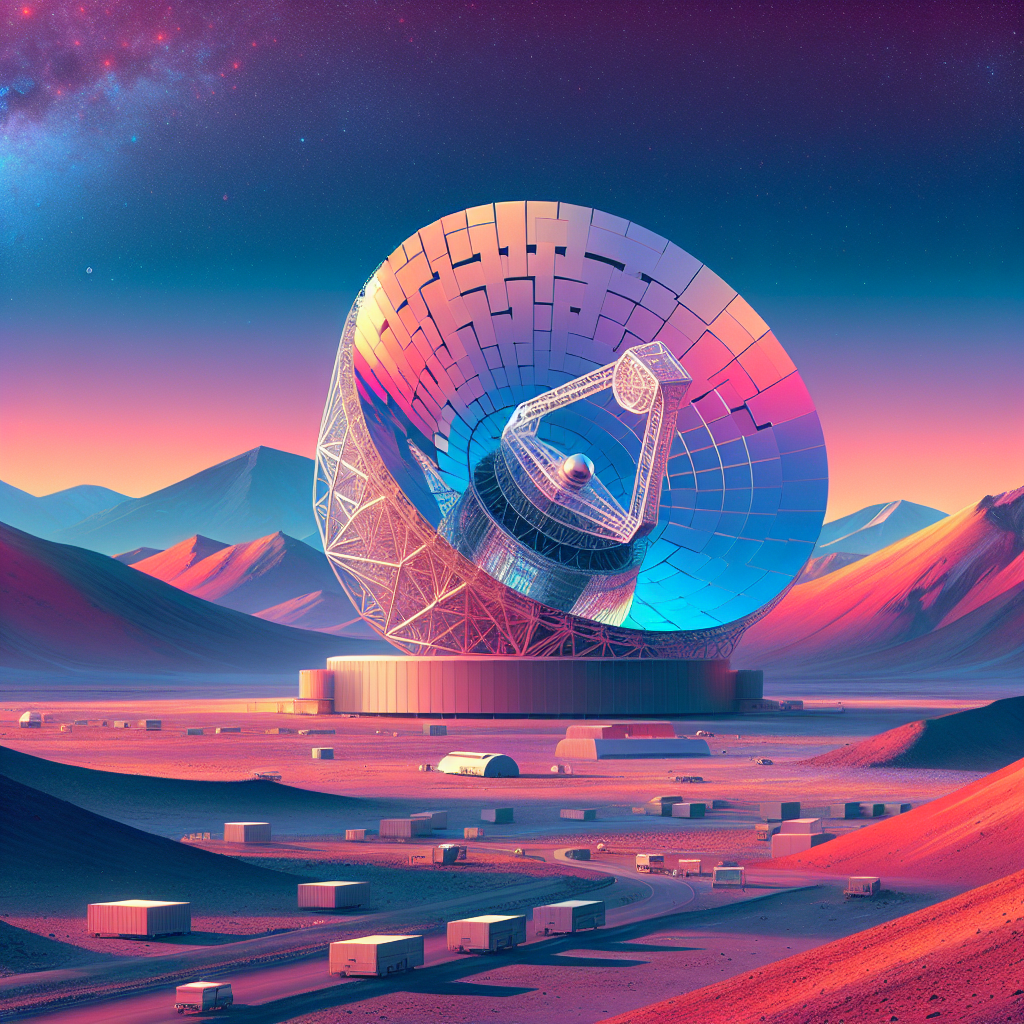
In a very dry place called the Atacama desert in Chile, people are building a huge telescope. This telescope will be the biggest in the world and will help us see stars and planets better. A scientist named Dr. Elise is helping to make special mirrors for this telescope. The biggest mirror is as wide as 39 meters and is made of 798 pieces. These mirrors help the telescope see clearly by catching and fixing light.
In Germany, a company named Zeiss is making very smooth mirrors for tiny machines. These machines help make computer chips, which are like the brains of computers. The mirrors are so smooth that they can help see very tiny things clearly. This helps put more tiny parts on computer chips. By 2030, they want to make chips with lots and lots of tiny parts to make computers even smarter.
Original news source: The mind-bending mirrors behind advanced technology (BBC)
🎧 Listen:
📖 Vocabulary:
Group or Classroom Activities
Warm-up Activities:
– Charades
Instructions: Write down key words from the article on separate pieces of paper (e.g., telescope, Atacama desert, Chile, stars, planets, mirrors, Germany, Zeiss, computer chips). Have students take turns picking a word and acting it out without speaking while the others guess what it is.
– Vocabulary Pictionary
Instructions: Write down key words from the article on the board. Divide the students into small groups. Each group takes turns choosing a word and drawing it while the others try to guess the word. Encourage them to use their English vocabulary to describe and guess the drawings.
– News Summary
Instructions: Divide the class into pairs. Have each pair read the article together and then summarize it in their own words. Encourage them to focus on the main points and practice speaking English to explain the article to their partner.
– Opinion Poll
Instructions: Create simple questions related to the article (e.g., "Do you think building the world's biggest telescope is important?"). Have students move around the classroom to ask their classmates the questions and record their answers. Afterwards, encourage them to share their findings with the class using English.
– Sketch It
Instructions: Divide the class into pairs. Give each pair a key word from the article (e.g., telescope, mirrors, computer chips). One student describes the word to their partner, who then tries to sketch it. This activity helps students practice communication skills and expand their English vocabulary.
🤔 Comprehension Questions:
They are building a huge telescope.
Dr. Elise is helping to make the special mirrors.
The biggest mirror is made of 798 pieces.
Zeiss is making mirrors for tiny machines.
The smooth mirrors help see very tiny things clearly.
Computer chips are like the brains of computers.
They want to make computers even smarter by adding lots of tiny parts to the chips.
🎧✍️ Listen and Fill in the Gaps:
In a very dry called the Atacama desert in Chile, people are building a huge . This telescope will be the biggest in the world and will help us see stars and planets better. A scientist named Dr. Elise is helping to make special mirrors for this telescope. The biggest mirror is as wide as 39 and is made of 798 . These mirrors help the telescope see clearly by catching and fixing light. In Germany, a company named is making very smooth mirrors for machines. These machines help make computer chips, which are like the brains of computers. The mirrors are so smooth that they can help see very tiny things clearly. This helps put more tiny parts on computer chips. By 2030, they want to chips with lots and lots of tiny parts to make even smarter.
💬 Discussion Questions:
1. What do you think about the big telescope in the desert?
2. Do you like looking at stars and planets?
3. How would you feel if you could see stars and planets better with a telescope?
4. What is a computer chip?
5. Why do you think it's important to make computer chips with tiny parts?
6. Do you think it's cool that mirrors can help make computer chips?
7. What do you think about the mirrors being made in Germany?
8. How do you feel about the idea of computers becoming smarter in the future?
9. Do you like learning about science and technology?
10. Why do you think it's important to have big telescopes to see stars and planets?
11. How would you feel if you could help build a telescope or make computer chips?
12. What is your favorite thing to learn about in science class?
Individual Activities
📖💭 Vocabulary Meanings:
Click a dot next to a word, then click the dot next to its meaning to draw a line connecting them.
Words
Meanings
🔡 Multiple Choice Questions:
🕵️ True or False Questions:
📝 Write a Summary:
Write a summary of this news article in two sentences.
Check your writing now with the best free AI for English writing!