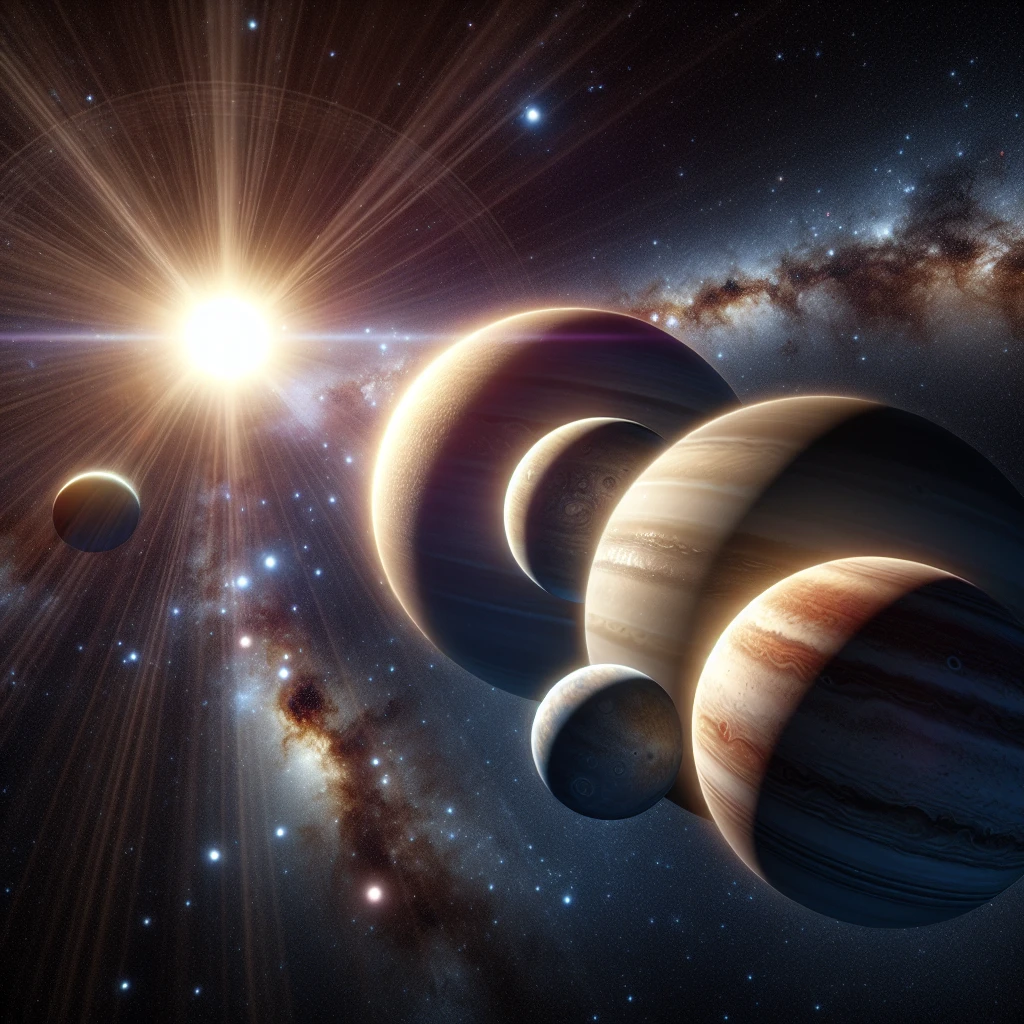
People who study stars and planets are very excited about this. They think these planets can help us learn a lot. We can look at the air around these planets to find signs of life. These planets are bigger than Earth but smaller than a big planet called Neptune.
Scientists think there might be life on planets like these. They want to learn what these planets are made of. They hope to find clues of life on one of these planets. New tools will help them look for life in space. They think they might find life not too far in the future.
Original news source: Perfect solar system' found in search for alien life (BBC)
📖 Vocabulary:
Group or Classroom Activities
Warm-up Activities:
– Charades
Instructions: Divide the class into small groups. Give each group a slip of paper with a word or phrase related to the article (e.g. planets, stars, life, tools). One student from each group will act out the word or phrase without speaking, while the other students in the group try to guess what it is. The group that guesses correctly gets a point.
– Word Association
Instructions: Have the class sit in a circle. Start by saying a word related to the article (e.g. planets). The next student has to say a word that is associated with the previous word (e.g. stars). Continue around the circle, with each student saying a word that is related to the previous word. If a student can't think of a word, they're out. The last student remaining wins.
– Vocabulary Pictionary
Instructions: Divide the class into pairs. Give each pair a list of vocabulary words from the article (e.g. planets, life, tools). Student A chooses a word and has to draw a picture to represent it, while Student B tries to guess the word. After a certain amount of time, switch roles. The pair with the most correct guesses wins.
– Speed Summarizing
Instructions: Divide the class into pairs. Give each pair a copy of the article. Student A has one minute to summarize the article to Student B, using their own words. After one minute, Student B has to summarize what they heard to Student A. Encourage students to use simple language and focus on the main points of the article.
– Think-Pair-Share
Instructions: Have the class sit in pairs. Read a question related to the article (e.g. "Why are scientists excited about these planets?"). Give students a few moments to think about their answer, then have them discuss their answers with their partner. After a few minutes, ask a few pairs to share their answers with the class.
🤔 Comprehension Questions:
Scientists found a special group of planets far away.
These planets are all the same size.
No, these planets have not changed for a very long time.
We can find signs of life by looking at the air around these planets.
These planets are bigger than Earth.
Scientists think there might be life on these planets.
Scientists think they might find life not too far in the future.
🎧✍️ Listen and Fill in the Gaps:
Scientists a special group of far away. These planets are all the same size and very old. They have not changed for a very long time. The way they move around their sun is special and can be made into music. People who study stars and planets are very excited about this. They think these planets can us a lot. We can look at the air around these planets to find signs of life. These planets are bigger than Earth but smaller than a big planet . Scientists think there might be life on planets like these. They want to learn what these planets are made of. They hope to clues of life on one of these planets. New will help them look for life in space. They think they might find life not too far in the future.
💬 Discussion Questions:
1. What do scientists study?
2. How do scientists feel about the special group of planets they found?
3. How do scientists think these planets can help us?
4. What do scientists hope to find on these planets?
5. Do you think there is life on these planets? Why or why not?
6. Do you like learning about stars and planets? Why or why not?
7. How do scientists want to find signs of life on these planets?
8. How do scientists feel about the new tools that will help them look for life in space?
9. How would you feel if you found signs of life on one of these planets?
10. What do you think these planets are made of?
11. How big are these planets compared to Earth?
12. What do you think the music made from the way these planets move would sound like?
Individual Activities
📖💭 Vocabulary Meanings:
Click a dot next to a word, then click the dot next to its meaning to draw a line connecting them.
Words
Meanings
🔡 Multiple Choice Questions:
🕵️ True or False Questions:
📝 Write a Summary:
Write a summary of this news article in two sentences.
Check your writing now with the best free AI for English writing!