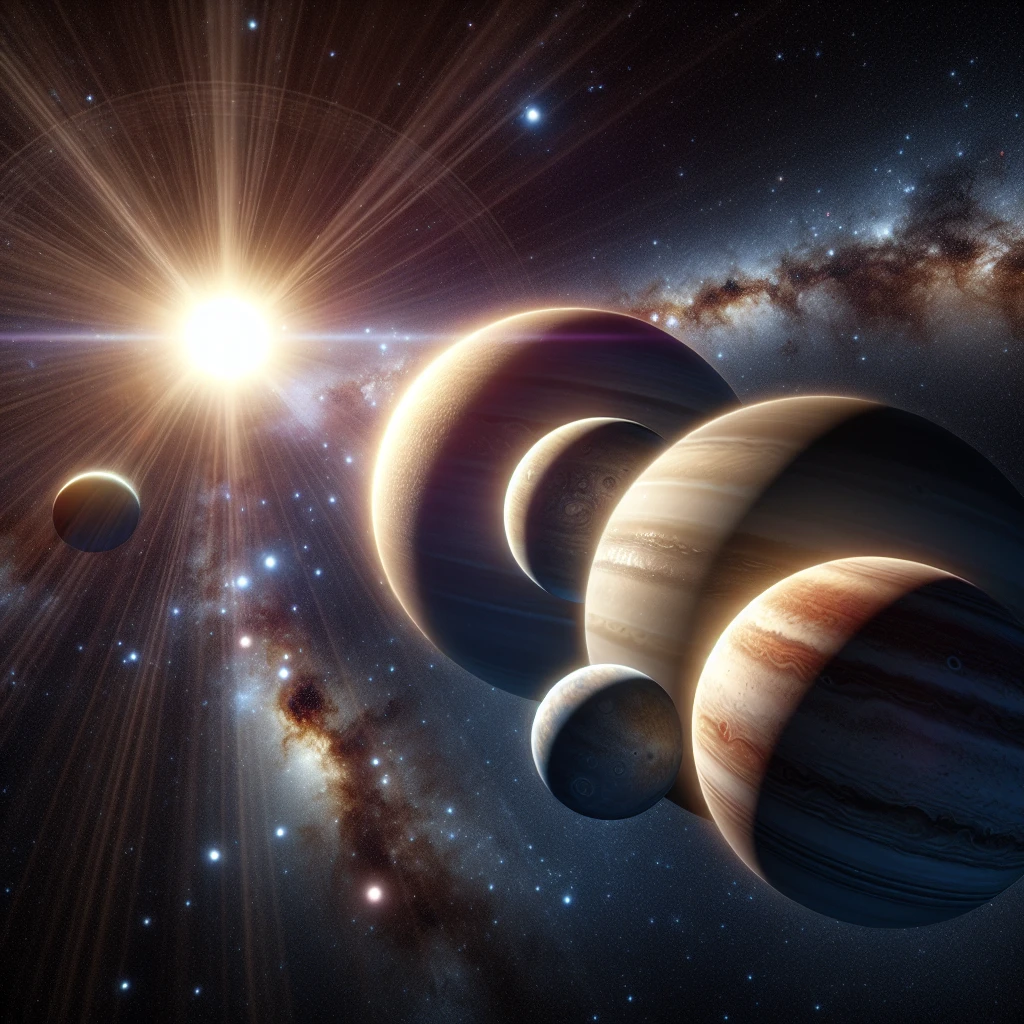
Dr Rafael Luque, who led the research, described HD110067 as "the perfect solar system" because it didn't have the chaotic beginnings that our own system had. Dr Marina Lafarga-Magro added that the system was "beautiful and unique" and that it was exciting to see something that no one had seen before. This system is of great interest to astronomers because its undisturbed nature and the near-identical size of its planets make it easier to study how planets form and evolve. Additionally, the system has a bright star, which makes it easier to search for signs of life in the planets' atmospheres.
All six planets in this system are classified as "sub-Neptunes," which are larger than Earth but smaller than Neptune. These types of planets are thought to be the most common in the galaxy, yet astronomers know very little about them. The discovery of HD110067 provides an opportunity to learn more about these planets and whether they can support life. If the next round of observations indicates that sub-Neptunes can indeed support life, it greatly increases the chances of finding signs of life on other planets.
Scientists are now racing to detect biosignatures on one of the six new sub-Neptunes or on other similar planets discovered by different groups. With the help of advanced telescopes and new technologies, many astronomers believe that the search for alien life may not take too long. The planets in HD110067 were discovered using NASA's Transiting Exoplanet Survey Satellite (TESS) and ESA's CHaracterising ExOPlanet Satellite (Cheops).
Original news source: Perfect solar system' found in search for alien life (BBC)
📖 Vocabulary:
Group or Classroom Activities
Warm-up Activities:
– News Summary
Instructions:
1. Divide the class into small groups.
2. Give each group a copy of the article.
3. Have each group read the article silently and discuss the main points.
4. Instruct each group to create a concise summary of the article, highlighting the key information.
5. After a designated amount of time, have each group share their summary with the class.
– Opinion Poll
Instructions:
1. Divide the class into pairs.
2. Give each pair a copy of the article.
3. Instruct each pair to read the article and discuss their opinions on the discovery of the "perfect solar system" and the possibility of finding signs of life on other planets.
4. After the discussion, have each pair come up with three poll questions related to the topic.
5. Have each pair take turns asking their poll questions to another pair, recording the responses.
6. After all pairs have asked their questions, have a class discussion sharing the different opinions and results.
– Sketch It
Instructions:
1. Divide the class into pairs.
2. Give each pair a blank sheet of paper and a pen or pencil.
3. Instruct one person in each pair to describe one of the planets in the "perfect solar system" to their partner, without using its name.
4. The other person must sketch the planet based on the description they hear.
5. After a designated amount of time, have the pairs switch roles.
6. Once both partners have had a chance to describe and sketch a planet, have them compare their sketches and discuss any similarities or differences.
– Vocabulary Pictionary
Instructions:
1. Write down 10 vocabulary words from the article on individual pieces of paper and put them in a hat or container.
2. Divide the class into two teams.
3. Have one person from each team come to the front of the class.
4. Draw a word from the hat and show it to both players.
5. Each player must take turns drawing a picture to represent the word, without using any letters or numbers.
6. The rest of the team must guess the word based on the drawing.
7. The team that guesses the word correctly earns a point.
8. Repeat the process with new players until all the words have been drawn.
– Future Predictions
Instructions:
1. Have a class discussion about the discovery of the "perfect solar system" and the potential for finding signs of life on other planets.
2. Ask each student to make a prediction about what they think will happen in the future regarding the search for alien life.
3. Instruct each student to write their prediction down on a piece of paper, without sharing it with anyone.
4. After everyone has written their prediction, collect the papers and read them out loud to the class.
5. Have a class discussion about the different predictions and the reasons behind each one.
🤔 Comprehension Questions:
The HD110067 solar system has six planets that are all about the same size and have remained unchanged for up to 12 billion years, while our solar system has planets of different sizes formed through violent collisions.
Scientists are interested in studying the HD110067 solar system because its undisturbed nature and the near-identical size of its planets make it easier to study how planets form and evolve. Additionally, the system has a bright star, which makes it easier to search for signs of life in the planets' atmospheres.
"Sub-Neptunes" are planets that are larger than Earth but smaller than Neptune.
The discovery of HD110067 is significant for learning more about sub-Neptunes because it provides an opportunity to study these types of planets, which are thought to be the most common in the galaxy. By studying HD110067 and its planets, scientists can learn more about the formation and evolution of sub-Neptunes and whether they can support life.
Scientists are racing to detect biosignatures on one of the sub-Neptunes or other similar planets. Biosignatures are signs of life, such as the presence of certain molecules or gases in a planet's atmosphere.
The planets in the HD110067 system were discovered using NASA's Transiting Exoplanet Survey Satellite (TESS) and ESA's CHaracterising ExOPlanet Satellite (Cheops).
The undisturbed nature of the HD110067 system makes it easier to study planet formation and evolution because the planets in this system have remained unchanged for up to 12 billion years. This allows scientists to observe the planets in their original state and understand how they formed and evolved over time.
If sub-Neptunes can support life, the chances of finding signs of life on other planets increase greatly. Since sub-Neptunes are thought to be the most common type of planet in the galaxy, discovering that they can support life would suggest that the potential for life on other planets is also high.
🎧✍️ Listen and Fill in the Gaps:
Scientists have discovered a "perfect system" that is ideal for studying how form and whether they can support life. Located 100 light years away, this system has six planets that are all about the same size and have unchanged for up to 12 billion years. In contrast, our own solar system was formed through violent collisions, in planets of different sizes. The planets in this new system, named HD110067, rotate in sync and have a precise pattern of relative orbit speeds. Researchers have even created a musical based on this planetary choreography. Dr Rafael Luque, who led the research, described HD110067 as "the perfect solar " because it didn't have the chaotic beginnings that our own system had. Dr Marina Lafarga-Magro added that the system was "beautiful and unique" and that it was exciting to see something that no one had seen before. This system is of interest to astronomers because its nature and the near-identical size of its planets make it easier to study how planets form and evolve. Additionally, the system has a bright star, which makes it easier to search for signs of life in the planets' atmospheres. All six planets in this system are as "sub-Neptunes," which are larger than Earth but smaller than Neptune. These types of planets are thought to be the most common in the galaxy, yet know very little about them. The discovery of provides an opportunity to learn more about these planets and whether they can support life. If the next round of indicates that sub-Neptunes can indeed support life, it greatly the chances of finding signs of life on other planets. Scientists are now racing to detect biosignatures on one of the six new sub-Neptunes or on other planets discovered by different groups. With the help of advanced and new technologies, many astronomers believe that the for alien life may not take too long. The planets in HD110067 were discovered using NASA's Transiting Exoplanet Survey Satellite (TESS) and ESA's CHaracterising ExOPlanet Satellite (Cheops).
💬 Discussion Questions:
1. What do you think is the significance of discovering a "perfect solar system"?
2. How would you feel if scientists discovered signs of life on one of the sub-Neptunes in HD110067?
3. Do you think it is possible for planets in other solar systems to support life? Why or why not?
4. How do you think the discovery of HD110067 will impact our understanding of how planets form and evolve?
5. What is a biosignature and why is it important in the search for alien life?
6. Do you think the discovery of HD110067 increases the chances of finding signs of life on other planets? Why or why not?
7. How do you think the use of advanced telescopes and new technologies will aid in the search for alien life?
8. What is your opinion on the idea of alien life existing in the universe?
9. How do you think the discovery of HD110067 will impact future space exploration missions?
10. How would you feel if you were part of the team of scientists studying HD110067 and made a groundbreaking discovery?
11. Do you think it is possible for humans to eventually inhabit other planets? Why or why not?
12. How do you think the discovery of HD110067 will influence public interest in space exploration?
13. What do you think is the likelihood of finding signs of life on other planets within our lifetime?
14. How would you feel if you were able to visit HD110067 and see the "perfect solar system" in person?
15. Do you think the discovery of HD110067 will change our perspective on the uniqueness of our own solar system? Why or why not?
Individual Activities
📖💭 Vocabulary Meanings:
Click a dot next to a word, then click the dot next to its meaning to draw a line connecting them.
Words
Meanings
🔡 Multiple Choice Questions:
🕵️ True or False Questions:
📝 Write a Summary:
Write a summary of this news article in two sentences.
Check your writing now with the best free AI for English writing!