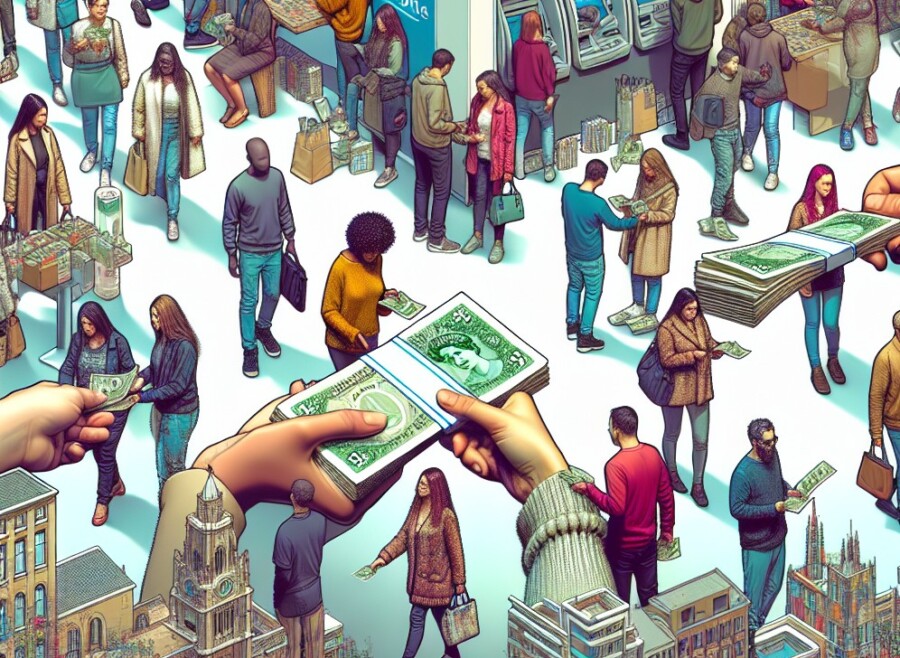
People in the UK are using money you can touch, like coins and paper bills, more than before. This is the first time in ten years that this has happened. They are doing this because things cost more and they want to be careful with their money. When people were sick a lot, they didn't use this kind of money much. But now, they are using it again. Shops have to pay more money when people buy things with cards, and they don't like that.
There are new rules to help people get to money they can touch. These rules say that banks have to make sure people can find money near them. Some places where you can get money are closing, and this is hard for people who live where there are not many people. The new rules want to make sure people can still get money without it being too hard or costing too much. Even though people are using money they can touch right now, they might use it less later when things get easier with money. But it's still important that people can get to money they can touch, especially if they really need it.
Original news source: Shopping with cash rises for first time in a decade (BBC)
🎧 Listen:
📖 Vocabulary:
Group or Classroom Activities
Warm-up Activities:
– Charades
Instructions: Divide the class into two teams. One student from each team will come to the front of the class and act out a word or phrase related to the article, without speaking. The rest of the class must guess what they are acting out. The team that guesses correctly gets a point. Continue until all students have had a turn or until time runs out. The team with the most points wins.
– News Summary
Instructions: In pairs or small groups, students will take turns summarizing the main points of the article to their partner/group. They can only use a certain number of words (e.g. 10-15) to summarize each point. After each summary, the partner/group must guess what the main point was. Rotate roles and continue until each student has had a turn.
– Opinion Poll
Instructions: In pairs or small groups, students will discuss their opinions on using cash versus using cards for payments. They should discuss the advantages and disadvantages of each method and come to a consensus within their group. Once they have reached a decision, each group will share their opinion with the class and explain their reasons.
– Vocabulary Pictionary
Instructions: Divide the class into two teams. One student from each team will come to the front of the class. The teacher will give them a word or phrase related to the article, and they must draw it on the board without using any letters or numbers. Their team must guess what they are drawing within a certain time limit (e.g. 1 minute). If their team guesses correctly, they get a point. Continue until all students have had a turn or until time runs out. The team with the most points wins.
– Future Predictions
Instructions: In pairs or small groups, students will discuss and make predictions about the future of using cash and cards for payments. They should consider factors such as technology advancements, convenience, and cultural changes. Each group will share their predictions with the class and explain their reasoning.
🤔 Comprehension Questions:
Because things cost more and they want to be careful with their money.
When they were sick a lot.
Because they have to pay more money when people use cards.
The new rules say that banks have to make sure people can find money near them.
Because they live where there are not many people.
The new rules want to make sure people can still get money without it being too hard or costing too much.
Because they might really need it, especially when things get easier with money.
🎧✍️ Listen and Fill in the Gaps:
People in the UK are using money you can touch, like coins and paper , more than before. This is the time in ten years that this has happened. They are doing this because things cost more and they want to be careful with their money. When people were sick a lot, they didn't use this of money much. But now, they are using it again. Shops have to pay more money when people buy things with cards, and they don't like that. There are new rules to people get to money they can touch. These rules say that banks have to make sure people can find money near them. Some where you can get money are closing, and this is hard for people who where there are not many people. The new rules want to make sure people can still get money without it being too hard or costing too much. Even though people are using they can touch right now, they might use it less later when things get easier with money. But it's still that people can get to money they can touch, especially if they really need it.
💬 Discussion Questions:
1. What is money you can touch?
2. How would you feel if you had to pay more money when you buy things with a card?
3. Do you like using coins and paper bills? Why or why not?
4. Do you think it's important to have money you can touch? Why or why not?
5. What are the new rules for getting money you can touch?
6. How do you think people feel when places where they can get money are closing?
7. Do you think it's fair that some people have a hard time getting money because there are not many people where they live? Why or why not?
8. How do you think things will be different when it gets easier with money?
9. Do you think it's important for people to be able to get money they can touch? Why or why not?
10. How do you think people feel when they really need money but can't get it?
11. What are some things you can buy with money you can touch?
12. How do you think people will feel if they can't use money they can touch anymore?
Individual Activities
📖💭 Vocabulary Meanings:
Click a dot next to a word, then click the dot next to its meaning to draw a line connecting them.
Words
Meanings
🔡 Multiple Choice Questions:
🕵️ True or False Questions:
📝 Write a Summary:
Write a summary of this news article in two sentences.
Check your writing now with the best free AI for English writing!