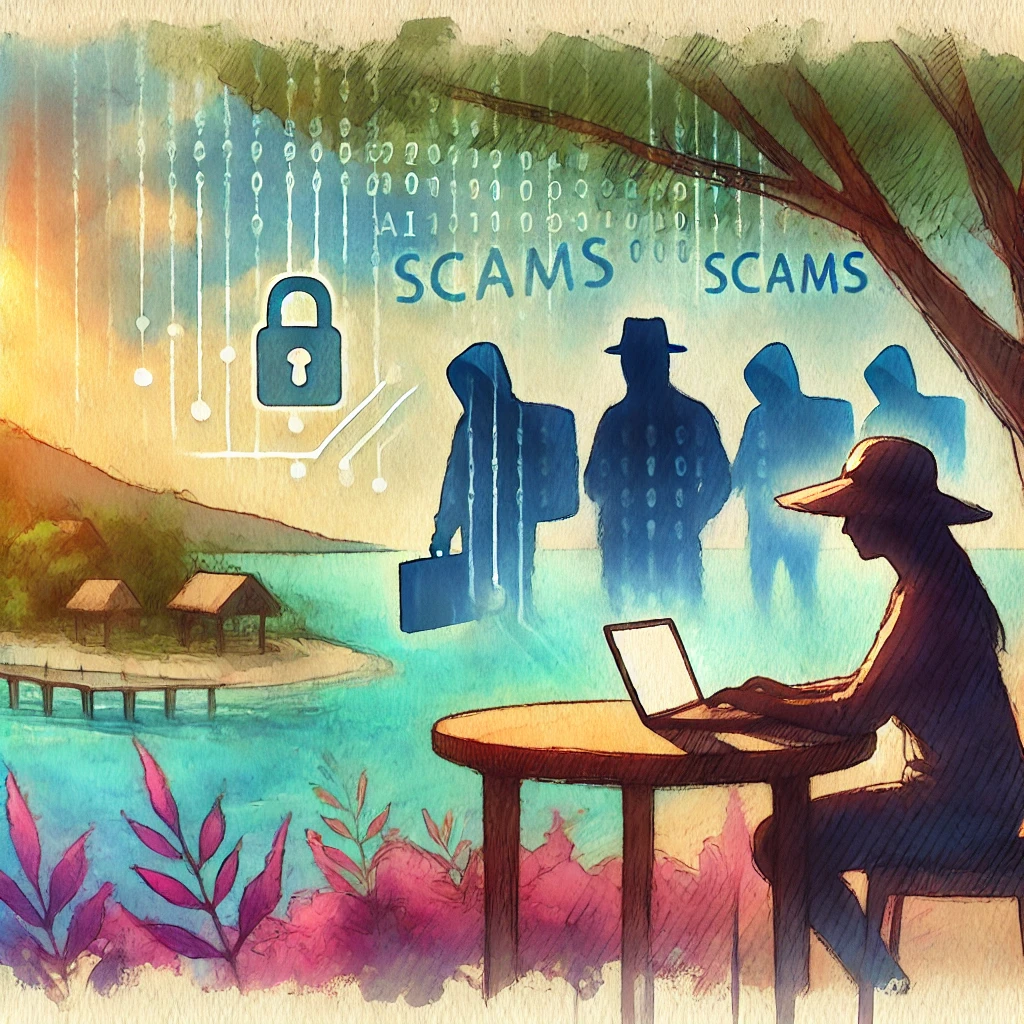
People are getting tricked when they book trips online. Bad people use smart computers to make fake emails and websites. These tricks make people give away their money and personal information. Booking.com says everyone should be careful and use extra safety steps, like two-factor authentication. This means you need two ways to prove who you are before you can log in.
Booking.com is also using smart computers to find and remove fake hotels from their website. They want to stop the bad people before anyone gets tricked. Experts say travel companies should tell people more about these tricks. They suggest checking details carefully and using credit cards for safety. This way, people can stay safe when booking their trips.
Original news source: Booking.com warns of up to 900% increase in travel scams (BBC)
🎧 Listen:
📖 Vocabulary:
Group or Classroom Activities
Warm-up Activities:
– Charades
Instructions: Divide the class into two teams. Give each team a set of travel-related words or phrases written on separate pieces of paper. One person from each team will come to the front of the class and act out the word or phrase silently, while their teammates try to guess what it is. The team that guesses correctly gets a point. Repeat with different students acting out the words or phrases until all of them have been used. The team with the most points wins.
– Vocabulary Pictionary
Instructions: Divide the class into pairs. Give each pair a set of travel-related vocabulary words or phrases written on separate pieces of paper. One person from each pair will choose a word or phrase and draw a picture to represent it, while their partner tries to guess what it is. The pair that guesses correctly earns a point. Switch roles and repeat with different words or phrases until all of them have been used. The pair with the most points wins.
– Speed Summarizing
Instructions: Give each student a copy of the article. In pairs, students take turns summarizing the article to their partner in 1 minute or less. The partner should listen and try to understand the main points of the article. After each round, students switch roles. Repeat several times with different sections of the article. Encourage students to use their own words and not read directly from the article.
– Keyword Taboo
Instructions: Write a list of key words from the article on the board. Divide the class into two teams. One student from each team will come to the front of the class. Their team members must try to get them to guess the key word without using the word itself or any forms of the word. The team that successfully guesses the most key words in a given amount of time wins.
– Future Predictions
Instructions: In pairs, students discuss and make predictions about the future of online travel booking. They should use the information from the article to support their ideas. After discussing, each pair shares their predictions with the class. Encourage students to use future tenses and modal verbs to express their predictions.
🤔 Comprehension Questions:
Bad people are using smart computers to make fake emails and websites to trick others.
Booking.com suggests people be careful and use extra safety steps, like two-factor authentication.
You need two ways to prove who you are before you can log in with two-factor authentication.
Booking.com is using smart computers to find and remove fake hotels from their website.
Experts say travel companies should tell people more about these tricks and suggest checking details carefully.
People should be careful, use extra safety steps like two-factor authentication, and check details carefully.
Using credit cards for safety is important because it helps protect your money and personal information.
🎧✍️ Listen and Fill in the Gaps:
People are getting tricked when they book trips online. Bad use smart computers to make fake emails and websites. These tricks make people away their money and personal information. Booking.com says everyone should be careful and use extra safety steps, like two-factor authentication. This you two ways to prove who you are before you can log in. Booking.com is also smart computers to find and remove fake hotels from their website. They want to stop the bad people before anyone gets tricked. say travel companies should tell people more about these tricks. They suggest checking details carefully and using cards for safety. This way, people can stay safe when their trips.
💬 Discussion Questions:
1. What is a trick?
2. How would you feel if someone tricked you out of your money?
3. Do you like booking trips online? Why or why not?
4. What is two-factor authentication?
5. How do smart computers help Booking.com?
6. Do you think travel companies should tell people more about tricks? Why or why not?
7. Why is it important to check details carefully when booking a trip?
8. Do you use credit cards for safety? Why or why not?
9. What are some ways people can stay safe when booking trips online?
10. How do you prove who you are when you log in to a website?
11. Have you ever been tricked online? How did it make you feel?
12. What would you do if you found a fake hotel on a website?
Individual Activities
📖💭 Vocabulary Meanings:
Click a dot next to a word, then click the dot next to its meaning to draw a line connecting them.
Words
Meanings
🔡 Multiple Choice Questions:
🕵️ True or False Questions:
📝 Write a Summary:
Write a summary of this news article in two sentences.
Check your writing now with the best free AI for English writing!