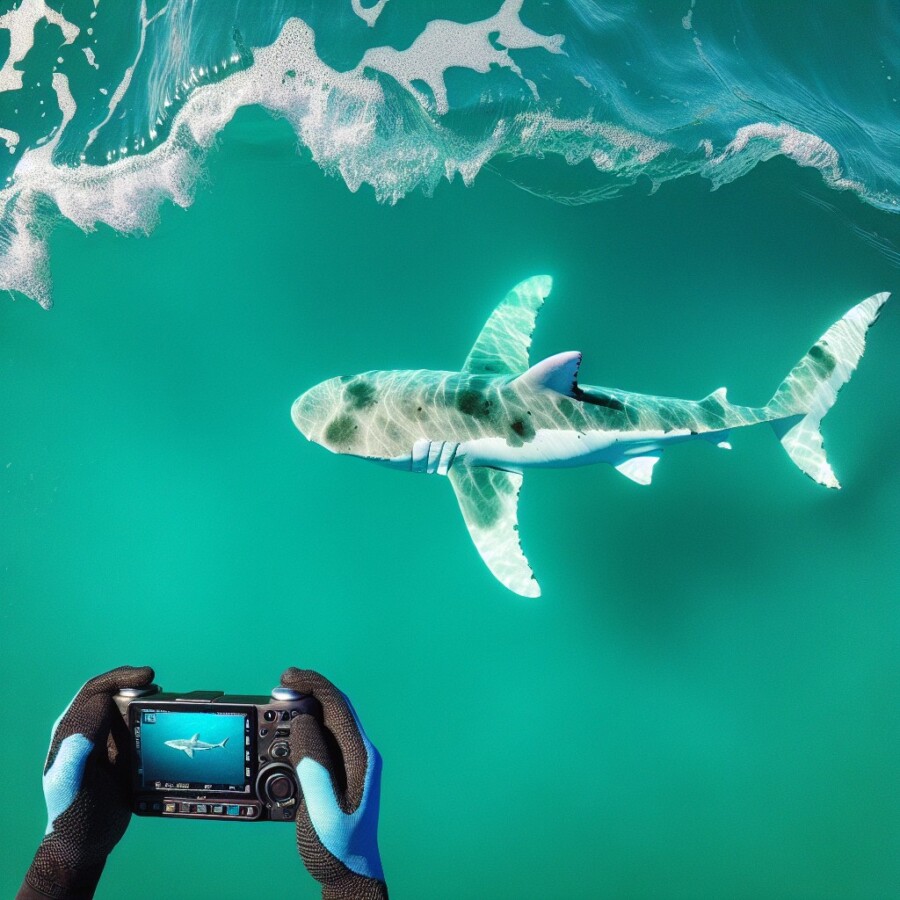
A man named Carlos Gauna, who likes to film sharks from the sky with a flying camera, found a very small white shark. This little shark had a special white coat on its body. A shark expert thinks this baby shark might have just been born because its fins look different. But, some other sea animal doctors say we should be careful. They think the white coat might be because the shark is sick or something else we don't know.
Carlos uses his flying camera to watch sharks and sometimes sees them swimming near people. His videos help us learn more about sharks. He really wants to film a shark being born one day. But, to know for sure if the baby shark he found was just born, we need to find out more. Sharks are interesting, and Carlos's videos help us see how they live in the water.
Original news source: Has great white shark newborn been caught on film for the first time? (BBC)
🎧 Listen:
📖 Vocabulary:
Group or Classroom Activities
Warm-up Activities:
– Word Association
Instructions: Have the students take turns saying a word that comes to mind when they hear the word "shark". Encourage them to think of different words each time and avoid repeating words that have already been said.
– Vocabulary Pictionary
Instructions: Write a list of shark-related vocabulary words on the board (e.g. fin, water, swim, teeth, etc.). Divide the students into pairs or small groups. One student from each group will choose a word and draw a picture to represent that word, while the other students guess what word it is.
– Speed Summarizing
Instructions: Divide the students into pairs. Give each pair a copy of the article. Set a timer for 1 minute. One student will read the article aloud while the other student listens. After 1 minute, the roles switch and the other student summarizes what they heard. Encourage the students to use their own words and not read directly from the article.
– Keyword Taboo
Instructions: Write down a list of keywords from the article on separate cards (e.g. shark, white coat, fins, etc.). Divide the students into teams. One student from each team will come to the front of the class and pick a card. They must then describe the keyword to their team without using the actual keyword. The team must guess the keyword within a certain time limit.
– Two Truths and a Lie
Instructions: Have the students take turns sharing three statements about sharks, with one statement being false. The other students must guess which statement is the lie. Encourage the students to use information from the article to make their statements.
🤔 Comprehension Questions:
Carlos Gauna is a man who likes to film sharks from the sky with a flying camera.
Carlos likes to use his flying camera to watch sharks and film them.
Carlos found a very small white shark in the water.
Some people think the baby shark might be sick because of its white coat.
Carlos's videos help us learn more about sharks and how they live in the water.
Carlos wants to film a shark being born one day.
We need to find out more information to know for sure if the baby shark was just born.
🎧✍️ Listen and Fill in the Gaps:
A man named Carlos Gauna, who likes to sharks from the sky with a flying camera, found a very small white shark. This little shark had a special white on its body. A shark expert thinks this baby might have just been born because its fins look different. But, some other sea animal doctors say we should be careful. They think the white coat might be because the shark is or something else we don't know. Carlos uses his flying camera to watch sharks and sometimes sees them swimming near . His videos help us learn more about sharks. He really to film a shark being born one day. But, to know for sure if the baby shark he was just born, we need to find out more. Sharks are , and Carlos's videos help us see how they live in the water.
💬 Discussion Questions:
1. What is a shark?
2. How would you feel if you saw a shark swimming near you?
3. Do you like watching videos of sharks?
4. Do you think it would be fun to film sharks with a flying camera? Why or why not?
5. What do you think a baby shark looks like?
6. How do you think sharks live in the water?
7. Have you ever seen a shark before? Where?
8. How do you think the baby shark's white coat is different from other sharks?
9. Why do you think some sea animal doctors are worried about the baby shark?
10. What do you think we can learn from Carlos's videos of sharks?
11. How do you think Carlos feels when he films sharks?
12. Do you think it's important to protect sharks? Why or why not?
Individual Activities
📖💭 Vocabulary Meanings:
Click a dot next to a word, then click the dot next to its meaning to draw a line connecting them.
Words
Meanings
🔡 Multiple Choice Questions:
🕵️ True or False Questions:
📝 Write a Summary:
Write a summary of this news article in two sentences.
Check your writing now with the best free AI for English writing!