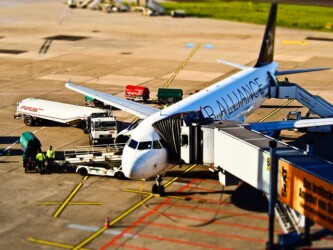
A new company has an idea to make using hydrogen easier. They made special containers to keep the hydrogen cold. These containers can be taken to the airport and put into planes. The company is going to test this idea with a small plane next year, but we don't know if all planes will use hydrogen in the future.
People who run airports really want to stop making bad air. But they are not sure how to do it or how much it will cost. Even if some planes start using hydrogen soon, it might take a long time before all planes do. To use hydrogen, airports will need to build new things, but it could help a lot in keeping the air clean.
Original news source: Could airports make hydrogen work as a fuel? (BBC)
📖 Vocabulary:
Group or Classroom Activities
Warm-up Activities:
– News Summary
Instructions:
1. Give each student a copy of the article.
2. In pairs or small groups, students have to read the article and summarize it in their own words.
3. After a few minutes, have students share their summaries with the class.
4. Discuss any differences or similarities in the summaries and clarify any misunderstandings.
– Vocabulary Pictionary
Instructions:
1. Write a selection of keywords from the article on the board.
2. Divide the class into teams.
3. One student from each team comes to the board and chooses a keyword.
4. Without using any words, the student must draw a picture to represent the keyword.
5. The team members have to guess the keyword based on the drawing.
6. The team that guesses correctly earns a point.
7. Repeat with different students and keywords.
– Opinion Poll
Instructions:
1. Divide the class into pairs.
2. Give each pair a copy of the article.
3. In their pairs, students have to discuss their opinions on the use of hydrogen fuel in airports.
4. After a few minutes, have each pair share their opinions with another pair.
5. As a class, conduct a poll by asking students to raise their hand if they agree or disagree with using hydrogen fuel in airports.
6. Discuss the different opinions and reasons behind them.
– Think-Pair-Share
Instructions:
1. Give each student a copy of the article.
2. Have students read the article individually.
3. After reading, ask students to think about the following question: "What are the advantages and disadvantages of using hydrogen fuel in airports?"
4. Pair up the students and have them discuss their thoughts with their partner.
5. After a few minutes, ask each pair to share their thoughts with the class.
6. Facilitate a class discussion to explore the different advantages and disadvantages mentioned.
– Future Predictions
Instructions:
1. Divide the class into small groups.
2. Assign each group a role (e.g., airport manager, environmentalist, pilot, economist).
3. Give each group a copy of the article.
4. In their groups, students have to discuss and make predictions about the future of using hydrogen fuel in airports based on their assigned role.
5. After a few minutes, have each group present their predictions to the class.
6. Encourage discussion and debate between groups, allowing students to challenge or support each other's predictions.
🤔 Comprehension Questions:
The new kind of fuel that airports want to use is called hydrogen.
It is hard to use hydrogen as fuel for planes because it is very cold and it costs a lot of money to set up.
The new company made special containers to keep the hydrogen cold, which makes using hydrogen easier.
The company is going to test the idea of using hydrogen in a small plane next year.
We don't know if all planes will use hydrogen in the future. It might take a long time before all planes start using it.
People who run airports want to stop making bad air because they want to help keep the air clean and protect the environment.
Airports need to build new things and make changes in order to use hydrogen as fuel for planes.
🎧✍️ Listen and Fill in the Gaps:
Airports want to stop hurting the environment. They are to use a new kind of fuel that doesn't make bad air. This new fuel is called and it's better than the fuel use now. But it's hard to use because it's very and costs a lot of money to set up. A new company has an idea to make hydrogen . They made special containers to keep the hydrogen cold. These containers can be taken to the airport and put into planes. The company is going to test this idea with a small plane next year, but we don't know if all planes will use hydrogen in the . People who run really want to making bad air. But they are not sure how to do it or how much it will cost. Even if some planes using hydrogen soon, it might take a long before all planes do. To use hydrogen, airports will need to new things, but it could help a lot in keeping the air clean.
💬 Discussion Questions:
1. What is hydrogen fuel?
2. How do airports want to stop hurting the environment?
3. Do you think using hydrogen fuel is a good idea? Why or why not?
4. How would you feel if all planes used hydrogen fuel in the future?
5. Why do you think it's hard to use hydrogen fuel?
6. What do you think about the idea of using special containers to keep the hydrogen cold?
7. Do you think it's important for airports to find ways to make the air clean? Why or why not?
8. How do you think using hydrogen fuel could help in keeping the air clean?
9. What do you think might be some challenges in getting all planes to use hydrogen fuel?
10. Have you ever heard of any other ways to make transportation more environmentally friendly? What are they?
11. Do you like the idea of airports using hydrogen fuel? Why or why not?
12. How do you think using hydrogen fuel could impact the cost of flying?
Individual Activities
📖💭 Vocabulary Meanings:
Click a dot next to a word, then click the dot next to its meaning to draw a line connecting them.
Words
Meanings
🔡 Multiple Choice Questions:
🕵️ True or False Questions:
📝 Write a Summary:
Write a summary of this news article in two sentences.
Check your writing now with the best free AI for English writing!