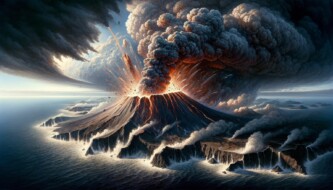
People saw the eruption in a video made by the coast guard. It showed smoke and rocks shooting up and then falling into the water. Japan has a lot of earthquakes and volcanoes because it's on the "Ring of Fire." This is a place in the Pacific Ocean where the ground moves a lot. The eruption was not dangerous for people living nearby, but it shows that Japan needs to watch its volcanoes carefully.
Japan has more than 100 volcanoes that are still active, which means they can erupt. Eruptions happen often in Japan. It's not very common for a new island like Niijima to be made by a volcano. Scientists are studying the island to learn more about how the Earth changes. Japan is trying to learn more about its volcanoes to keep people safe.
Original news source: Watch: Volcano in Japan spews ash, rock 200m into sky (BBC)
📖 Vocabulary:
Group or Classroom Activities
Warm-up Activities:
– News Summary
Instructions: Divide the class into pairs. Give each pair a copy of the article. One student in each pair will be the "news reporter" and the other will be the "listener." The news reporter has 2 minutes to read the article and summarize the main points to the listener. After 2 minutes, the listener must summarize what they heard from the news reporter. Then, switch roles and repeat the activity.
– Word Association
Instructions: Write the word "volcano" on the board. Ask the students to brainstorm as many words as they can that they associate with volcanoes. Give them 2 minutes to come up with their words individually. Then, have the students share their words with a partner. Afterward, have a class discussion and write the words on the board.
– Sketch It
Instructions: Divide the class into pairs. One student in each pair will describe the eruption from the article to their partner, while the other student listens and tries to sketch what they hear. Afterward, have the students compare their sketches and discuss how accurate they are.
– Vocabulary Pictionary
Instructions: Write a list of vocabulary words from the article on the board (e.g. eruption, volcano, rocks, coast guard). Divide the class into teams. One student from each team comes to the front of the class and chooses a word from the list. They have 1 minute to draw a picture that represents the word, while their team tries to guess what word it is. The team that guesses correctly gets a point.
– Future Predictions
Instructions: Have a class discussion about what might happen in the future with the volcano on Niijima. Ask the students to make predictions about whether the volcano will continue to erupt, if the island will grow bigger, or if any other changes will occur. Encourage them to use language such as "I think," "maybe," and "possibly" to express uncertainty.
🤔 Comprehension Questions:
🎧✍️ Listen and Fill in the Gaps:
Last week, a on a small in Japan erupted very strongly. Rocks flew high into the air and into the sea. This island is called Niijima and it's a new island that appeared only 10 years ago. It's far away from Tokyo, the big city in Japan. People saw the eruption in a video by the coast guard. It showed smoke and rocks shooting up and then falling into the . Japan has a lot of earthquakes and volcanoes because it's on the "Ring of Fire." This is a in the Pacific Ocean where the ground moves a lot. The eruption was not dangerous for people living nearby, but it shows that Japan to watch its volcanoes carefully. Japan has than 100 volcanoes that are still active, which they can erupt. Eruptions happen often in Japan. It's not very common for a new island like Niijima to be made by a volcano. are the island to learn more about how the Earth changes. Japan is trying to learn more about its volcanoes to keep people .
💬 Discussion Questions:
1. What is a volcano?
2. How would you feel if you saw a volcano erupting?
3. Do you like watching videos of natural disasters like volcanoes?
4. Do you think it's scary to live near a volcano? Why or why not?
5. What do you think scientists can learn from studying the new island, Niijima?
6. How do you think Japan can keep people safe from volcanic eruptions?
7. Have you ever experienced an earthquake? How did it feel?
8. Do you think it's important for Japan to watch its volcanoes carefully? Why or why not?
9. What other natural disasters do you know about?
10. How do you think the ground moving a lot in the Pacific Ocean affects the people living nearby?
11. Why do you think Japan has so many volcanoes?
12. What would you do if you lived on an island that was made by a volcano?
Individual Activities
📖💭 Vocabulary Meanings:
Click a dot next to a word, then click the dot next to its meaning to draw a line connecting them.
Words
Meanings
🔡 Multiple Choice Questions:
🕵️ True or False Questions:
📝 Write a Summary:
Write a summary of this news article in two sentences.
Check your writing now with the best free AI for English writing!