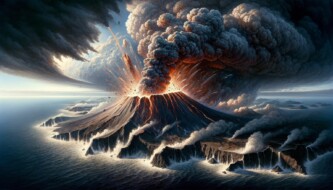
When a volcano erupts, it can shoot out ash and rocks into the sky. This happens when there's a lot of pressure building up under the Earth's surface and it needs to be released. The ash and rocks can travel far and be dangerous to nearby places. Luckily, this eruption was far away from Tokyo, so it didn't directly threaten the city.
Japan is no stranger to volcanic eruptions because it's located in an area called the Pacific Ring of Fire. This area is known for having lots of volcanoes and earthquakes. The Ring of Fire is shaped like a horseshoe and goes from the west coast of the Americas to the east coast of Asia. It has 75% of the world's active volcanoes and is prone to earthquakes and tsunamis.
Even though volcanic eruptions can be scary and cause damage, they also help shape the Earth's surface and create new land. Volcanoes can make islands, mountains, and fertile soil. They remind us of the powerful things happening inside the Earth and how our planet is always changing.
In conclusion, the recent eruption at Niijima Island in Japan shows us that volcanic activity is still happening in that area. It's cool to see, but we should also remember that it can be dangerous. The video taken by Japan's coast guard lets us see how powerful and beautiful nature can be, and how people who live near volcanoes have to be strong and resilient.
Original news source: Watch: Volcano in Japan spews ash, rock 200m into sky (BBC)
📖 Vocabulary:
Group or Classroom Activities
Warm-up Activities:
– News Summary
Instructions:
1. Divide the class into pairs or small groups.
2. Give each group a copy of the article.
3. Ask the groups to read the article and summarize it in 3-5 sentences.
4. After a designated time, have each group share their summary with the class.
– Vocabulary Pictionary
Instructions:
1. Divide the class into pairs or small groups.
2. Give each group a list of vocabulary words from the article.
3. Ask each group to take turns selecting a word and drawing it on the board without using any letters or numbers.
4. The rest of the class must guess the word based on the drawing.
5. Once the word is guessed correctly, the group can move on to the next word.
– Pros and Cons
Instructions:
1. Divide the class into pairs or small groups.
2. Assign each group a position: either pro or con.
3. Ask each group to discuss and list the pros or cons of living near a volcano based on the information in the article.
4. After a designated time, have each group present their list to the class.
5. Encourage class discussion and debate about the advantages and disadvantages of living near a volcano.
– Future Predictions
Instructions:
1. Discuss with the class the concept of predicting the future.
2. Ask each student to individually write down three predictions about volcanic activity in the future based on the information in the article.
3. After a designated time, have the students share their predictions in pairs or small groups.
4. Encourage the students to discuss and debate their predictions, providing reasons and evidence to support their ideas.
5. Finally, have a class discussion to share and compare the different predictions.
– Think-Pair-Share
Instructions:
1. Ask the class to think about and reflect on the following question based on the article: "What are the potential impacts of volcanic eruptions on people and the environment?"
2. Pair up the students and instruct them to discuss their thoughts and ideas with their partner.
3. After a designated time, have each pair share their answers with the class.
4. Facilitate a class discussion to further explore the topic and encourage students to consider different perspectives.
🤔 Comprehension Questions:
Last week, a volcano near Niijima Island in Japan had a big explosion.
The rocks from the volcano went up about 200 meters high.
A volcano erupts when there's a lot of pressure building up under the Earth's surface and it needs to be released.
The recent eruption didn't threaten Tokyo because it was far away from the city.
Japan is prone to volcanic eruptions and earthquakes because it is located in an area called the Pacific Ring of Fire, which has lots of volcanoes and earthquakes.
The Pacific Ring of Fire is an area shaped like a horseshoe that goes from the west coast of the Americas to the east coast of Asia. It has 75% of the world's active volcanoes and is prone to earthquakes and tsunamis.
Volcanic eruptions help shape the Earth's surface by creating new land, such as islands and mountains. They also create fertile soil.
The recent eruption at Niijima Island reminds us that nature can be powerful and beautiful, but also dangerous. It shows us that people who live near volcanoes have to be strong and resilient.
🎧✍️ Listen and Fill in the Gaps:
Last week, a near Niijima Island in Japan had a big explosion. It was caught on video by Japan's coast and shared online. The video shows from the volcano being thrown into the sea, up about 200 meters high. Niijima Island is a new island that formed 10 years ago. When a volcano erupts, it can shoot out ash and rocks into the sky. This happens when there's a lot of pressure building up under the Earth's surface and it needs to be released. The ash and rocks can travel far and be to nearby places. Luckily, this eruption was far away from Tokyo, so it didn't directly the city. Japan is no to eruptions because it's located in an area called the Pacific Ring of Fire. This area is known for having lots of volcanoes and earthquakes. The Ring of Fire is shaped like a horseshoe and goes from the west coast of the Americas to the east coast of Asia. It has 75% of the world's active volcanoes and is prone to and . Even though volcanic eruptions can be scary and cause damage, they also help shape the Earth's surface and create new land. Volcanoes can make , , and fertile soil. They remind us of the powerful things happening inside the Earth and how our is always changing. In conclusion, the recent eruption at Niijima Island in shows us that volcanic activity is still in that area. It's cool to see, but we should also remember that it can be dangerous. The video taken by Japan's coast guard lets us see how and beautiful nature can be, and how people who live near volcanoes have to be strong and resilient.
💬 Discussion Questions:
1. What is a volcanic eruption?
2. How would you feel if you lived near a volcano?
3. Do you like watching videos of natural disasters? Why or why not?
4. Do you think it's important for people to learn about volcanic eruptions? Why or why not?
5. What do you think is the scariest thing about volcanic eruptions?
6. How do you think volcanic eruptions shape the Earth's surface?
7. Have you ever experienced an earthquake or volcanic eruption? If so, can you describe what happened?
8. What precautions do you think people should take if they live near a volcano?
9. Do you think it's worth living near a volcano, despite the potential dangers? Why or why not?
10. How do you think volcanic eruptions affect the environment?
11. What do you think would happen if a volcano erupted in a big city like Tokyo?
12. Have you ever seen a volcano in person? If so, where and what was it like?
13. Do you think humans can predict when a volcano will erupt? Why or why not?
14. How do you think volcanic eruptions impact the economy of the affected areas?
15. What can we learn from volcanic eruptions about the power of nature?
Individual Activities
📖💭 Vocabulary Meanings:
Click a dot next to a word, then click the dot next to its meaning to draw a line connecting them.
Words
Meanings
🔡 Multiple Choice Questions:
🕵️ True or False Questions:
📝 Write a Summary:
Write a summary of this news article in two sentences.
Check your writing now with the best free AI for English writing!