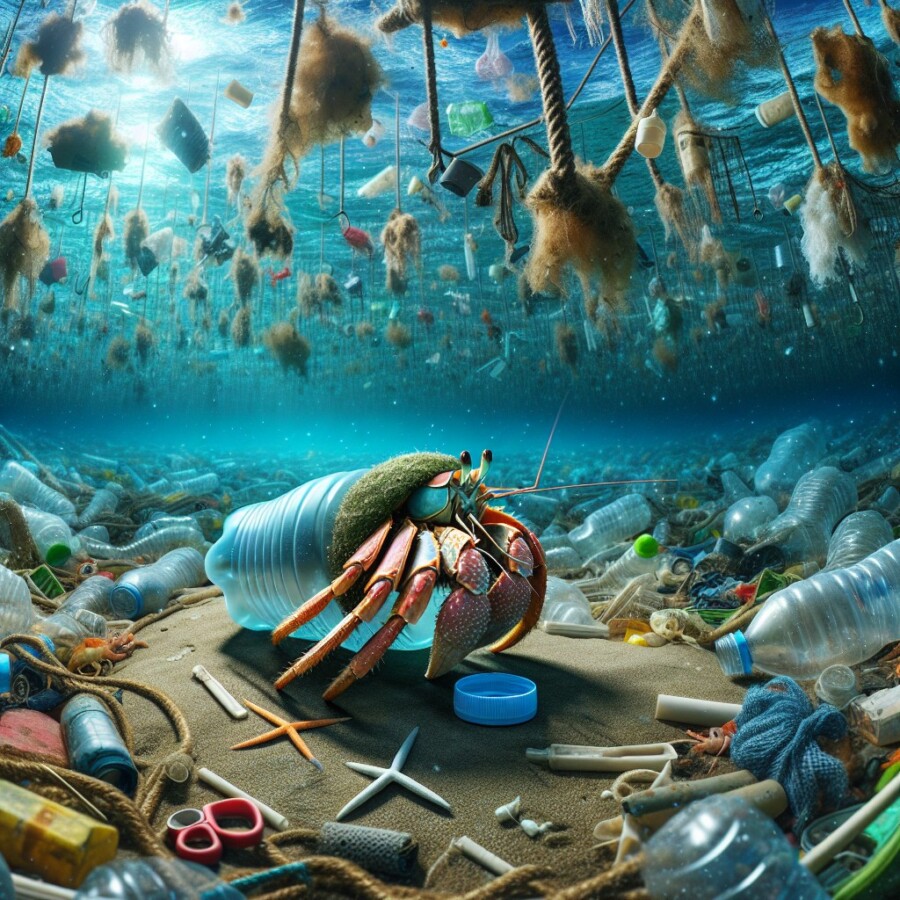
Scientists have found that hermit crabs are using pieces of plastic as their homes. They looked at pictures from people who like to watch animals and saw many crabs with "fake" plastic shells. They found 386 crabs using plastic tops as shells on the internet. People don't know yet if the plastic is good or bad for the crabs.
The people who did the study felt very sad to see crabs living in plastic. Crabs in warm places all over the world were seen using plastic. They are trying to understand how plastic affects these crabs and if it changes how they grow. Since there are fewer natural shells, crabs might be picking plastic because there's a lot of it, and it can be lighter to carry.
This study shows that many hermit crabs are using plastic trash. The scientists want to learn more about how plastic can help or hurt these animals. There is so much plastic in the sea that crabs have many choices for shells. The study tells people to use plastic again instead of throwing it away. It is important to work on the problem of plastic in the ocean because there is a lot of it out there.
Original news source: Hermit crabs are 'wearing' our plastic rubbish (BBC)
🎧 Listen:
📖 Vocabulary:
Group or Classroom Activities
Warm-up Activities:
– Charades
Instructions: Divide the students into small groups. Give each group a piece of paper with a word related to the article (e.g. hermit crab, plastic, shell). One student from each group will act out the word without speaking, while the other students in the group try to guess what it is. The group that guesses correctly gets a point. Rotate roles so that each student has a chance to act and guess.
– News Summary
Instructions: Give each student a copy of the article. In pairs, students take turns summarizing the main points of the article to their partner in their own words. After both students have summarized the article, they compare their summaries to see if they got the same information.
– Opinion Poll
Instructions: Divide the class into pairs. Each pair will have a discussion about whether they think plastic is good or bad for hermit crabs. After discussing their opinions, each pair will interview another pair and record their opinions on a piece of paper. Finally, the class can come together to share the different opinions and discuss the reasons behind them.
– Vocabulary Pictionary
Instructions: Write a list of vocabulary words from the article on the board (e.g. hermit crab, plastic, shell). Divide the students into pairs. One student from each pair will choose a word from the list and draw a picture on a piece of paper to represent that word. The other student must guess the word based on the drawing. Repeat until all the words have been guessed.
– Opinion Spectrum
Instructions: Create a line on the board with "Agree" on one end and "Disagree" on the other end. Ask the students to stand somewhere along the line to indicate their opinion on the statement "Using plastic as homes for hermit crabs is a good idea." Once everyone has chosen a spot, ask a few students to explain why they are standing where they are. Encourage discussion and respectful disagreement.
🤔 Comprehension Questions:
🎧✍️ Listen and Fill in the Gaps:
Scientists have found that hermit are using of plastic as their homes. They looked at pictures from people who to watch animals and saw many crabs with "fake" plastic shells. They found 386 crabs using plastic tops as shells on the internet. People don't know yet if the is good or bad for the crabs. The people who did the felt very sad to see crabs living in plastic. Crabs in warm places all over the world were using plastic. They are trying to understand how plastic affects these crabs and if it changes how they grow. Since there are fewer natural shells, crabs might be picking plastic because there's a lot of it, and it can be lighter to carry. This study that many hermit crabs are using plastic trash. The scientists to more about how plastic can help or hurt these animals. There is so much plastic in the sea that crabs have choices for shells. The study tells to use plastic again instead of throwing it away. It is important to work on the of plastic in the ocean because there is a lot of it out there.
💬 Discussion Questions:
1. What is a hermit crab?
2. How would you feel if you saw a hermit crab living in a plastic shell?
3. Do you think it is good or bad for the crabs to use plastic as their homes? Why or why not?
4. Have you ever seen a hermit crab before? If so, where?
5. What do you think happens to the crabs when they use plastic as their homes?
6. Do you like the idea of using plastic again instead of throwing it away? Why or why not?
7. How do you think plastic affects the growth of the crabs?
8. What other animals do you think might be affected by plastic in the ocean? Why?
9. Have you ever seen plastic trash in the sea or on the beach? How did it make you feel?
10. Do you think people should do more to solve the problem of plastic in the ocean? Why or why not?
11. How can we help reduce the amount of plastic in the ocean?
12. What can you do personally to help protect animals like hermit crabs from plastic pollution?
Individual Activities
📖💭 Vocabulary Meanings:
Click a dot next to a word, then click the dot next to its meaning to draw a line connecting them.
Words
Meanings
🔡 Multiple Choice Questions:
🕵️ True or False Questions:
📝 Write a Summary:
Write a summary of this news article in two sentences.
Check your writing now with the best free AI for English writing!