

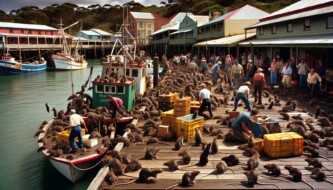
People have put pictures and videos on the internet that show many dead rats on the sand and in the water. The rats and mice are so many that it's like a very bad time in 2011. Some people think it will get even worse because they hear that more rats and mice might come. People who take others fishing on boats are scared that the bad name of the town will last a long time.
The towns by the sea are having a hard time because of all the rats and mice. The reason there are so many is that the weather has been very good for them to have babies and there is a lot of food for them to eat. The rats and mice have gone to the beaches to look for food, and now there are dead and alive ones everywhere. This is bad for the people who live there because it can hurt their cars and buildings, and they are scared that not as many visitors will come. More rain is coming, and that might make things even worse.
Original news source: Rat plague spreads to Australia's fishing towns (BBC)
📖 Vocabulary:
Group or Classroom Activities
Warm-up Activities:
– News Summary
Instructions:
1. Divide the class into pairs or small groups.
2. Give each group a copy of the article.
3. Instruct the groups to read the article and summarize the main points in their own words.
4. After a set amount of time, have each group share their summary with the class.
– Opinion Poll
Instructions:
1. Divide the class into pairs or small groups.
2. Give each group a list of questions related to the article (e.g. "Do you think the rat problem will get worse?").
3. Instruct the groups to discuss and answer the questions together.
4. After a set amount of time, have each group share their answers with the class.
– Vocabulary Pictionary
Instructions:
1. Write a list of key vocabulary words from the article on the board.
2. Divide the class into pairs or small groups.
3. Instruct each group to choose one word from the list.
4. Give the groups a few minutes to draw a picture representing the word.
5. After a set amount of time, have each group share their drawing and ask the class to guess the word.
– Pros and Cons
Instructions:
1. Divide the class into pairs or small groups.
2. Instruct each group to discuss the pros and cons of the rat and mice problem in the towns by the sea.
3. After a set amount of time, have each group share their ideas with the class.
– Future Predictions
Instructions:
1. Instruct each student to individually write down three predictions about the rat and mice problem in the towns by the sea.
2. After a set amount of time, have the students share their predictions with a partner.
3. Encourage the students to discuss their reasoning behind each prediction.
4. Ask a few students to share their predictions with the whole class.
🤔 Comprehension Questions:
Because the weather has been good for them to have babies and there is a lot of food for them to eat.
Because they are hurting cars and buildings.
They are scratching and biting them.
Because they might be scared of the rats and mice.
By putting pictures and videos on the internet.
Because they hear that more rats and mice might come.
More rain, because it will bring more rats and mice.
🎧✍️ Listen and Fill in the Gaps:
In some towns by the sea in Queensland, Australia, there are too many rats and mice. The rats and mice have left their homes to find food and are now on the beaches. They are causing problems for who live there by hurting cars and . are also worried that visitors will not want to come to their towns because of the rats and mice. People have put pictures and videos on the internet that many dead rats on the sand and in the water. The rats and mice are so many that it's like a very bad time in 2011. Some people think it will get even worse because they that rats and mice might come. People who take others fishing on boats are scared that the bad of the town will last a long time. The towns by the sea are having a hard time because of all the rats and mice. The there are so many is that the has been very good for them to have babies and there is a lot of food for them to eat. The rats and mice have to the beaches to look for food, and now there are dead and a ones everywhere. This is bad for the people who live there because it can hurt their cars and buildings, and they are scared that not as many visitors will come. More is coming, and that might make things even worse.
💬 Discussion Questions:
1. What are some problems that the rats and mice are causing for the people who live by the sea in Queensland, Australia?
2. How do you think the people feel about the rats and mice being on the beaches?
3. Do you think visitors will still want to come to the towns by the sea because of the rats and mice? Why or why not?
4. How do you think the people who take others fishing on boats feel about the bad name of the town?
5. Why do you think there are so many rats and mice in the towns by the sea?
6. What do you think the rats and mice are looking for on the beaches?
7. Why is it bad for the people who live there to have rats and mice everywhere?
8. How do you think the people feel about the rats and mice hurting their cars and buildings?
9. How do you think the people in the towns by the sea feel about more rain coming?
10. What do you think the people in the towns can do to solve the problem with the rats and mice?
11. Do you like rats and mice? Why or why not?
12. How would you feel if you lived in a town with too many rats and mice? Why?
Individual Activities
📖💭 Vocabulary Meanings:
Click a dot next to a word, then click the dot next to its meaning to draw a line connecting them.
Words
Meanings
🔡 Multiple Choice Questions:
🕵️ True or False Questions:
📝 Write a Summary:
Write a summary of this news article in two sentences.
Check your writing now with the best free AI for English writing!