

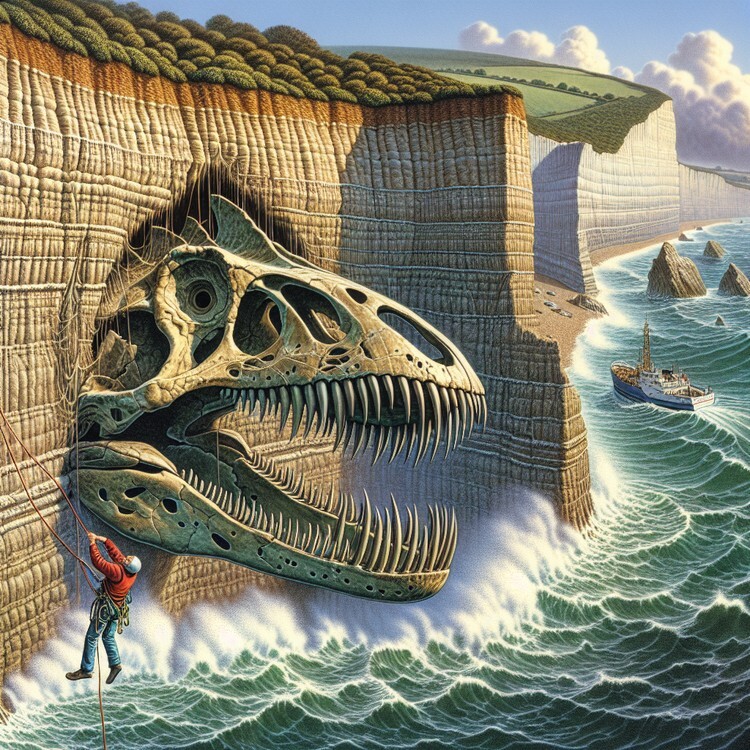
Scientists found a very old sea monster's head in the cliffs by the sea in a place called Dorset in England. It is from a long time ago, about 150 million years, and it is almost all together, which is very special. This sea monster had a big head, bigger than most people, and it had 130 sharp teeth. A famous person named David Attenborough will talk about it on TV.
The sea monster was very big and strong, and it could swim fast. It ate other animals that lived in the water, like itself. Someone found the monster's head by accident on a beach, and people had to climb down the cliff carefully to get it. This was not easy to do.
Now, the scientists are learning new things from the sea monster's head. They can tell how strong its mouth was and how it caught its food. They found some small holes in the head that might have helped the monster feel things in the water, and a space for an extra eye to see better. The head will be kept in a museum, and the scientists hope to find more of the monster before the sea washes it away.
Original news source: Pliosaur discovery: Huge sea monster emerges from Dorset cliffs (BBC)
🎧 Listen:
📖 Vocabulary:
Group or Classroom Activities
Warm-up Activities:
– News Summary
Instructions: In pairs, students will read the article and create a summary of the main points. They should include information about the discovery of the sea monster's head, its size and features, and what the scientists hope to learn from it. Afterward, pairs can share their summaries with the class.
– Vocabulary Pictionary
Instructions: Divide the class into small groups. Give each group a list of vocabulary words from the article, such as "sea monster", "cliffs", "sharp teeth", "beach", etc. One student from each group will choose a word and draw a picture representing that word. The rest of the group must guess the word based on the drawing. The group with the most correct guesses wins.
– Pros and Cons
Instructions: In pairs, students will discuss the pros and cons of finding the sea monster's head. They can consider factors such as the scientific knowledge gained, the preservation of history, and the impact on tourism. After discussing, each pair will present their arguments to the class, and the class can have a debate on the topic.
– Think-Pair-Share
Instructions: Have students think individually about the following question: "What do you think it would be like to discover a sea monster's head?" After a few minutes, students will pair up and share their thoughts with each other. Finally, pairs can share their ideas with the whole class, and a discussion can be held on the topic.
– Charades
Instructions: Write down various words related to the article on separate pieces of paper, such as "cliffs", "sea", "teeth", "swim", etc. One student will choose a word without showing it to others and act it out silently, while the rest of the class tries to guess the word. The student who guesses correctly gets to choose the next word. Repeat the process until everyone has had a turn.
🤔 Comprehension Questions:
Scientists found the sea monster's head in the cliffs by the sea in Dorset, England.
The sea monster's head is about 150 million years old.
The sea monster's head is almost all together, which is very special.
The sea monster's head was bigger than most people.
The sea monster had 130 sharp teeth.
David Attenborough, a famous person, will talk about the sea monster on TV.
The scientists are learning how strong its mouth was, how it caught its food, and they found some small holes that might have helped the monster feel things in the water. They also found a space for an extra eye to see better.
🎧✍️ Listen and Fill in the Gaps:
Scientists found a very old sea 's head in the cliffs by the sea in a place Dorset in England. It is from a long time ago, about 150 million years, and it is almost all together, which is very special. This sea monster had a big head, than most people, and it had 130 teeth. A famous person named David will talk about it on TV. The sea monster was very big and strong, and it could swim fast. It ate other animals that lived in the water, like itself. Someone the monster's by accident on a beach, and people had to climb down the cliff carefully to get it. This was not easy to do. Now, the scientists are learning new things from the sea monster's head. They can tell how strong its mouth was and how it its . They found some small holes in the head that might have helped the monster things in the water, and a for an extra eye to see better. The head will be kept in a museum, and the hope to find more of the monster before the sea washes it away.
💬 Discussion Questions:
1. What is a sea monster?
2. How would you feel if you found a sea monster's head on the beach?
3. Do you like learning about dinosaurs and sea monsters?
4. Do you think it's cool that the sea monster's head is almost all together?
5. Why do you think the scientists want to find more of the sea monster?
6. How do you think the sea monster caught its food?
7. Why do you think the sea monster had so many sharp teeth?
8. What do you think the small holes in the head were for?
9. How do you think the scientists felt when they found the sea monster's head?
10. Do you think it was hard for the people to climb down the cliff to get the head?
11. Why do you think the head will be kept in a museum?
12. What would you do if you found a sea monster's head on the beach?
Individual Activities
📖💭 Vocabulary Meanings:
Click a dot next to a word, then click the dot next to its meaning to draw a line connecting them.
Words
Meanings
🔡 Multiple Choice Questions:
🕵️ True or False Questions:
📝 Write a Summary:
Write a summary of this news article in two sentences.
Check your writing now with the best free AI for English writing!