


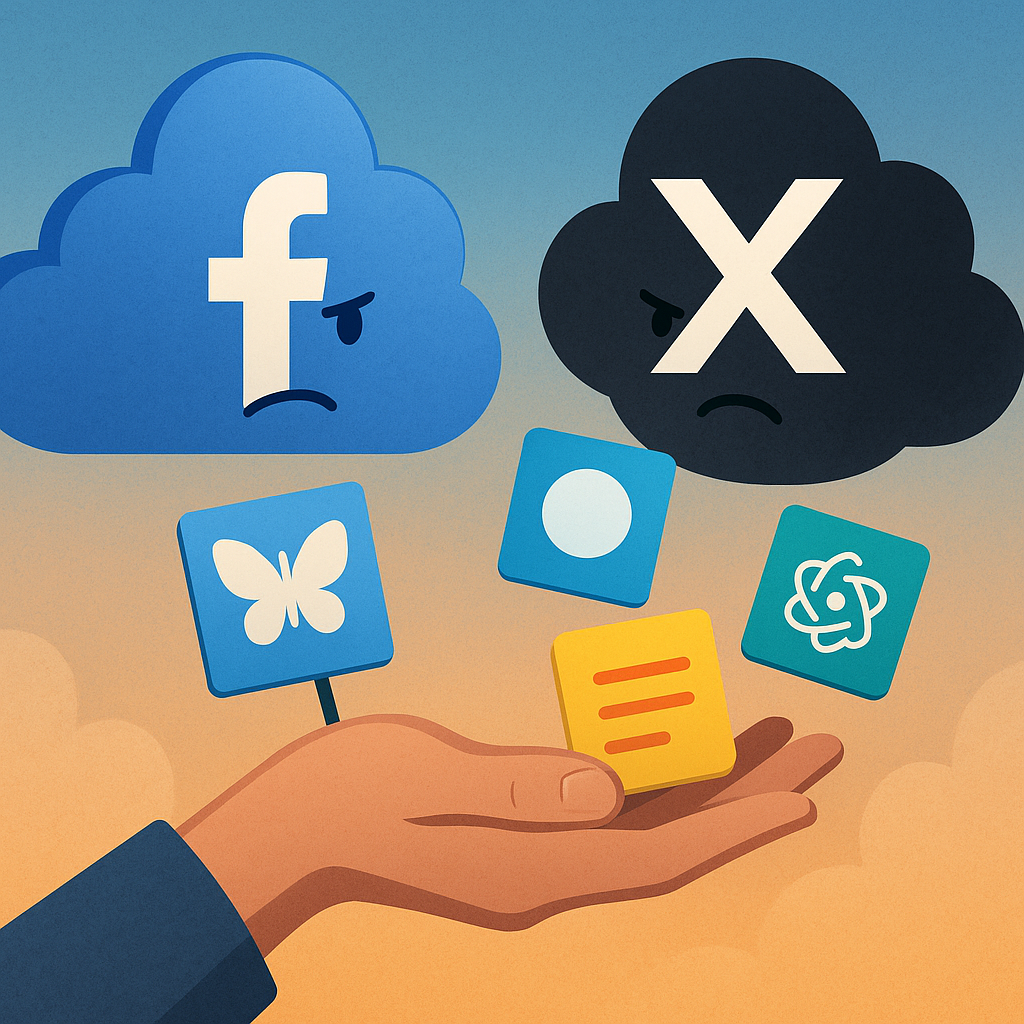
Social media is changing quickly, with new platforms popping up to compete with big names like Facebook and X. One of these new platforms is Butterflies AI, which lets users interact with both real people and AI characters. Tech expert Jay Springett joined Butterflies out of curiosity and discovered that it offered a unique experience, almost like a game where AIs tell their own stories. Even though he didn’t use it like regular social media, he found it interesting enough to watch for over six months. This shows that more people are looking for fun and interactive experiences online.
As more users become unhappy with major social media sites, alternatives like Bluesky are becoming popular. Data shows that fewer people are using X every day, and Facebook is also seeing less traffic. Bluesky has gained millions of users by letting people customize their feeds and choose how they want to moderate their content. This different approach gives users more control over their online experience, unlike traditional platforms that are more centralized.
However, making Bluesky as big as Facebook and X is not easy. Experts like Andy Tattersall point out that it’s important to find a balance between making money, keeping users safe, and managing content. At the same time, projects like Free Our Feeds, supported by famous people, are trying to create a more open social media environment using the AT Protocol, which is the foundation of Bluesky. This project wants to address worries about centralized control and ensure social media serves the public good.
Another challenge for new platforms is Metcalfe's Law, which says that a network is more valuable when it has more users. This means that larger networks have more resources, making it tough for smaller platforms to compete. Organizations like the Social Web Foundation are trying to find ways to overcome this challenge by creating platforms that can work together and share content from different services. This way, users can have a smooth experience without depending on just one big platform. Alongside these changes, niche social media apps are also emerging, each offering something different, like Mozi, which encourages real-life connections, and Flipboard's Surf app, which helps users access content from various platforms in one place.
Original news source: What's next for social media? (BBC)
🎧 Listen:
📖 Vocabulary:
Group or Classroom Activities
Warm-up Activities:
– CHARADES
Instructions: Divide the class into small groups. Each group will take turns acting out different social media-related words or phrases from the article without speaking, while the other groups guess what they are. Examples include "Butterflies AI," "Bluesky," and "real-life connections."
– OPINION POLL
Instructions: Create a set of statements related to the article, such as "Social media is becoming too centralized" or "I prefer using new platforms like Bluesky over Facebook." Students will walk around the classroom and ask their classmates how they feel about each statement, collecting responses to discuss as a class afterward.
– HEADLINE CREATION
Instructions: Have students work in pairs to create catchy headlines for the article, emphasizing the main ideas and the impact of new social media platforms. After they create their headlines, each pair can present their favorite to the class for discussion.
– MIND MAP
Instructions: On a large piece of paper or whiteboard, draw a central circle with "Social Media Changes" written in it. Students will brainstorm and add branches for each major point from the article, such as "Butterflies AI," "User Control," and "Challenges for New Platforms," allowing them to visually organize the information.
– SPEED SUMMARIZING
Instructions: Students will pair up and take turns summarizing sections of the article to each other within a two-minute time limit. After one person summarizes, they switch roles. This will help them practice concise speaking and listening skills while reinforcing their understanding of the article's content.
🤔 Comprehension Questions:
Butterflies AI is a new social media platform that allows users to interact with both real people and AI characters. It differs from traditional platforms because it offers a unique experience where AIs tell their own stories, making it feel more like a game rather than just a regular social media experience.
Jay Springett joined Butterflies AI out of curiosity. He found it interesting because it provided a unique and interactive experience that kept him engaged for over six months, even though he didn't use it like regular social media.
Bluesky is attracting more users by allowing them to customize their feeds and choose how they want to moderate their content. This gives users more control over their online experience, which is appealing compared to the more centralized approach of traditional platforms.
New social media platforms face challenges like the need to balance making money, keeping users safe, and managing content. They also struggle to attract enough users to compete with the larger networks that have more resources.
Metcalfe's Law states that a network is more valuable when it has more users. This means that larger social media networks are more appealing because they have more resources and connections, making it difficult for smaller platforms to compete effectively.
Projects like Free Our Feeds aim to create a more open social media environment by using the AT Protocol, which is the foundation of Bluesky. They want to address concerns about centralized control and ensure that social media serves the public good.
The Social Web Foundation is working to create platforms that can work together and share content from different services. This helps smaller platforms compete with larger ones by allowing users to have a smoother experience without relying on just one big platform.
Two niche social media apps mentioned are Mozi and Flipboard's Surf app. Mozi encourages real-life connections among users, while Flipboard's Surf app helps users access content from various platforms in one place, making it easier to find what they want.
🎧✍️ Listen and Fill in the Gaps:
Social media is changing quickly, with new platforms popping up to compete with big names like Facebook and X. One of these new platforms is Butterflies AI, which lets users with both real people and AI characters. Tech Jay Springett joined Butterflies out of curiosity and discovered that it a unique experience, almost like a game where AIs tell their own stories. Even though he didn’t use it like regular social media, he found it interesting enough to for over six months. This shows that more people are looking for fun and interactive experiences . As more become with major social media sites, alternatives like Bluesky are becoming popular. Data shows that fewer people are using X every day, and Facebook is also seeing less traffic. Bluesky has gained millions of users by letting people their feeds and choose how they want to moderate their content. This different approach gives users more control over their online experience, unlike traditional platforms that are more centralized. However, making Bluesky as big as Facebook and X is not easy. Experts like Andy Tattersall point out that it’s to find a balance between money, keeping users safe, and managing content. At the same time, projects like Free Our Feeds, supported by famous people, are trying to create a more open media environment using the AT , which is the foundation of Bluesky. This project wants to address worries about centralized control and ensure social media serves the public good. Another challenge for new platforms is Metcalfe's Law, which says that a network is more valuable when it has more users. This means that larger networks have more resources, making it for smaller to compete. Organizations like the Web Foundation are to find ways to overcome this challenge by creating platforms that can work together and share content from different services. This way, users can have a smooth experience without depending on just one big platform. Alongside these changes, niche social media apps are also emerging, each offering something different, like Mozi, which encourages real-life connections, and Flipboard's Surf app, which helps users access content from various platforms in one place.
💬 Discussion Questions:
1. What is your favorite social media platform and why do you like it?
2. How would you feel if a new social media app became more popular than Facebook?
3. Do you think it's important for social media to have both real people and AI characters? Why or why not?
4. Have you ever tried a new social media app? What was your experience like?
5. What do you think makes a social media platform successful?
6. How would you feel if you could customize your social media feed completely?
7. Do you like the idea of more control over your online experience? Why?
8. What is a major problem you think social media faces today?
9. How do you think social media can serve the public good?
10. Do you think smaller social media platforms can compete with giants like Facebook? Why or why not?
11. What do you think about the idea of niche social media apps? Would you use one?
12. How would you feel if social media became more focused on real-life connections?
13. Do you think it’s possible to find a balance between making money and keeping users safe on social media? Why?
14. What is a feature you wish your favorite social media platform had?
15. How do you think social media will change in the next five years?
Individual Activities
📖💭 Vocabulary Meanings:
Click a dot next to a word, then click the dot next to its meaning to draw a line connecting them.
Words
Meanings
🔡 Multiple Choice Questions:
🕵️ True or False Questions:
📝 Write a Summary:
Write a summary of this news article in two sentences.
Check your writing now with the best free AI for English writing!