

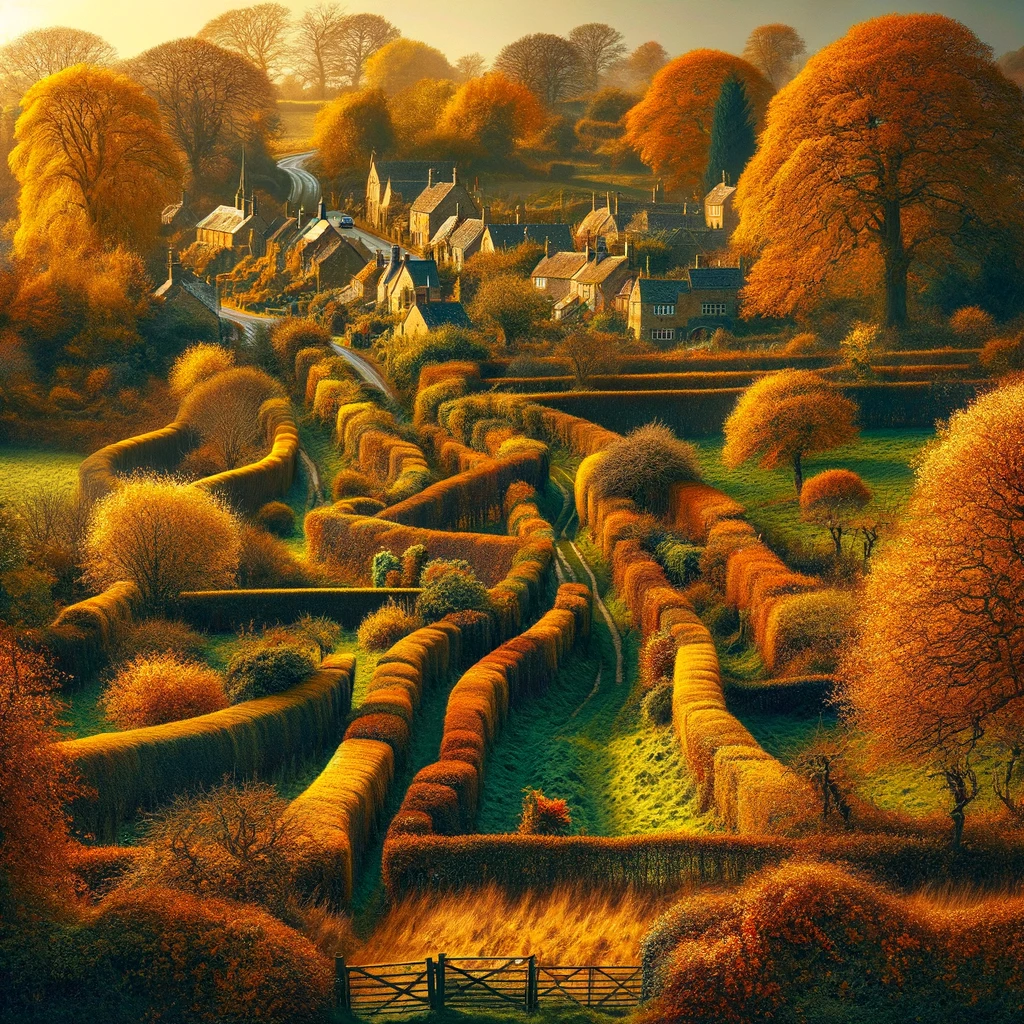
A new map has been made that shows all the hedgerows in England. If you lined up all the hedgerows end to end, they would go around the Earth almost ten times! This map is really detailed and will help scientists who study nature. Hedgerows are important because they look nice and they help animals and plants. They also help to store carbon. The map shows that there are 390,000 kilometers of hedgerows in England, with the most in the South West.
The person in charge of the project, Dr. Richard Broughton, says that England probably has more hedgerows than any other country. This is a good thing because the government wants to make more hedgerows. The map will help them see where there are gaps in the hedgerows that need to be filled. Hedgerows have been around in England since a long time ago and they were used to keep cows in. They are home to lots of different plants and animals.
It's not good news though, because lots of hedgerows were lost between the 1940s and 1990s. This happened because of farming and building. Even though it's not happening as much now, hedgerows are still being damaged or taken away. The new map is really helpful because it gives more information than before. It shows that there are 390,000 kilometers of hedgerows in England, with some being 1 meter tall and others being 6 meters tall.
The map also shows that some parts of England have more hedgerows than others. The South West has the most, while the northeast has the least. At the county level, Somerset, Derbyshire, and Cornwall have the most hedgerows, while Surrey, Hampshire, and Berkshire have the fewest. The government has said that they want to make or fix 48,000 kilometers of hedgerows by 2037 and 72,000 kilometers by 2050. This is part of a plan to make the environment better.
In conclusion, this new map is really useful because it tells us a lot about England's hedgerows. It shows that they are important and need to be protected and made more.
Original news source: England's hedges would go around Earth ten times (BBC)
🎧 Listen:
📖 Vocabulary:
Group or Classroom Activities
Warm-up Activities:
– News Summary
Instructions: Divide the class into pairs or small groups. Give each group a few minutes to read the article. Then, ask them to summarize the main points of the article in their own words. Afterward, have each group share their summary with the rest of the class.
– Opinion Poll
Instructions: Write the following statement on the board: "Hedgerows are important for the environment." Divide the class into two groups and assign one group to agree with the statement and the other group to disagree. Give the groups a few minutes to discuss their opinions and come up with reasons to support their stance. Then, conduct a class poll by asking each student to vote on whether they agree or disagree with the statement. Finally, have a class discussion where students can share their opinions and reasons.
– Vocabulary Pictionary
Instructions: Write a list of vocabulary words from the article on the board (e.g., hedgerows, carbon, project, government, environment). Divide the class into pairs or small groups. Give each group a whiteboard or large piece of paper. One student from each group will choose a word from the list and draw a picture to represent that word. The rest of the group must guess the word based on the drawing. The group that guesses correctly earns a point. Continue until all the words have been guessed or time runs out. The group with the most points wins.
– Pros and Cons
Instructions: Divide the class into pairs or small groups. Ask each group to discuss the pros and cons of having hedgerows. Give them a few minutes to brainstorm and write down their ideas. Then, have each group share their points with the rest of the class. Encourage a class discussion where students can debate the advantages and disadvantages of hedgerows.
– Future Predictions
Instructions: Ask students to imagine what England's hedgerows will be like in the future. Will there be more or fewer hedgerows? Will they be better protected? Will they have a different purpose? In pairs or small groups, have students discuss and make predictions about the future of hedgerows in England. Afterward, ask a few groups to share their predictions with the class. Encourage students to support their predictions with reasons and evidence from the article.
🤔 Comprehension Questions:
🎧✍️ Listen and Fill in the Gaps:
A new map has been made that shows all the in England. If you up all the hedgerows end to end, they would go around the Earth almost ten times! This map is really detailed and will help scientists who study nature. Hedgerows are important because they look nice and they help animals and plants. They also help to store carbon. The map shows that there are 390,000 kilometers of hedgerows in England, with the most in the South West. The in of the project, Dr. Richard Broughton, says that probably has more hedgerows than any other country. This is a good because the government wants to make more hedgerows. The map will help them see where there are gaps in the hedgerows that need to be filled. Hedgerows have been around in England since a long time ago and they were used to keep cows in. They are home to lots of different and . It's not good news though, because lots of hedgerows were lost between the 1940s and 1990s. This happened because of and . Even though it's not happening as much now, hedgerows are still being or away. The new map is really helpful because it gives more information than before. It shows that there are 390,000 kilometers of hedgerows in England, with some being 1 meter tall and others being 6 meters tall. The map also shows that some parts of England have more hedgerows than others. The South West has the most, while the northeast has the least. At the county level, Somerset, Derbyshire, and have the most hedgerows, while Surrey, Hampshire, and Berkshire have the fewest. The government has said that they want to make or fix 48,000 kilometers of hedgerows by 2037 and 72,000 kilometers by 2050. This is part of a plan to make the environment better. In , this new map is really useful because it us a lot about England's hedgerows. It that they are important and need to be protected and made more.
💬 Discussion Questions:
1. What is a hedgerow and why are they important?
2. How do hedgerows help animals and plants?
3. Do you think it's important to protect hedgerows? Why or why not?
4. How would you feel if you found out that many hedgerows were lost between the 1940s and 1990s?
5. Have you ever seen a hedgerow? Where and what did it look like?
6. Do you like the idea of the government making more hedgerows? Why or why not?
7. How do you think the new map will help the government fill gaps in the hedgerows?
8. Why do you think the South West has the most hedgerows in England?
9. Do you think it's fair that some parts of England have more hedgerows than others? Why or why not?
10. How would you feel if you lived in a county with very few hedgerows?
11. What do you think will happen to the environment if more hedgerows are made and fixed?
12. Have you ever seen any animals or plants in a hedgerow? What were they?
13. How do you think hedgerows can help store carbon?
14. Do you think other countries should also make more hedgerows? Why or why not?
15. Why do you think the government has set goals to make and fix a certain number of kilometers of hedgerows by specific years?
Individual Activities
📖💭 Vocabulary Meanings:
Click a dot next to a word, then click the dot next to its meaning to draw a line connecting them.
Words
Meanings
🔡 Multiple Choice Questions:
🕵️ True or False Questions:
📝 Write a Summary:
Write a summary of this news article in two sentences.
Check your writing now with the best free AI for English writing!